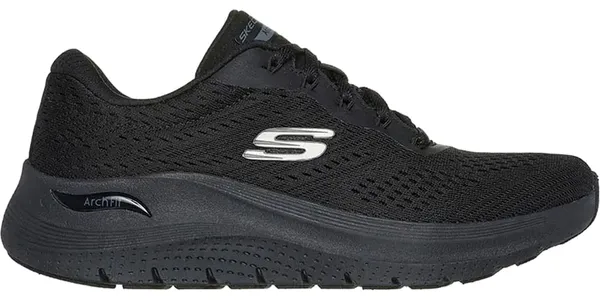
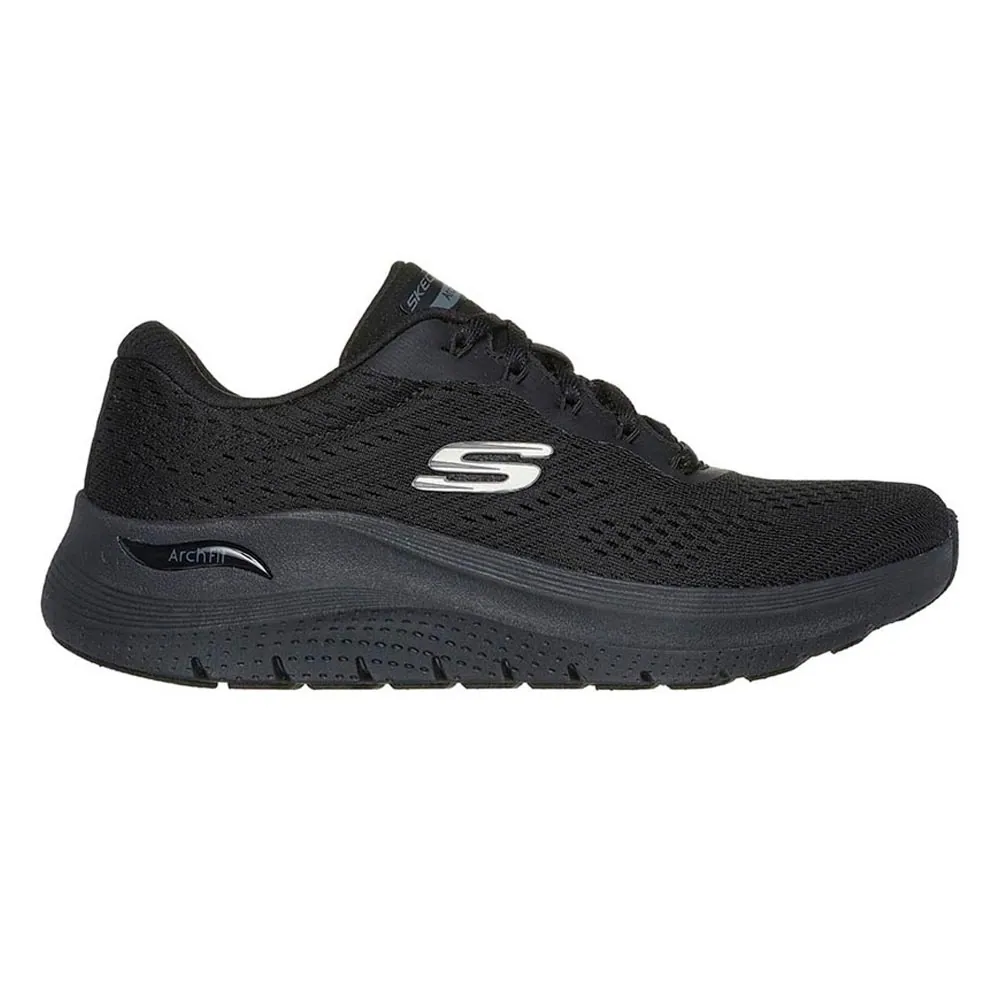
The details that matter
What sits under your foot
The most important part is the insole. Skechers says podiatrists designed its shape using about 120,000 foot scans, and some designs carry the American Podiatric Medical Association (APMA) Seal of Acceptance. RunRepeat measured the insole at 9.8 mm, thicker than average, and it is removable. Best Walking Feet explains that the arch support comes from this shaped insole, not from a firm post on the inner side of the midsole.
Skechers describes the insole as air-cooled, and Best Walking Feet names Air-Cooled Memory Foam working together with the shaped footbed. Beneath the insole is what Skechers calls a cushioned midsole. ShoeFitLab says it absorbs shock but is not designed like a running shoe. RunRepeat's lab results agree: heel shock absorption was very high at 134 SA (walking-shoe average 111 SA), but energy return was only 43%. You feel the impact softened, but the shoe doesn't spring you forward.
Underneath is a rubber outsole that Skechers calls a flexible traction outsole. RunRepeat measured the rubber at 2.6 mm thick and harder than average (85.9 HC), but it does not cover the whole contact area and has no lugs to bite into tricky surfaces. The sole curves up slightly at the heel and toe, which smooths the heel-to-toe roll a little.
Upper, heat and comfort
The upper depends on the style. Most lace-up versions use engineered mesh. Style 150332 adds leather overlays on the mesh, and the laceless 150055 uses a Stretch Fit knit that stretches like a sock. ShoeFitLab notes that some women's colourways use suede, which holds its shape more than knit. For the mesh and knit styles (150051, 150055, 150067 and 232700), Skechers lists 100% vegan materials and machine washing; if those matter to you, check the style code before you buy.
Heat is worth thinking about before you buy. Under the microscope, RunRepeat found extra fabric layers and a thick lining beneath the large mesh pores. It scored breathability 2/5 and suggests about 10–20°C. ShoeFitLab says the knit versions breathe better, so if you will walk outdoors on hot days, try a knit version on for comparison first.
The tongue is padded to 8.0 mm (average 5.7 mm), and Zone2 says this eases pressure on the top of the foot. The tongue is not stitched to the sides, but RunRepeat found its shape and padding keep it from sliding sideways. The heel counter (the stiff shell around the heel) is moderately stiff. Together with the collar padding, RunRepeat says it held the heel very securely without restricting the ankle or Achilles. Best Walking Feet likes the soft memory-foam collar, and Zone2 mentions reflective details that make you easier to see in low light.
How it feels on your feet
This shoe is made for walking, standing and all-day errands; ShoeFitLab says exactly that. Zone2 calls it ideal for long city walks, and Best Walking Feet says it is comfortable from the first day, with the lighter build keeping it pleasant over a full day.
Reviewers disagree on softness. Zone2 calls the cushioning exceptional. RunRepeat measured the foam's firmness as average for a walking shoe and says it is not plush. ShoeFitLab rates the ride very firm, and Best Walking Feet sums it up as supportive first and soft second. Which view fits you depends on what you value. If you want your arch held through every step, you will probably like it. If you prefer a soft, sinking feel like the GO WALK, it may feel too firm.
They also differ on control. RunRepeat says the support for overpronation is excellent, and when it tested shifting the ankle, the shoe kept the foot firmly planted. ShoeFitLab, however, scores pronation control only 2/5. Best Walking Feet explains that because the support comes from the insole, the shoe steadies the foot gently rather than strongly.
The heel-to-toe roll is described differently too. Zone2 says the rocker-bottom shape smooths each step, while RunRepeat sees only a slight curve, kept small for stability. For grip, RunRepeat reports great traction on wet and dry surfaces, better than the original, but does not recommend it on wet rocks or wood, oily floors, ice or mud. Best Walking Feet also calls it a road-and-sidewalk outsole. ShoeFitLab advises against running in it because the midsole is not built for the repeated impacts of running.
Reading this shoe's numbers
The key numbers come from RunRepeat. Heel stack is 39.2 mm, the tallest among the walking shoes RunRepeat has tested (average 32.7 mm), and forefoot stack is 24.0 mm (average 22.4 mm). That makes the drop (the difference between heel and forefoot thickness) 15.2 mm, clearly above the 10.3 mm average and close to the original Arch Fit.
A thick heel helps absorb impact when the heel lands, and a high drop puts the heel clearly higher than the toes. If you usually wear flat or low-drop shoes, walk around the store in it for a while to see whether you like that feel.
RunRepeat weighed it at 309 g: lighter than the original (353 g) but heavier than the average walking shoe (294 g). ShoeFitLab lists the women's version at 8 oz (about 227 g). In the store, compare it in your hand with your current pair. RunRepeat says it feels weightless on the foot despite its bulky look, and Zone2 also says it feels weightless.
For firmness, RunRepeat measured 50.1 AC (Asker C scale), on par with the walking-shoe average, and ShoeFitLab measured 30.4 HA and rates it very firm. The two units measure differently, so the numbers can't be compared directly. For flexibility, RunRepeat measured that it takes 13.4 N to bend the shoe 30 degrees, the same as an average walking shoe.
Thick heel and high drop: walk in it to feel it
Heel stack is 39.2 mm, forefoot 24.0 mm and drop 15.2 mm, higher than a typical walking shoe. If you usually wear flat shoes, walk around the store in it for a while and compare it with your current pair to see whether you like having the heel this much higher than the toes.
Thick insole: check the arch and big toe
The 9.8 mm insole with its raised arch takes up some room inside. When trying it on, wiggle your big toe, since that area measured narrower than average. If you use your own insoles, bring them along.
Weight: compare it in your hand
RunRepeat weighed it at 309 g. In the store, compare it in your hand with your current pair.
What to check on try-on, and what to look at instead
When you try it on, focus on the arch first. Best Walking Feet says some neutral, high-volume feet find the raised arch intrusive. Walk around the store for a while; if the arch feels pushed to the point of discomfort, this shoe may not suit your foot.
Then wiggle your toes, especially the big toe, since RunRepeat measured the inside width at the big toe as narrower than average. Walk and check whether your heel lifts out of the shoe as you step. If you use your own insoles or orthotics, bring them along: the stock insole is thick, so swapping it changes the fit slightly. If the regular width feels tight across the forefoot, look for a colourway that comes in wide.
If it doesn't suit you, choose the alternative by the problem you hit. For a softer ride, look at a plush walking shoe such as the GO WALK, which Best Walking Feet uses as a comparison. If you overpronate heavily and want real motion control, look at a shoe with a firm medial post, such as the New Balance 928v3 that Best Walking Feet names. If you are often in hot weather, look at a knit version or a shoe with a thinner upper. And if you want to run, choose a running shoe.
Size and fit
Size: RunRepeat says it is true to size, and Best Walking Feet says it fits close to true to size. ShoeFitLab, reviewing the women's version, says it runs slightly long, and narrow-footed wearers sometimes go down a half size.
Width: the sources describe different parts of the shoe. Using a men's US 9 foot mould, RunRepeat measured the inside width at its widest point at 94.6 mm, a standard width that is close-fitting but not constricting for medium-width feet. At the big toe, however, the inside width was 68.3 mm, narrower than the walking-shoe average (70.6 mm). Toe-box height was 25.6 mm, on par with the average. Zone2, ShoeFitLab and Best Walking Feet describe the toe box as moderately to amply roomy. ShoeFitLab says Skechers lasts run notably wider than Nike or ASICS, which suits wider feet, and Best Walking Feet says the stretch knit gives a little as feet swell.
RunRepeat also measured the sole's forefoot width at 114.5 mm, a bit wider than average. That is the width of the shoe's base, not the space inside for your toes.
Heel and midfoot: RunRepeat says the heel is held very securely. Best Walking Feet describes a secure midfoot, with the shaped heel keeping the foot centred on the insole instead of sliding around.
Wide versions: RunRepeat says some colourways come in wide and extra-wide. Best Walking Feet recommends wide if you have a broad forefoot, because the thick footbed takes up some of the room inside.
Black US:6Black US:7
สเก็ตเชอร์ส-รองเท้าผู้หญิง-ลำลอง-women-sport-arch-fit-2-0-shoes-150051-bbk · 2026-11-24 · Recorded sizes, not current stock