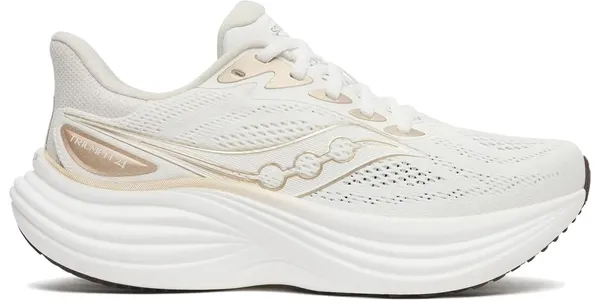
The details that matter
Underfoot: a single layer of incrediLUX, no plate
The midsole is one piece of incrediLUX foam, which Saucony describes as supercritical A-TPU. RTINGS found no second foam layer and no plate. The foam replaces the PWRRUN PB used in the Triumph 22 and 23.
On the run, it compresses a lot under load and still springs back. RTINGS measured energy return of 81.0% at the heel and 84.7% at the forefoot. In its simulated 10 to 40 km test, shock absorption dropped only slightly, from 8.57 to 8.01 J, meaning the cushioning holds up deep into long runs.
The heel has a pronounced rounded rocker that helps heel strikers roll forward smoothly. The forefoot still flexes a little; RTINGS explains that the softness and flex limit how quick the toe-off feels. Saucony fits what it calls a super responsive sockliner. Run to the Finish noticed a squeak until the shoe was well broken in, which appears to come from the insole rubbing inside the shoe.
The outsole is XT-900 carbon rubber on the heel and forefoot, with the midfoot foam left exposed and the front and rear sections decoupled. A Road Trail Run tester found the grip solid on tarmac, asphalt and brick; another on the same team found it ineffective on wet concrete and stone. After three weeks of testing, the rubber showed minimal wear.
Upper: plush all round, with a thick tongue
The upper is what Saucony calls a breathable comfort mesh. The tongue is thickly padded and wraps around the top of the foot like a sock. The collar is well padded and sits fairly high, and the heel lining uses a textured material that grips your sock so it doesn't slip.
Testers disagree on breathability. Doctors of Running and Believe in the Run found it surprisingly breathable, and Active Gear Review found it breathable enough for warmer runs without feeling loose or flimsy. Tom's Guide says it's not the most breathable, particularly under the thick tongue, and Road Trail Run would like slightly better ventilation. If you often run in the heat, pay attention to how the tongue area feels when you try the shoe on.
The laces are round and stretchy; RTINGS measured 17.5% stretch. Doctors of Running had no lace bite, while Road Trail Run would like better laces, and The Run Testers say the laces lock down securely once you've worked to get the volume dialled in.
How it feels on the run
The Triumph 24 is happiest on slow, long runs. Several testers describe it as soft from the first step, with the cushioning becoming more useful the further you go. Active Gear Review says it took the sting out of pavement late in runs when the legs were tired, and Road Trail Run says it truly comes into its own on efforts of 10+ miles (about 16 km).
Testers differ on softness. Doctors of Running calls it one of the softest foams they've tried, and Road Trail Run calls it plush but not mushy. Tom's Guide finds it not as soft and springy as some shoes, and The Run Testers found it a little too sinky at slower paces and on heavy-legged runs, with little bounce coming back. Which of these you experience depends on your pace and how much softness you like.
They also differ on speed. One Road Trail Run tester sees it as a shoe you could tempo run or race a half marathon in, and Believe in the Run says it works for runs with strides at the end or a progression. Tom's Guide and Run to the Finish don't recommend it for speedwork, and Active Gear Review wouldn't reach for it for aggressive speedwork. If you have another pair for the days you want to run faster, the Triumph 24 fits well as your main easy-day shoe.
For walking, Active Gear Review says it's comfortable for long walks and long hours on your feet, and Run to the Finish finds it very wearable for non-running activities, while Doctors of Running warns that people sensitive to soft foams may struggle with it for standing and walking.
Reading the numbers: drop, stack and weight
Drop (the difference between sole thickness under the heel and under the forefoot) is 10 mm. Saucony lists 43 mm under the heel and 33 mm under the forefoot. RTINGS measured a 9.7 mm drop in a men's US 9, close to the listed figure. The Run Testers list the stack as 40 mm and 30 mm; the numbers differ from Saucony's, but the drop is the same.
The 43 mm heel stack puts it in the max-cushion group for reviewers. Road Trail Run notes it is about 6 mm taller than the Triumph 23 at both heel and forefoot. A 10 mm drop is a traditional figure: Run Oregon says it tends to suit heel strikers but isn't a drop everyone prefers, and Run to the Finish hoped for a lower drop in the next model. Drop tells you how much your foot tilts forward; it doesn't by itself tell you what kind of running the shoe suits.
Weight only makes sense alongside size. Believe in the Run lists 8.8 oz (about 249 g) for a men's US 9, down from 9.8 oz for the Triumph 21 and 10.1 oz for the Triumph 22. When comparing with other shoes, compare at the same size.
10 mm drop and 43 mm stack: what to notice when trying it on
Saucony lists 43 mm under the heel and 33 mm under the forefoot, and reviewers place it in the max-cushion group. If you're used to low-drop shoes, jog a few steps and see whether the forward tilt feels like too much. Run Oregon says this drop suits heel strikers, but not everyone likes it.
Compare weight at the same size
Believe in the Run and Run Oregon list 8.8 oz (about 249 g) for a men's US 9. To compare with your current pair, use figures for the same size, or hold both in your hands when trying them on in store.
Room above the toes
Testers describe a roomy interior with good length up front, but RTINGS found little vertical space above the toes. Wiggle your toes when you try it on; if the upper presses on them, it may not suit tall toes.
What to check when trying it on, and what to look at if it doesn't suit
When you try it on, check these points:
- Wiggle your toes and see whether the upper presses on them, since RTINGS found little vertical room in the forefoot.
- Lace it snugly before you decide, then check that the top of your foot stays put, because the laces stretch and take some adjusting.
- Walk up and down or jog a few steps to check the heel stays locked in.
- Stand still for a while to see whether this level of softness suits your feet, especially if you'll walk or stand in it for long periods.
If you want more stability, look at a max-cushion shoe with more support. Believe in the Run would choose the Saucony Hurricane 26 for longer efforts when added stability is needed, and RTINGS rates the Brooks Glycerin 23 as much more stable. If you want one shoe that also handles faster runs, Tom's Guide suggests a lighter, more versatile cushioned trainer such as the ASICS Novablast 6.
Size and fit
Doctors of Running found it true to size in their men's 9.5. Most testers describe a roomy interior. The Run Testers report good length up front with a thumb's width of space in the toe box. Run Oregon finds it a little more voluminous than older Triumphs but never sloppy. Road Trail Run says it controls the foot well once the laces are cinched, and Run to the Finish says it isn't a wide shoe but fits comfortably in the midfoot and toe box.
The point to watch is height above the toes, which is a different measurement from length and width. RTINGS, measuring a men's US 9, found little vertical room in the forefoot (5.3 mm lower than its reference), which may feel restrictive if you have taller toes.
At the heel, Doctors of Running had no slippage and enough space behind the Achilles, and Active Gear Review's tester reported no heel movement or toe irritation.
The Triumph 24 comes in standard and wide versions for both men and women. If the standard version feels tight through the midfoot, try the wide version.
61241W-S100999-1019 · 2026-11-24 · Recorded sizes, not current stock