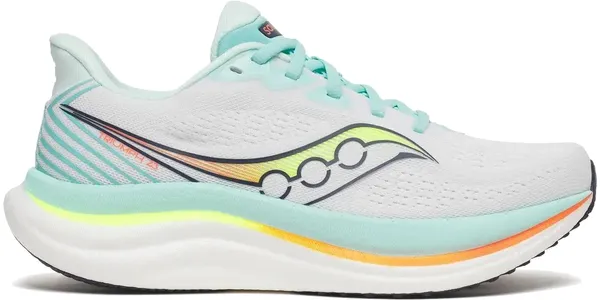
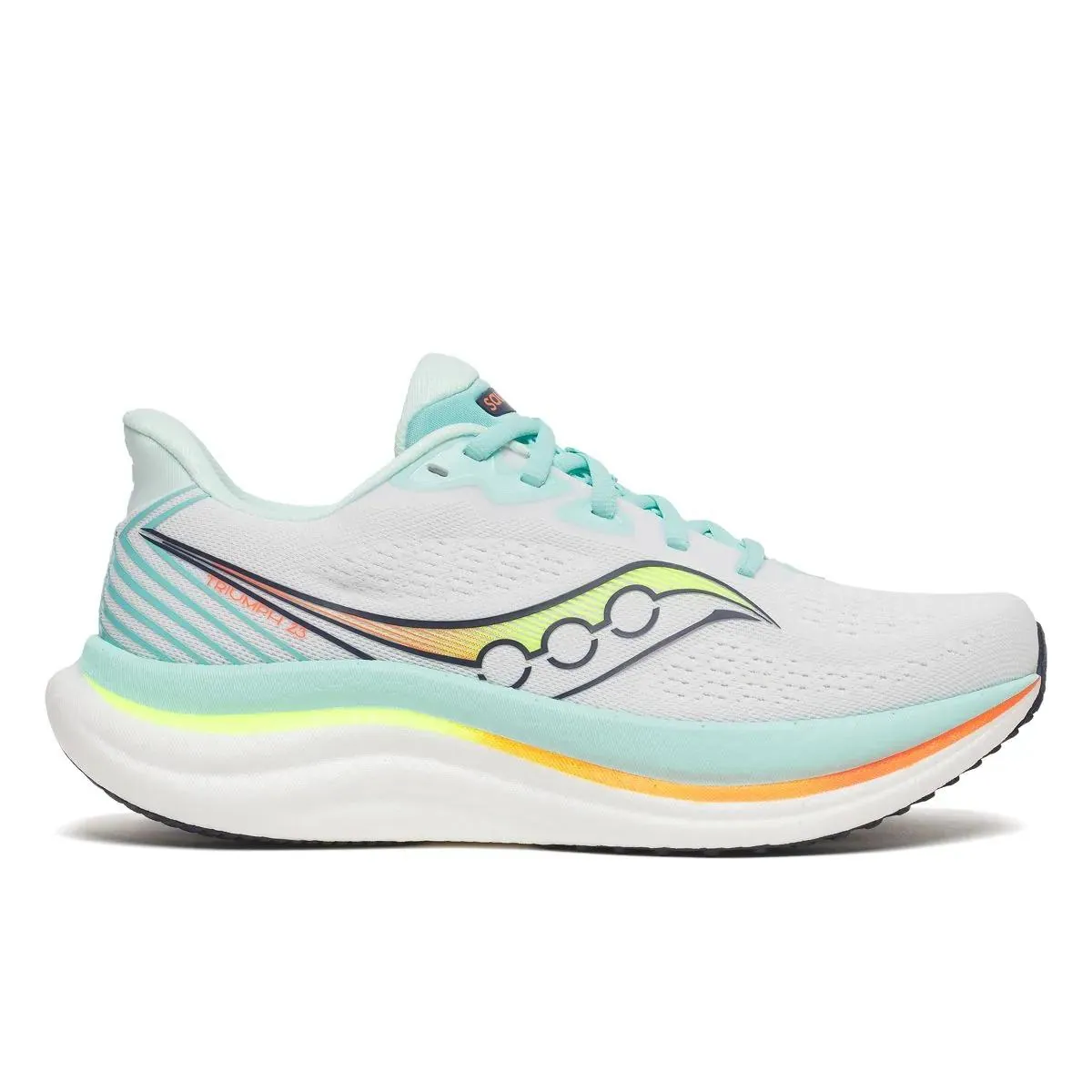
The details that matter
What's underfoot: PWRRUN PB foam, a thick sockliner and patchy rubber
Saucony says the midsole is a softer, lighter PWRRUN PB foam, now with more cushioning, paired with an insole it calls the Super Responsive Sockliner (SRS) and an updated outsole. In RunRepeat's lab, the shoe measured what RunRepeat calls a huge 149 SA of shock absorption at the heel and an impressive 136 SA at the forefoot.
RunRepeat measured the sockliner at 6.3 mm thick (4.4 mm average) and says its soft foam makes the shoe feel less firm than it would with a standard insole. Caroline Bermel, who wrote Fleet Feet's review, felt that difference too: on a run using the sockliner that came with the shoe instead of the Currex insoles usually worn for arch support, the shoe felt gloriously plush and luxurious. If you use your own insoles, try the shoe on both with the original sockliner and with yours, because the underfoot feel may change.
The outsole mixes black rubber segments with exposed PWRRUN PB foam. Alastair Running says XT-900 rubber covers the key zones but more midsole foam is exposed than on the Triumph 22, and RTINGS says the shoe is over 20 g lighter than version 22, largely because of less rubber coverage. Even with less rubber, RunRepeat measured grip at 0.62 (0.53 average) and sees it as a fantastic option for runners who often face slippery surfaces such as rain or morning dew.
A plush, comfortable upper, but sources disagree about heat
Saucony describes the upper as a lightweight engineered mesh that keeps feet cool and comfortable from first step to last. The tongue is thickly padded: RunRepeat measured the padding at 8.8 mm. Alastair Running praises the beautifully cushioned collar and tongue for a secure, comfortable lockdown without pressure hot spots, Running Shoes Guru's Larry Lam says the foot feels wrapped in softness and is generally comfortable the whole time, and Doctors of Running credits the gusseted tongue for helping lock the foot in. Doctors of Running also found the material comfortable against bare skin except for the inner side of the toe guard, so it recommends socks.
Heat is where sources disagree, which matters if you run in hot, humid weather. In RunRepeat's lab it scored 80 BR for breathability (75 BR average) and did an excellent job of pulling sweat away from the foot, and Larry Lam also calls the upper breathable for the hot summer. But RTINGS says the thickly padded upper is not very breathable and can get uncomfortably hot in summer temperatures, Alastair Running finds breathability limited, especially in hot and humid climates, and Reddit user ImNotHalberstram thinks the lack of breathability might be an issue coming into summer, but nothing major. If your feet run hot, try it on with the socks you run in and, if you can, walk or jog in it for a while before deciding.
How it feels on the run: reviewers disagree on soft versus firm
RunRepeat measured the foam at 42.8 on the Asker C scale (35.4 average) and thinks its firmer feel won't satisfy fans of plush midsoles. Running Shoes Guru's Larry Lam also found it didn't feel soft underfoot despite the fairly high stack. Doctors of Running, by contrast, found that unlike version 22 the midsole feels cushioned, bouncy and responsive, though not quite at Endorphin Pro level because the midsole is much softer. Fleet Feet says the cushioning feels much softer than the previous model's. RTINGS found both in one shoe: a heel with very good impact absorption, but a forefoot that firms up dramatically as more force is applied, becoming one of the stiffest it has tested under moderate force, which can feel like the shoe becoming a brick during a run. RTINGS adds that the firm forefoot can feel harsh at faster paces. So judge its softness by running in it, not by standing or pressing the sole in a store, and include a short faster stretch if you can.
For long runs, RunRepeat says the ride shines at the end of long runs and recommends it for runs over 1.5 hours, but RTINGS's test found a relatively sharp drop in forefoot cushioning within the first 10 km, then a more gradual decline. RTINGS says there is still adequate protection for long runs, but the forefoot becomes less forgiving over distance, making it a better fit for shorter efforts than for runners who want plush comfort deep into a 20 km or longer session. Reviewers who did long runs in it also differ: Doctors of Running's Matt Klein says the legs felt fresh even afterwards, while Larry Lam's legs felt very tired and sore towards the end of the run and the next day.
On stability, several sources point the same way. RunRepeat credits its wide landing base, supportive sidewalls, firmer foam and structured upper for great stability. RTINGS credits its balanced construction and fully gusseted tongue, adding that a platform more flared on the medial side than the Triumph 22 widens the base. Doctors of Running explains that the heel's sole flares out far more on the inner side than the outer, which pushes the rearfoot towards the outside; that works for the reviewer's medial (inner-side) stability issues but may be a problem for runners with lateral (outer-side) stability needs. It stresses that this is not a stability shoe, just not completely neutral either. RTINGS says the heel lacks rigidity, so landings feel softer but heel strikers may be less stable.
Outsole durability results differ. Matt Klein was already starting to wear through the exposed PWRRUN PB on the outsole after 30 miles, though he still expects an average number of miles and says runners who are light on their feet should be fine. Alastair Running warns of potentially less durability. But Larry Lam saw very little wear after more than 66 miles, RunRepeat's Dremel outsole abrasion test showed only 0.7 mm of wear (1.1 mm average), and Reddit user ImNotHalberstram has used the shoe all the time for more than 500 miles and says the pair is now dying. Doctors of Running thinks runners who tear up outsoles may struggle with this shoe, given how much foam is exposed on the bottom.
Reading the specs: the drop agrees, stack height and weight vary by source
The spec table shows Saucony's listed figures. Saucony lists a 10 mm drop (the difference between sole thickness under the heel and under the forefoot). RunRepeat measured the same 10 mm, and RTINGS measured 9.6 mm. RunRepeat says 10 mm is a figure many brands prefer because it works very well for heel strikers, though it thinks 8 mm could be more versatile, while Doctors of Running felt the drop closer to 8 mm because the midsole compresses.
Stack height is where the numbers disagree. Saucony lists 37 mm under the heel and 27 mm under the forefoot, but RunRepeat measured 42.3 mm under the heel and 32.3 mm under the forefoot, RTINGS measured 39.4 mm under the heel, and Running Shoes Guru's facts box lists 42 mm under the heel and 32 mm under the toe. RunRepeat notes that it usually measures lower stacks than brands claim but found the opposite here, and its 42.3 mm heel reading (35.6 mm average across the shoes it has measured) puts the shoe in true maximalist territory.
Weight varies by source too. Saucony's page lists 263 g without a size, and sources that give a size 9 report figures from 263 to 283 g; the spec guide lists each one. When comparing with other shoes, use figures from the same source at the same size.
What the 10 mm drop tells you
Drop is the difference in sole thickness between the heel and the forefoot; Saucony's figures are 37 minus 27 mm, or 10 mm. RunRepeat measured the same 10 mm (8.4 mm average across the shoes it has measured) and says this drop works very well for heel strikers. One Reddit user who lands midfoot, though, says the high drop makes their stride feel a little awkward. Drop doesn't tell you how thick or soft the sole is. If you land midfoot or on the forefoot, run in the shoe for a stretch to see whether a heel 10 mm thicker than the forefoot gets in the way of your stride.
What the 42.8 foam-firmness reading means
RunRepeat measured the midsole foam with an Asker C durometer, where a higher number means firmer: this shoe read 42.8 (35.4 average across 267 shoes), putting it on the firm side. RunRepeat also says the soft-foam sockliner makes the shoe feel less firm, and Doctors of Running and Fleet Feet found the ride soft. The number describes the foam alone, not how the whole shoe feels. If you love a sink-in soft feel, run in the shoe yourself before buying.
Compare weight at the same size
Saucony's page lists 263 g (9.2 oz) without a size, and Doctors of Running gives 263 g for a men's size 9. RTINGS weighed 264.8 g in men's US 9, RunRepeat weighed 272 g in the US size 9 it always buys, Running Shoes Guru gives 9.7 oz for a men's size 9, and Alastair Running lists 283 g in men's US 9. When comparing with other shoes, only use weights from the same source at the same size.
Three things to check when you try it on
Wear the socks you run in, lace up as snugly as you would for a run, and check three spots.
First, the outside of your little toes. Running Shoes Guru's Larry Lam found the toe box a bit tight and noticed the little toes sticking out from the second run onward; it never caused blisters or irritation, but it was definitely noticeable. Separately, during one run Lam noticed a very slight bit of rubbing on the outside of the little toes as the narrow toe box became apparent. If your little toes already feel squeezed while you're just standing, try on a wide version or a different shoe for comparison.
Second, the tops of your toes. Doctors of Running calls the toe guard prominent and suggests that people sensitive to toe guards may need to go up half a size; the reviewer didn't need to size up but felt pressure on the tops of the toes.
Third, the heel. RunRepeat measured the heel counter (the stiff structure wrapped around the heel) as very stiff, though thick heel padding mostly offsets it. Doctors of Running says it bothered the reviewer's Haglund's deformity (a bony bump at the back of the heel) a little, while Alastair Running found it comfortable around the Achilles and secure without being stiff or restrictive. If your heels are sensitive to pressure, walk around for a while and pay attention to the back edge of the shoe.
RunRepeat found that the insole removes without trouble and says swapping in a thinner one is an option if you need a bit more room inside the shoe, though it doesn't recommend it because the original adds a lively, bouncy feel. For wide feet, Saucony offers a Wide version, which RunRepeat says is sold in select markets such as the United States. The men's Wide uses style code 60312M, different from the regular-width 60311M on this page. If you buy online, compare the store's size chart and check whether it accepts size exchanges or returns before you order.
Length runs true to size; width depends on your foot
On length, the sources that discuss it agree it is true to size. RTINGS, which tested a men's US 9, says it fits remarkably true to size and most runners can buy their usual size, Doctors of Running found it mostly true to size in a usual men's US 10, Alastair Running and Running Shoes Guru also list it as true to size, and the poll on RunRepeat's page (55 votes) comes out true to size.
Width is where they disagree. RunRepeat says this version is narrower than last year's, measured an interior width of 93.8 mm with its gel mould (95.2 mm average) and 71.4 mm in the big-toe area (73.2 mm average), and concludes, "we think it fits most runners, but it's especially good for those with low-volume feet or who enjoy a snug fit." RunRepeat also measured the toe-box height at 26.8 mm (27.0 mm average) and says there is sufficient vertical room for most feet. On the snug side, Doctors of Running describes a slightly tapered toe box opening into a normal-width but lower-volume forefoot and calls it one of the more snug premium trainers, and Running Shoes Guru's Larry Lam found the toe box a bit tight and writes, "If you have even slightly wide feet, I might avoid this shoe."
On the roomier side, Alastair Running calls it medium width and able to comfortably take higher-volume feet. At Fleet Feet, author Caroline Bermel, typically a 6.5, found the forefoot a tad roomier than preferred, tied a marathon loop through the extra eyelet to cinch down the fit, and had no heel slippage. Heather, who has a high instep, found it surprisingly roomy, with more than enough room to wiggle the toes without feeling sloppy, and Max, who has narrow, low-volume feet, got a really nice midfoot lockdown and a decent amount of room in the toe box. RTINGS sits in between, with a gently tapered forefoot that leaves enough room for some toe splay. If your feet are wide or high-volume, trust how the shoe feels at the try-on more than the size number, or look at the Wide version.
60313W-S11023-130 · 2026-11-24 · Recorded sizes, not current stock