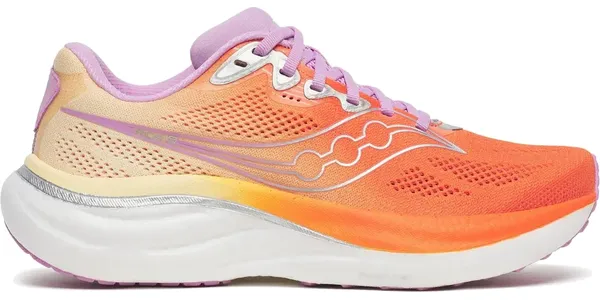
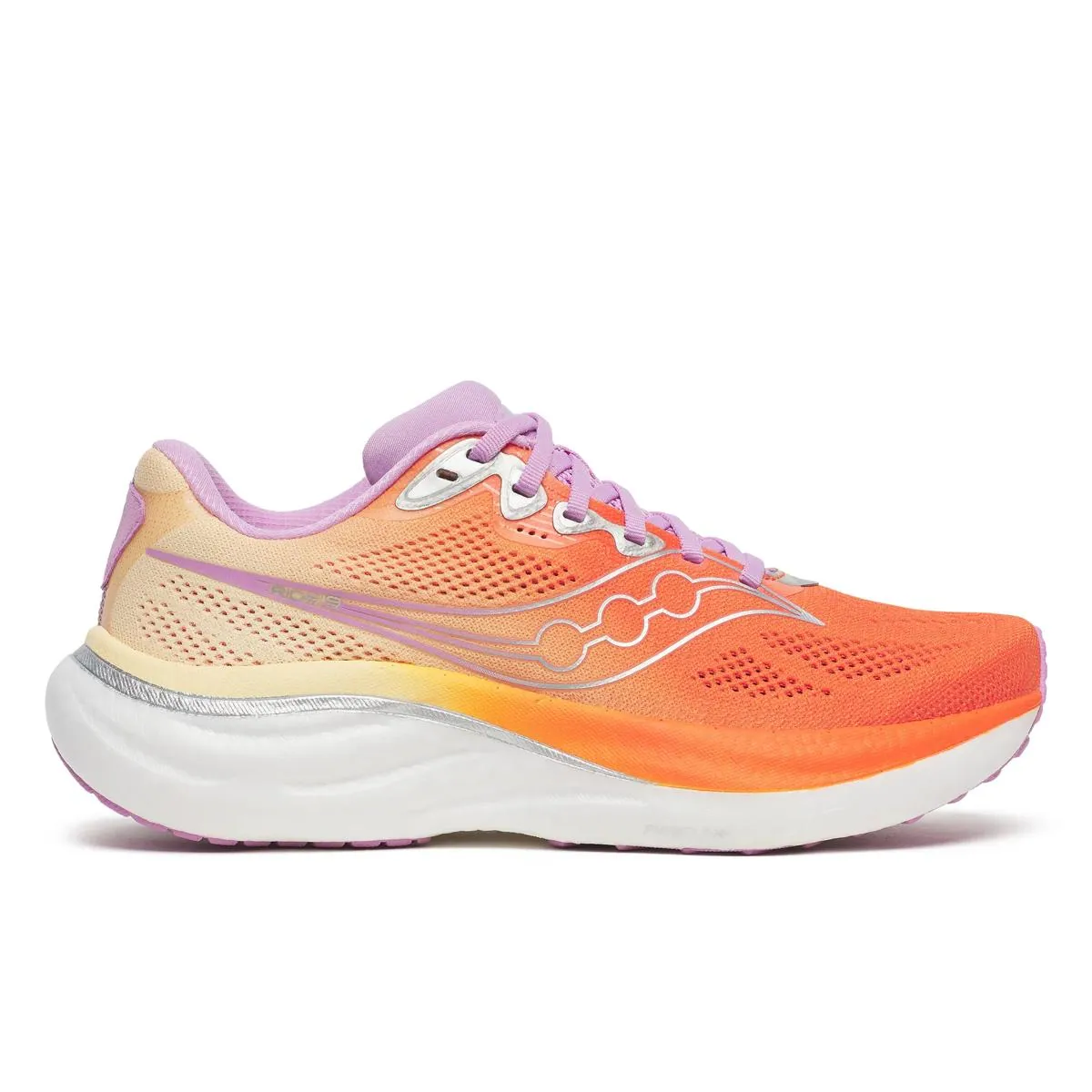
The details that matter
Underfoot: PWRRUN+ foam, a wider base and a stiffer forefoot
The whole midsole is PWRRUN+ foam. Saucony says the new formula is lighter, softer and more responsive. RunRepeat measured the foam's softness and calls it moderate rather than firm, and the shoe feels slightly softer than the measurement because the insole is softer than the foam.
The insole is 6.5 mm thick, removable and no longer made of PWRRUN+ as in earlier versions. RunningShoesGuru says it is slightly thinner, so the step-in feel is less plush.
There is no plate, but RTINGS found the forefoot fairly stiff, and RunRepeat measured 19.1 N to bend the sole lengthwise, 73% more than the Ride 18. If you like a shoe that flexes easily, bend the forefoot when you try it on.
Compared with the Ride 18, the platform is wider, flares out more at the sides and has a more pronounced rocker (the curved toe and heel that help the foot roll forward). Doctors of Running says the flare makes the heel feel softer; OutdoorGearLab thinks the wider platform may feel bulky to lighter runners.
XT-900 rubber covers the heel and forefoot, with foam exposed in the midfoot. RunRepeat measured 3.5 mm of rubber with only 0.6 mm of wear in its test. RunningShoesGuru, however, found no rubber on the outer edge of the heel and saw wear there after about 83 km. If your old shoes wear quickly at the outer heel, check this area before buying.
Upper: plush, secure at the heel, but can feel warm in the heat
The upper is an engineered mesh that stretches with the foot, with large ventilation holes around the foot and toe box. The semi-gusseted tongue (partly stitched to the shoe) doesn't slide sideways and has 7.3 mm of padding, enough for comfort without bulk.
The collar around the ankle is generously padded and locks the heel in place; a RoadTrailRun tester appreciated that padding on longer runs. The heel counter (the stiff cup around the heel) scored a maximum 5/5 for stiffness at RunRepeat, which some runners may find excessive, though Doctors of Running had no rubbing or pressure from it.
The lining is smooth: OutdoorGearLab ran sockless without friction, and Run To The Finish had no irritation even in low socks. The laces hold tension without double-knotting, and there are 3 eyelets at the top with laces long enough to try different lacing options.
On heat, sources differ. RunRepeat rated breathability strong and a RoadTrailRun tester felt the airflow on humid morning runs. RunningShoesGuru, testing in Malaysia, found it a warm shoe because of the thick tongue and collar, and OutdoorGearLab says you will notice it above about 27°C (80°F). If you often run in the Thai daytime heat, try it with thin socks and see whether it feels too warm.
The large openings have a downside: Run To The Finish, who often runs on crushed gravel, found small bits of dirt and tiny rocks getting inside.
On the run: clear strength on easy days, mixed views on faster days
Easy days are the strength most sources agree on; on long runs, views differ. RunRepeat measured shock absorption and says it covers daily training and long runs. OutdoorGearLab ran past 10 miles (about 16 km) without the cushioning bottoming out, but RTINGS found that beyond 20 km the midsole absorbs less and feels less plush than at the start. If you regularly run longer than 20 km, do one long run in it before making it your main shoe.
The softness is felt differently too. Doctors of Running and RunningShoesGuru found it softer than before, RunnersLab says only marginally, and the Marathon Sports blog thinks runners who like a soft feel on long runs may find it too stiff. RTINGS also found the forefoot cushioning less impressive under heavier loads, so heavier runners may want more protection.
On speed, a RoadTrailRun tester says it feels plush at easy pace and firms up and responds well when you speed up, handling faster running in short doses. RunnersLab used it up to interval sessions. RunningShoesGuru, however, found it too sluggish when you want to pick up the pace, and Doctors of Running says it lost some versatility at faster paces. The practical takeaway: short pickups during easy runs are fine, but if you run fast sessions regularly, add a lighter, bouncier shoe.
If you own the Ride 18, reviewers differ on whether to switch. RTINGS calls it a worthwhile upgrade because it is more cushioned; RunningShoesGuru found it slower and less versatile; RunnersLab says the two are very close, so you can buy either depending on promotions; and Marathon Sports says that, apart from the improved upper, it feels largely the same as the previous version.
Off the road, it handled packed gravel without slipping, but it is not suited to technical trails or mud.
Reading the numbers: drop, stack and weight
Drop (the difference between sole thickness under the heel and under the forefoot) is listed by Saucony as 8 mm. RunRepeat measured 8.5 mm, close to the listed figure, while RTINGS measured 9.8 mm in a men's US 9, higher than advertised. RunnersLab sees 8 mm as a classic setup that needs no adaptation. If you are used to very low-drop shoes, take a test run to see whether the heel feels too high.
The sole is 36 mm thick under the heel and 28 mm under the forefoot, 1 mm more at each point than the Ride 18. Several testers say it delivers enough softness without a very high stack. If you want a maximal, towering feel, this one sits closer to the ground.
On weight, RoadTrailRun weighed a men's US 8.5 at 252 g and says it is about 13 g lighter than the Ride 18, while RunRepeat says it is heavier than the previous version. When comparing with other shoes, compare weights in the same size.
What an 8 mm drop feels like
Saucony lists 8 mm, but RunRepeat measured 8.5 mm and RTINGS 9.8 mm in a men's US 9. If you're used to low-drop shoes, jog for a while and see whether the heel feels too high.
Compare weight in the same size
RoadTrailRun weighed a men's US 8.5 at 252 g. Use size-stated figures to compare with other shoes in a similar size, and lift them side by side in the store.
Bend the forefoot before buying
RunRepeat measured 73% more force to bend the sole lengthwise than on the Ride 18. If you like a flexible shoe, bend the forefoot by hand and rise onto your toes to see whether it feels too stiff.
What to check when trying it on, and what to look at if it doesn't suit
Lace up snugly as you would for a run, then check three things: whether the top of your midfoot and forefoot feels pressed, since Doctors of Running found the volume a little low there; whether your toes can spread comfortably; and whether the very stiff heel counter presses on your heel or ankle. Then bend the forefoot and walk or jog for a while to see whether the wide platform feels bulky.
If you want a shoe that's more fun on days you want to run faster, look at a lighter, bouncier trainer. Testers compared it with the ASICS Novablast 5, which is more responsive, and the Saucony Kinvara, which picks up the pace a bit more. If you want a softer ride for long runs, look at a thicker, softer shoe: RTINGS says the Saucony Triumph 24 is more cushioned with better energy return, though the Ride 19 is more stable, and Marathon Sports says the ASICS Gel-Cumulus 27 may feel slightly softer. If your feet need help controlling inward roll, look at a support shoe such as the Brooks Adrenaline GTS 25 instead.
Size and fit
RunRepeat describes a dependable fit that avoids extremes and measured an internal width of 96.3 mm. RTINGS measured a men's US 9 at 282 mm internal length, 94 mm internal forefoot width and 66 mm internal heel width.
Reports on interior room differ. OutdoorGearLab found plenty of toe-box room without sloppiness and a midfoot that is secure without being tight. RoadTrailRun tester John (size 9) found the midfoot comfortably snug with adequate room for the toes to spread at toe-off. Doctors of Running, however, found the volume a little low through the midfoot and forefoot, wanted more room under the tongue and in the forefoot, and felt it a touch tighter than they wanted.
On the heel, every source agrees: it locks in well with no slipping.
The Ride 19 comes in regular and wide widths for both men and women, though the wide version is offered in only a few colours. If the regular width feels tight through the midfoot or forefoot, try on the wide version before buying, and check Saucony's size chart and the store's exchange policy.
60827W-S11055-126 · 2026-11-24 · Recorded sizes, not current stock