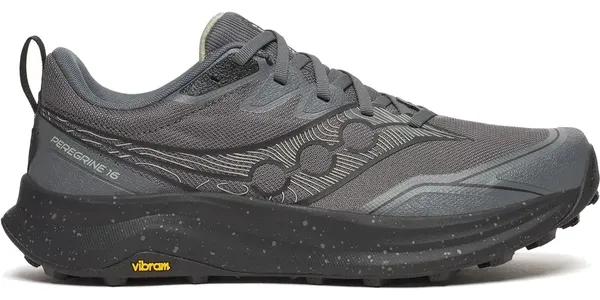
The details that matter
Underfoot: PWRRUN foam, a forefoot rock plate and Vibram rubber
Midsole: Saucony's PWRRUN foam, about 4 mm more of it than in the Peregrine 15 (BetterTrail calls it standard EVA). RunRepeat measured the foam at 31.3 on the Asker C scale, which counts as soft and is almost the same as the Peregrine 15. RunRepeat adds that it feels firmer on the run than a similar road shoe because of the trail outsole underneath. BetterTrail notes that an EVA midsole packs out faster than premium PEBA or TPEE foams.
Insole: a PWRRUN+ sockliner that RunRepeat measured at 6.3 mm thick and found removable. It adds some immediate comfort.
Rock plate: forefoot only, made of lightweight plastic. OutdoorGearLab says it blunts sharp rock strikes without adding rigidity, and because there is no full-length plate the shoe can conform to uneven ground. RunRepeat, however, measured 24.7 N to bend the shoe 30 degrees and rates it stiff, so testers feel its flexibility differently.
Outsole: Vibram Megagrip with a chevron lug pattern that is reversed between forefoot and heel to help on climbs and when braking downhill. Rubber covers nearly the whole sole; RunRepeat saw only a small strip of exposed foam in the centre, while OutdoorGearLab reports complete coverage with no exposed foam windows. Saucony lists 4 mm lugs; RunRepeat measured 3.5 mm, down from 4.7 mm on the Peregrine 15.
In use, the rubber grips well and lasts, but the shallow lugs suit hardpack, rock and mixed trails better than deep mud.
Upper: tough mesh, strong lockdown, mid-level breathability
The upper is a high-strength mesh that Saucony says resists abrasion. An oversized Saucony logo on the side provides most of the overlay coverage. The toe bumper, which OutdoorGearLab describes as beefy and wrapping further around the toe box than before, helps when you kick rocks on descents. The shoe is also gaiter compatible.
On breathability, RunRepeat gives it 3/5, a middle result. Believe in the Run says the large logo still allows plenty of breathability, and BetterTrail says air moves freely while the mesh still keeps out most grit. ActiveGearReview says it breathes well even in cold, wet conditions. Opinions on drying differ: CleverHiker says it dries quickly, while OutdoorGearLab found it slightly less breathable than before, drying at a reasonable pace after creek crossings, yet listed slow drying among its cons.
Lockdown is a strength. RunRepeat scores the heel counter's rigidity 5/5, the heel collar is well padded, and the tongue is gusseted for about two-thirds of its length so it stays centred and the foot doesn't slide sideways. OutdoorGearLab says the extra eyelet keeps the shoe secure on steep terrain.
Worth knowing: there are no reflective elements, so carry a light or wear reflective gear in the dark. CleverHiker says the laces may wear faster than on earlier versions, and RunRepeat rates heel padding durability 3/5.
On the trail: stable and controlled, not bouncy
Most testers praise its comfort and stability. ActiveGearReview says comfort is where it stands out most, with no hot spots or pressure points, and the extra foam helps on long runs and hard surfaces without making the shoe unstable or too soft. RunToTheFinish says their legs didn't feel heavy on back-to-back days.
On liveliness, opinions differ. Both Believe in the Run testers found the ride medium-firm and effective rather than lively, and one felt the special quality of the Peregrine 15 was gone. OutdoorGearLab calls the ride responsive yet grounded, and RunRepeat measured 58.1% energy return at the heel and 64.5% at the forefoot, above its lab average. Which matters to you depends on what you want: if you want a shoe that makes you want to run faster, you may be disappointed; if you want control on technical ground, you will likely like it.
On grip, Believe in the Run had zero slippage on loose dirt, snow, roots, rocks and wet boardwalks. In mud, RunRepeat and BetterTrail find the lugs too shallow, while RunToTheFinish reports good grip in mud and snow.
On long stretches of sharp rock and loose scree, OutdoorGearLab says you feel more impact than in higher-stack shoes. On pavement, ActiveGearReview used it for winter road miles and found it smooth enough, and BetterTrail says it handles road and gravel connectors to the trail well. For hiking, CleverHiker found it secure enough for hiking and backpacking while lighter and more flexible than most hiking shoes.
Reading the numbers: 4 mm drop, 32 mm heel and 28 mm forefoot stack, and weight
Drop (the difference between heel and forefoot stack): Saucony lists 4 mm, the same as the Peregrine 15, with 32 mm under the heel and 28 mm under the forefoot. RunRepeat measured 4.8 mm. That is a low drop. RunRepeat says the low-drop geometry and lack of an aggressive rocker naturally favour midfoot and forefoot strikers, and lists the low drop as a con for runners who prefer medium or high drop.
Stack: about 4 mm more than the Peregrine 15. RunToTheFinish worried about it before running but didn't notice the height on the trail, and it didn't affect ankle stability. CleverHiker says the extra foam doesn't turn it into a soft, tall platform. A catalog listing rates the cushion level as high, while most testers describe it as moderate.
Weight: OutdoorGearLab weighed 10.65 oz (302 g) per shoe in men's US 10.5, slightly heavier than the Peregrine 15.
4 mm drop, 32 mm heel and 28 mm forefoot stack
Drop is the difference between heel and forefoot stack. This shoe has 4 mm (RunRepeat measured 4.8 mm). If you usually wear higher-drop shoes, jog slowly in the store and notice how your foot lands and how it feels. The moderate stack keeps you in touch with the trail, but on long stretches of sharp rock you will feel more impact than in thicker shoes.
Check weight at a stated size
OutdoorGearLab weighed 302 g per shoe in men's US 10.5. When comparing, use weights from the same size, or hold the shoes side by side when trying them in a store.
Check forefoot hold and toe room
Lace up snugly, walk down a slope, and check whether the forefoot slides sideways and whether your toes have room to spread, since the toe box tapers. If the regular width is tight through the midfoot, try the wide version.
What to check when trying it on, and what to compare if it doesn't suit
Try them on with your running socks and lace them snugly, then check three things.
- Forefoot: walk down a slope or tilt your foot sideways and see whether the forefoot slides. One Believe in the Run tester had this issue on technical ground.
- Toes: check there is enough room for your toes to spread, because the toe box tapers.
- Heel and midfoot: the heel shouldn't lift as you walk and the midfoot shouldn't pinch. If the regular width is tight through the midfoot, try the wide version.
Slight tightness at first may ease. BetterTrail found it constrictive at first but it relaxed after the first mile into a comfortable snug fit. CleverHiker's test pair needed roughly 20–25 miles (about 32–40 km) to settle in and caused hotspots during that time, while OutdoorGearLab found it comfortable from the first step.
If it doesn't suit, choose by what you want more of. For more cushion on very long runs, consider a higher-stack shoe such as the HOKA Speedgoat 7 or Mafate 5 that reviewers compared it with. For frequent deep mud, look at a dedicated mud shoe with deeper lugs. For regular hiking on sharp rock or off-trail, consider a burlier hiking shoe. If you need a roomier toe box, look at shoes built with a wide forefoot.
Size and fit: mostly true to size, with some differing reports
True to size: OutdoorGearLab (men's) says it fits true to size with a secure midfoot and locked-in heel. RunToTheFinish says it is true to size, as every previous version has been. BetterTrail's tester, a standard men's US 11, found size 11 true to size. ActiveGearReview's tester usually wears 12.5 or 13; the US 13 fit slightly bigger than a 12.5 Peregrine 15, as expected, so sizing matches the previous version.
Big or small: one Believe in the Run tester in men's US 10 found it at least half a size to a full size big, with a wider and longer toe box that caused lateral slippage at the ball of the foot on technical sections. The midfoot and heel fit at the usual size, so sizing down is not an automatic fix. The second tester didn't report the same concern. RunRepeat's table lists it as slightly small.
Shape: RunToTheFinish says the heel and midfoot are narrow, the toe box feels slightly wider than earlier models, and it can run narrow for some. RunRepeat calls the toe box tapered and measured toe-box height at 27.4 mm, a middle value. OutdoorGearLab says the toe box allows natural splay without being bulky. CleverHiker describes a secure midfoot with a slightly roomier forefoot. BetterTrail warns the trim toe box may feel too snug over very long distances.
If you have worn the Peregrine 15, RunRepeat says the fit is strikingly similar.
60848M-S21066-101 · 2026-11-24 · Recorded sizes, not current stock