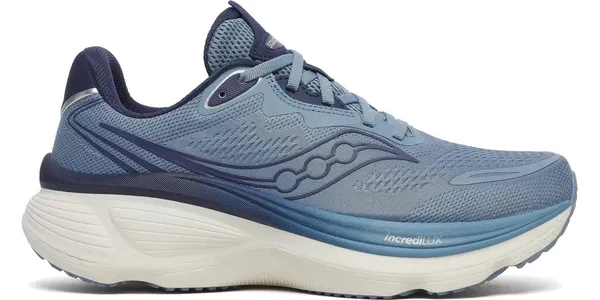
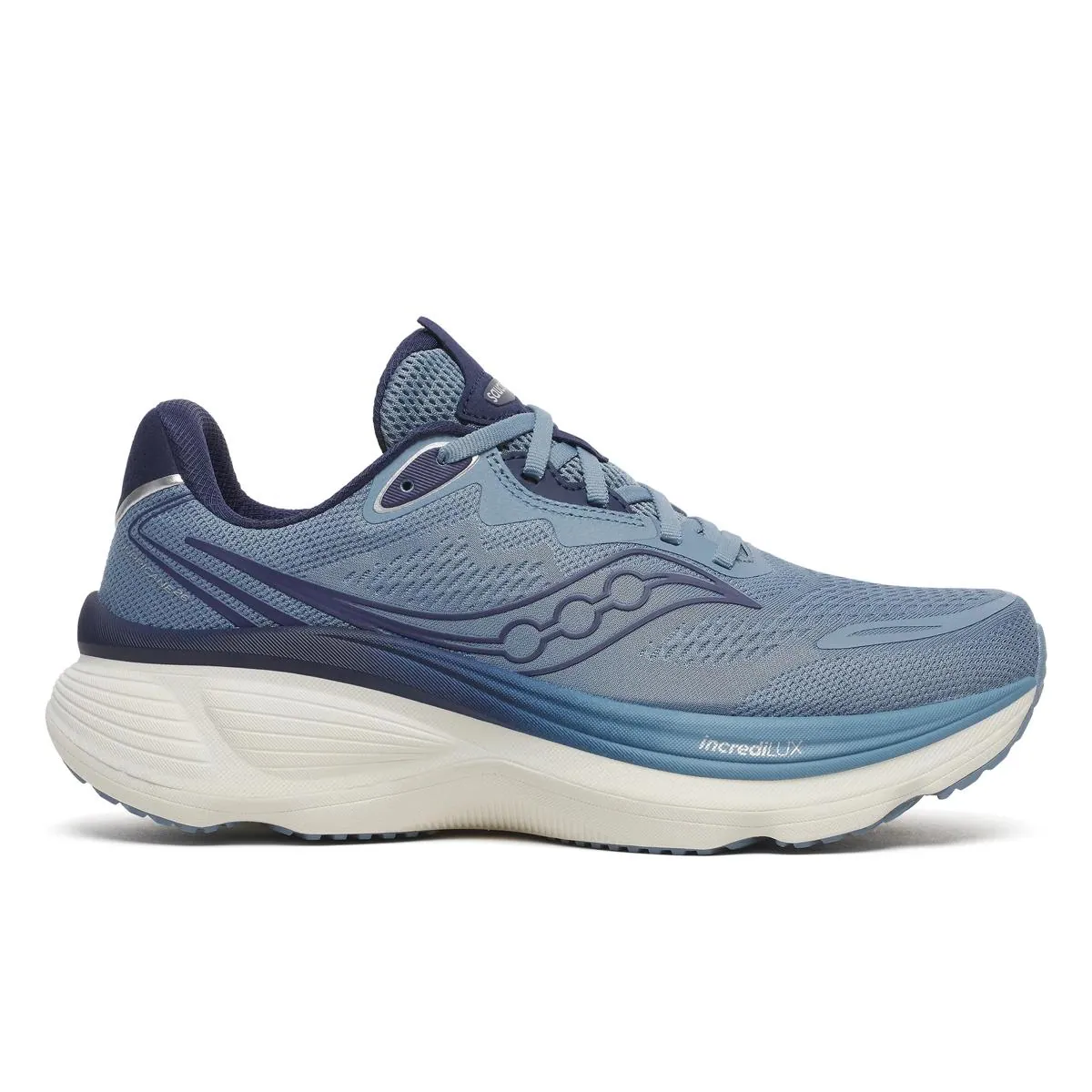
The details that matter
Under the foot: two foams on a very wide base
The midsole uses two foams. The top layer, right under your foot, is Saucony's new incrediLUX foam (A-TPU), which brings softness and bounce. Below it is a PWRRUN (EVA) frame that cradles the soft foam. Tom's Guide describes firmer foam on both sides of the foot for stability, while RunRepeat says the PWRRUN sits mainly around the heel and is smaller than in previous versions. The result is a soft step-in that does not become wobbly.
RunRepeat measured the foam at 33.8 AC, close to average: slightly soft but not unstable. It also measured shock absorption of 145 SA at the heel and 132 SA at the forefoot, both above the lab average.
The base is very wide. RunRepeat measured the forefoot midsole at 129.8 mm, the widest it has measured. A wide base helps you land steadily, but it also makes the shoe look and feel big.
The sole curves up at both toe and heel (a rocker), helping the foot roll smoothly from heel to toe. RTINGS rates the heel rocker geometry as great. The shoe does not bend easily: RunRepeat measured 17.2 N to flex it, higher than the v25.
The outsole is XT-900 carbon rubber, which Saucony highlights for traction and durability. RunRepeat measured it at 3.1 mm thick, around average, and found only 0.6 mm of wear after its Dremel abrasion test. RunRepeat, Doctors of Running and ActiveGearReview all report good grip on wet roads.
Upper: plush and secure, with mixed heat reports
The upper is a mesh that Saucony calls breathable, with plenty of padding around the collar, so it feels plush from the first step. Testers describe the tongue differently: ActiveGearReview and The Run Testers call it heavily padded and Tom's Guide calls it thick, while Lindsay at Believe in the Run found it tall but only lightly cushioned, with no hot spots.
On breathability, RunRepeat gave it 79 BR and found 56% of moisture released in its drying test, a good result for such a padded upper. Wearers have both good and bad experiences. Alastair Running's feet did not overheat on a hot afternoon, and ActiveGearReview's stayed cooler than expected. Tom's Guide, however, says it can get a little sweaty in hot conditions, especially under the tongue, and NextGait's upper became sweat-soaked on a long, exposed run in the heat. If you often run in the sun, try it on with the thin running socks you actually use.
Lockdown is good. The flat, moderately stretchy laces keep the midfoot snug without overtightening, and Doctors of Running never needed a lace lock. RunRepeat warns the laces may be too short for a runner's knot if you have high-volume feet, an easy fix with new laces; Believe in the Run found them the right length.
RunRepeat scored the heel counter (the stiff structure around the heel) 3/5 for stiffness, while Doctors of Running called it stiff but well padded and never bothersome. RunRepeat gave the heel padding a 5/5 for durability and the toe box 3/5.
The insole is 5.6 mm thick and removable. RunRepeat says most custom orthotics should fit, and NextGait advises orthotic users to try them in the actual pair before a long run.
On the run: at its best on easy and long runs
This shoe does its best work on relaxed, longer runs. ActiveGearReview ran 16 miles and said their legs stayed comfortable throughout, with feet, knees and hips feeling protected from the pounding of the pavement. Alastair Running found that at easy and steady paces the 26 lands softer than the 25 and gives a touch more energy back at push-off. RTINGS says heel landings feel more cushioned than springy, and in its simulated 10–40 km test the forefoot kept protecting well deep into the run.
Testers feel the softness differently. Tom's Guide, RoadTrailRun and Alastair Running call it softer than earlier versions, while Doctors of Running finds it a touch firmer, though by no means firm. All agree it is deeply cushioned and protective; whether the softness suits you is something to find out on a test run.
On speed, Tom's Guide found it got clunky at faster paces because of the wide profile. RoadTrailRun and The Run Testers would not pick it for tempo or faster runs, and NextGait would skip it as their only pair if most runs were tempo, intervals or racing. Doctors of Running, on the other hand, found the midsole responsive enough for some workouts, and RoadTrailRun says that, compared with the Nike Structure Plus, it does not fight back when the pace creeps up. In short: it handles a pick-up within a long run, but it is not a dedicated speed shoe.
NextGait found the guidance fairly insistent, so it can feel excessive on fresh-legged days when no support is needed. Alastair Running notes a small dip in stability versus the 25, and RunRepeat rates it slightly less stable than top rivals.
Saucony pitches it for running and walking, but Doctors of Running does not love it for walking, maybe because the sole feels best when really engaged. ActiveGearReview wore it at work for a couple of days and heard a squeak on almost every step, most noticeable indoors and on quiet walks. It persisted through several runs, including 16 miles; the tester traces it to the insert rubbing on the midsole and barely noticed it outdoors with headphones. Lindsay at Believe in the Run also heard a squeak on every step.
Reading the numbers: drop, stack and weight
Drop (the difference between heel and forefoot stack): Saucony lists 6 mm and RunRepeat measured 5.9 mm, very close. RTINGS, however, measured 7.7 mm in men's US 9 and sees a more heel-biased setup than the 25 that suits heel strikers, while RoadTrailRun lists the drop as unchanged. The figure depends on who measured it. If you are used to low-drop shoes, pay attention to how heel landings feel on a test run.
Stack: 41 mm under the heel and 35 mm under the forefoot, up from 38 mm and 32 mm on the Hurricane 25. That much foam gives plenty of impact protection but little ground feel; RTINGS says it will not suit runners who prioritise ground feel.
Weight: to compare with other shoes, use the same size. Believe in the Run lists 9.2 oz in men's US 9 (the 25 was 10 oz), and Doctors of Running weighed 272 g in US 10.
6 mm drop, though one lab measured more
Saucony lists 6 mm and RunRepeat measured 5.9 mm, but RTINGS measured 7.7 mm in men's US 9 and sees a more heel-biased setup that suits heel strikers. If you are used to low-drop shoes, notice how heel landings feel on a test run.
41/35 mm stack: lots of foam, little ground feel
41 mm under the heel and 35 mm under the forefoot, taller than the 25. The deep stack absorbs impact, but if you like to feel the road or prefer a firm, low ride, this shoe will not suit you.
Compare weight at the same size
To compare weight, use size-stated figures such as 9.2 oz in men's US 9 (Believe in the Run) or 272 g in US 10 (Doctors of Running), and compare other shoes at the same size.
What to check when trying it on, and what to compare
When trying it on, wear the running socks you actually use, lace up normally and check four things. First, height over the toes: if you have tall toes, see whether the top of the shoe presses on them. Second, the instep: if yours is high, check for lace pressure. Third, the heel should not slip as you walk. Fourth, walk on a hard floor in the store for a while to listen for a squeak. Then jog a few steps and speed up a little; if the wide base feels clunky, you will notice it right away. Bring your own orthotics if you use them, and check the exchange policy before buying.
If it does not suit you, compare these kinds of shoes:
- You want more support on the inside edge: a more aggressive stability shoe. Doctors of Running says the Saucony Omni has more prominent medial support.
- You supinate: Alastair Running suggests a neutral max-cushion shoe instead.
- You want something lighter and nimbler for faster runs: a lighter, nimbler stability shoe. Tom's Guide, The Run Testers and RoadTrailRun cite the Hoka Arahi 9, ASICS GT-2000 15 and Saucony Guide 19 as nimbler but less cushioned and comfortable.
- You need only mild guidance and want to run faster sometimes: NextGait would buy the Saucony Triumph 24 first. RTINGS says the Triumph 24 is better for faster training, while the Hurricane 26 is more stable.
Size and fit
Length runs true to size: The Run Testers had three testers in their normal running size and all found it fit well. NextGait wore men's US 10.5 D and found it true to their usual length, with an accommodating forefoot and a padded heel that held without sliding.
The two labs disagree on height over the toes. RunRepeat measured 27.4 mm and found plenty of room for the toes to move, with no pressure. RTINGS found the toe box 3.1 mm lower than its reference fit, so runners with taller toes may find the front slightly snug.
Doctors of Running describes normal width and volume, with a slightly tapered and ever-so-slightly short toe box that caused them no issues. The instep is a little low, so runners with high insteps will need to adjust the laces or it may not work. The heel fits normal to slightly snug, with no slipping even at faster paces.
RoadTrailRun says the toe box is more accommodating than in prior versions, which helps on long runs when feet swell. Another tester there, with wide feet, still found pockets of looseness in the upper after multiple adjustments and with thick socks.
The shoe comes in standard and wide versions for both men and women. If the standard version feels tight through the midfoot or forefoot, try on the wide version.
61249M-S101098-1020 · 2026-11-24 · Recorded sizes, not current stock