The details that matter
What is under your foot and what it does
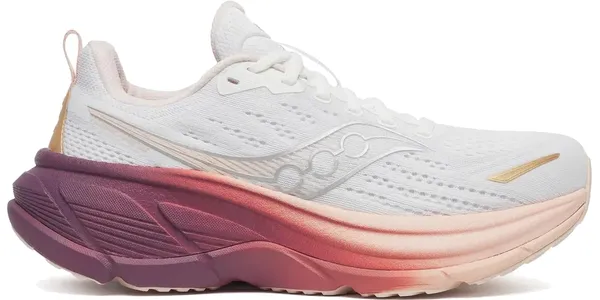
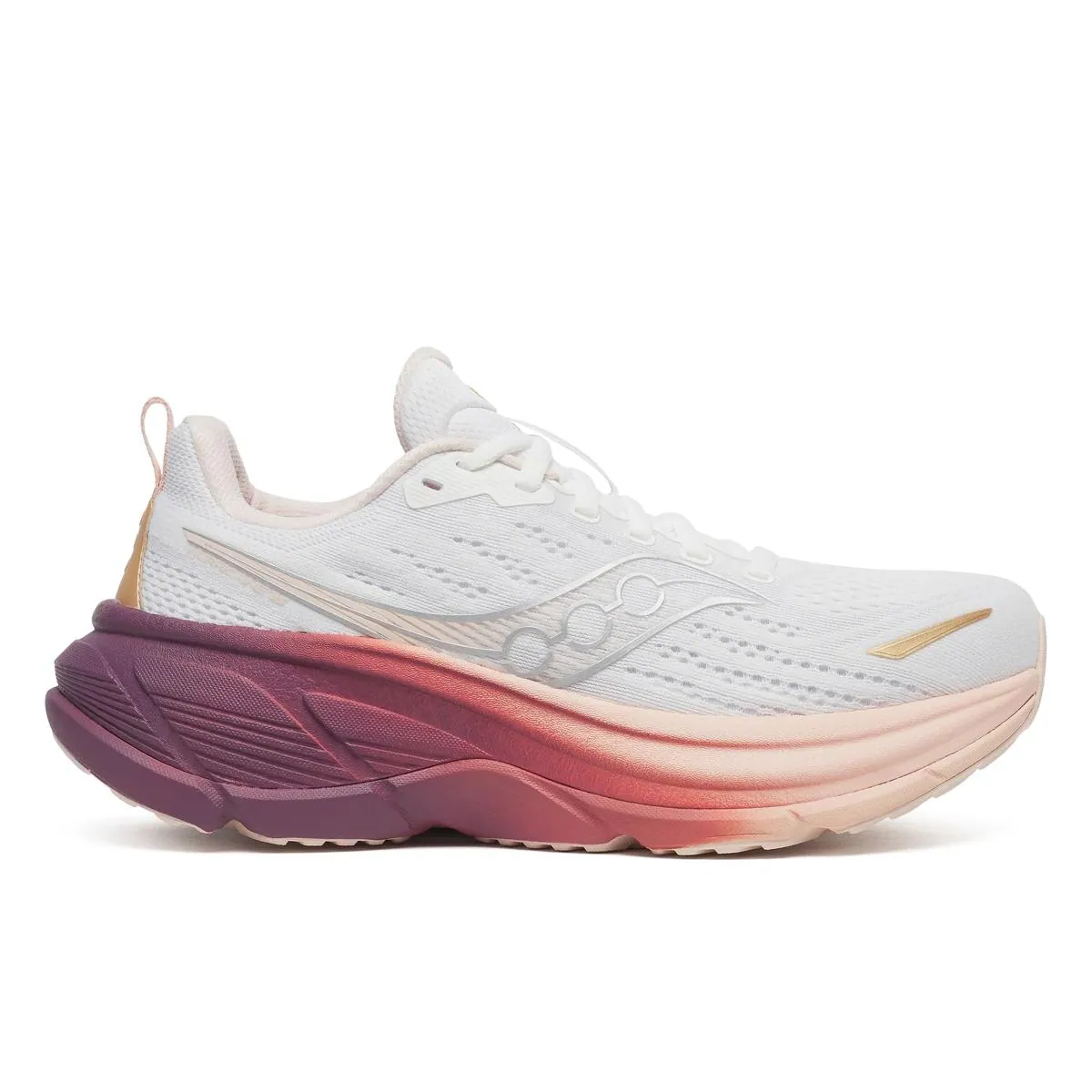
The midsole has two foam layers. The top layer, where your foot lands, is PWRRUN PB, a PEBA foam Saucony describes as soft yet responsive. Doctors of Running says this layer makes up most of the cushioning. The bottom layer is a PWRRUN frame, an EVA foam that Fleet Feet calls one of Saucony's densest and most durable. The frame wraps the base and rises up beside the foot. RunningShoesGuru explains that on the inner side under the heel this frame flares up to stop the foot rolling inward too much.
The CenterPath support system relies mainly on the shape of the sole: a wide base, raised sidewalls, a flared sole, extra foam on the inner side, a rocker shape and a bevelled heel. RunRepeat measured the midsole at 124.4 mm wide at the forefoot and 102.2 mm at the heel. That wide base gives stable landings, but RunRepeat also says the shoe is both tall and wide and can feel clunky during transitions.
RunRepeat measured energy return of 68.4% at the heel and 74.0% at the forefoot, in the top tier for stability shoes. There is no plate. The insole is 6 mm thick, and RunRepeat found it is removable.
The outsole is XT-900 rubber covering the forefoot and heel, the high-wear areas. RunRepeat measured 3.3 mm of rubber and only 0.9 mm of wear after its Dremel abrasion test.
The upper: soft and snug, with mixed reports on heat
The upper is a mesh that Saucony calls engineered mesh and some reviewers call flat knit. It is soft and slightly stretchy, with thick padding on the tongue and collar. RunRepeat measured 10.5 mm of tongue padding, so the top of the foot feels very plush under the laces. The tongue is attached to the sides of the shoe, so it does not slide around; RTINGS says it is fully gusseted, while RunningShoesGuru says it is semi-gusseted. Doctors of Running found the inside a little scratchy and strongly recommends wearing socks.
The heel counter (the stiff structure around the heel) is firm: RunRepeat rated it 4/5. Doctors of Running says it comes about two-thirds of the way up the heel, with some padding between heel and counter, and people sensitive to heel counters may not get on with it. For heel hold, Doctors of Running had no slippage without a lace lock, Treeline Review had no blisters, and The Run Testers say it held the foot securely on the run.
The laces are soft and thick and stay tied, but some pairs come with short laces. Three Fleet Feet testers found them only just long enough for a double knot or a heel-lock loop. One WearTesters reviewer also got short laces, while another in size 12 found them a normal length.
On heat, reports differ a lot. RunRepeat's smoke test scored 2/5 because the ventilation holes are sealed by an inner layer. RunningShoesGuru tested in Malaysian humidity and found breathability poor, better suited to cool climates. But Treeline Review, wearing it through summer, and WearTesters, during a heatwave, found it breathable. If you often run in hot weather and your feet heat up easily, weigh this before buying.
On reflectivity, RunRepeat lists no reflective elements, while Treeline Review found some small ones but says they are not enough for running in the dark, so if you run on roads at night, add other reflective gear.
How it feels on the run
Hurricane 25 does its best work on easy runs and long runs. RunningShoesGuru ran a 34 km easy long run in it and found it supportive and stable without forcing a particular running style. Believe in the Run used it during a Chicago Marathon build and says that on easy runs the shoe wanted to cruise faster than planned, so they had to consciously slow down. The Run Testers say it protects the legs well during high-mileage weeks.
Heel strikers are likely to enjoy it. RTINGS says the heel is very forgiving on landing, but that soft heel is also less inherently stable. RTINGS also found the forefoot returns energy well at toe-off, while the heel feels more muted. The rocker shape carries the foot smoothly from landing to toe-off.
Softness is where testers disagree. Most say it is soft without being squishy. Doctors of Running's first reviewer found it mushy at slow speeds but found it great at normal to uptempo paces. Their second reviewer, who prefers firmer shoes, struggled with it on recovery runs but got more out of the foam when the pace picked up. WearTesters, by contrast, found it firmer and more stable than the previous version. Doctors of Running's first reviewer found the ride oddly firm at first, but it quickly became soft and bouncy; the second reviewer says it felt more balanced once the foam settled after two or three runs.
When you speed up, reviewers agree more. RTINGS says it feels bulky when you push the pace, WearTesters calls it sluggish, RunningShoesGuru finds it a bit too heavy and cumbersome for uptempo runs, and Treeline Review says it is not ideal for tempo days or quick-turnover workouts.
On support level, RTINGS calls it gentle and not for runners who need maximum support. Doctors of Running places it at mild to moderate, just below higher-support shoes such as the Brooks GTS series. Treeline Review even calls it a neutral shoe and says you can add your own insoles if you need more arch support.
For walking, opinions split. Treeline Review wore it for runs, walks and long shifts at a brewery, and recommends it for jobs with standing and walking all day. Fleet Feet says it feels as good walking as running. But a WearTesters reviewer felt the heel was too plush for all-day walking, making the ankles work harder than they wanted, and RunningShoesGuru could feel the built-up inner heel when walking, though not once they started running.
Wet grip also has good and bad reports. RunRepeat measured better traction than the previous version, RunningShoesGuru found great grip on wet roads, and WearTesters had no trouble moving between dry and wet surfaces. But one Doctors of Running reviewer found the sole slipped on wet pavement, and the other rated wet-road grip average and felt a little cautious. Treeline Review says it handles roads, gravel and hardpacked dirt, but it is not a trail shoe.
How to read this shoe's numbers
Stack and drop: Saucony lists 38 mm under the heel and 32 mm under the forefoot, a 6 mm drop (the difference between heel and forefoot thickness). Treeline Review calls this stack pretty high and calls a 6 mm drop a mid drop that most runners can wear easily.
Lab measurements come out higher than the brand's figures. RunRepeat measured 40.2 mm at the heel and 33.1 mm at the forefoot (7.1 mm drop). RTINGS, in a men's US 9, measured 40.7 mm at the heel and 36.2 mm at the forefoot (4.4 mm drop). The overall picture is a very thick sole, and RunRepeat says this height completely removes any ground feel. Doctors of Running notes the heel compresses a lot, which makes the 6 mm drop more noticeable.
Foam feel: RunRepeat measured the midsole at 33.6 AC (a foam hardness unit; lower is softer), pleasantly soft, slightly firmer than the previous version and more stable.
Weight: Saucony's product pages list 285 g for the men's shoe and 252 g for the women's without stating the size. When comparing with other shoes, use same-size figures. For a men's US 9, RTINGS weighed 292.9 g and Believe in the Run lists 295 g; for a women's US 8, Believe in the Run lists 258 g. RunRepeat weighed its pair at 286 g. Several reviewers say it is clearly lighter than the previous version but still too heavy for fast running, while The Run Testers say it does not feel too much of a beast during daily training.
Stack height and drop
Saucony lists 38 mm at the heel, 32 mm at the forefoot and a 6 mm drop, but labs measured it thicker (around 40 mm at the heel). When trying it on, stand and walk to see whether you feel stable on a sole this thick. If you are used to low-drop shoes, notice the heel-to-forefoot difference too: Doctors of Running says the heel compresses a lot, which makes the drop more noticeable.
Compare weight at the same size
To compare with other shoes, use same-size weights: a men's US 9 comes in at about 293–295 g (RTINGS and Believe in the Run). In the store, also pick it up next to the other shoes you are considering.
Check interior volume and the toe box
Several reviewers describe low interior volume, a low instep and a tapered toe box. Lace it snugly and check whether the top of your foot feels pressed and whether your outer toes are squeezed.
What to check when trying it on, and what to compare if it does not suit
When trying it on, lace it snugly first, then check three things. First, whether the midfoot and instep feel tight, since several reviewers describe low volume there. Second, whether your outer toes are squeezed; Believe in the Run says the toe box tapers. Third, whether the heel counter presses on your heel. If you can, do a short run too: RunningShoesGuru felt the inner heel foam when walking but not when running. And do not judge the softness from the first try alone; one Doctors of Running reviewer found the ride oddly firm at first before it quickly turned soft and bouncy, and the other says it felt more balanced after two or three runs. Check the exchange policy before buying.
If it does not suit your feet or your running, choose by what is missing: for a shoe that can also run fast, look at lighter, bouncier max-cushion shoes; for more support, look at a higher-support stability shoe; if you prefer a firmer ride, look at a firmer stability shoe.
Size and fit
Length: almost every source says it fits true to size, including RunRepeat, RTINGS (men's US 9), RunningShoesGuru, Doctors of Running (men's US 10), Treeline Review (women's regular), WearTesters, The Run Testers (four testers in their usual running size) and Fleet Feet.
Width and interior height: try it on. RunRepeat measured the widest interior point at 95.1 mm, within the ideal range for a daily trainer; toe box width at 72.9 mm, about average; and 28.1 mm of height above the toes, which is spacious. Doctors of Running says the width is normal to slightly wide but offset by low volume along the whole shoe, with a low instep that sensitive feet should note. Treeline Review (women's regular) says the midfoot is narrower and leads into a wider toe box, snug but not restricting. RTINGS says there is not much forefoot volume, but it is not cramped.
Reports of a tight fit: WearTesters says it fits tighter throughout than the previous version, with room for toe splay but an upper that presses in on both sides, and a reviewer with slightly wide feet struggled to get it on. Believe in the Run says the toe box taper could be a problem for a wider forefoot. RunningShoesGuru goes further: their narrow-footed tester found the wide version fit perfectly with no excess space, so they recommend most runners buy the wide, and say even the wide version will be too narrow for very wide feet.
Wide version: available for men and women. Fleet Feet lists it as 2E for men and D for women, and RunRepeat says the wide is sold only in select regions. If the regular width is tight at the midfoot or squeezes your outer toes, try the wide version on.
60325W-S11026-224 · 2026-11-24 · Recorded sizes, not current stock