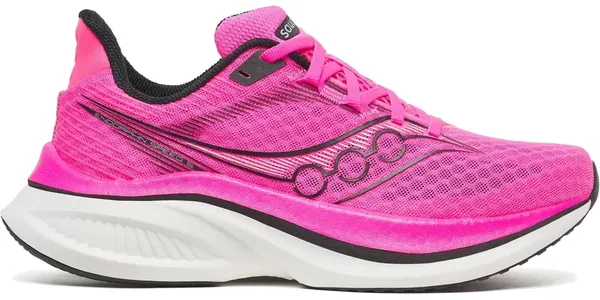
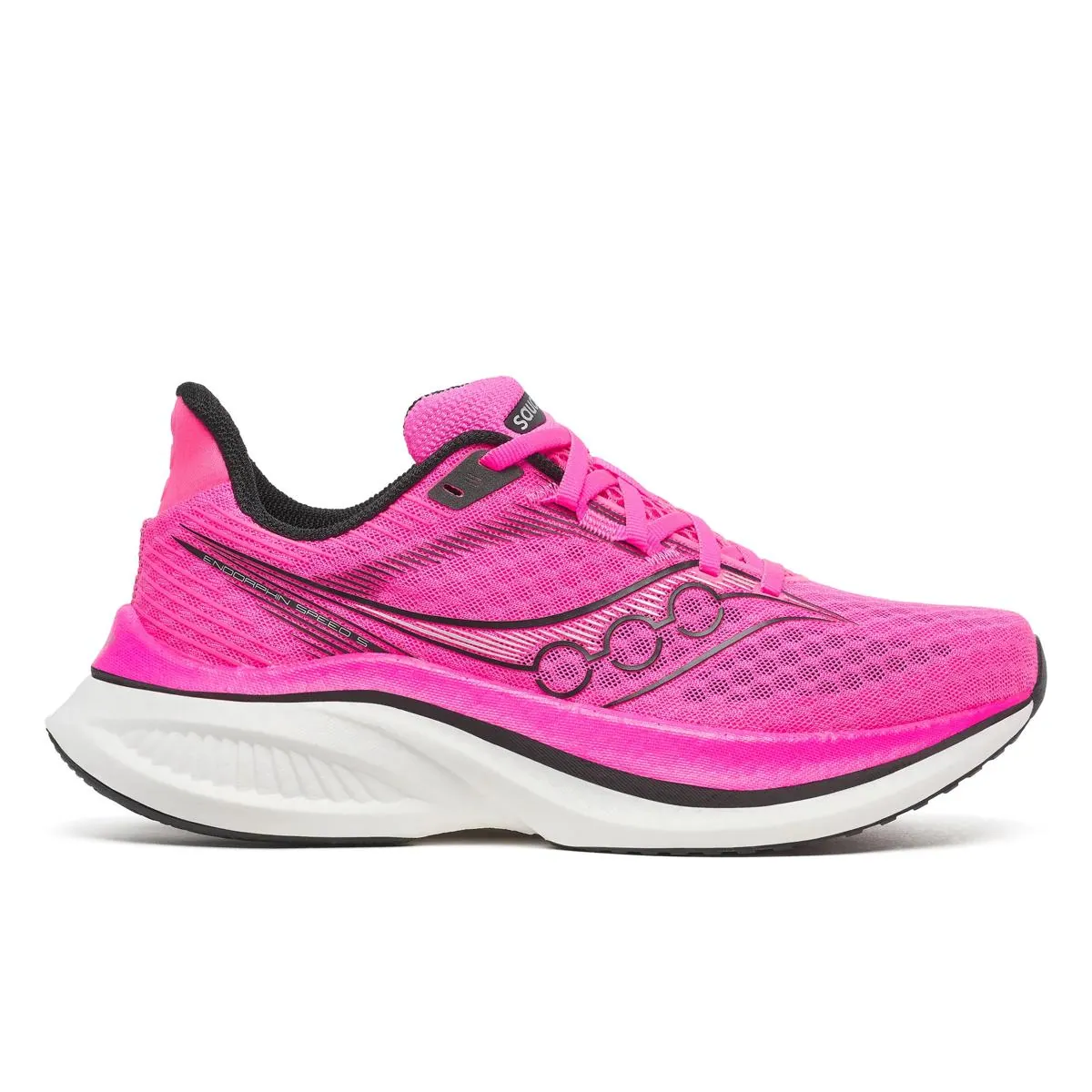
The details that matter
What's underfoot: two layers of PWRRUN PB around a nylon plate that still flexes
Saucony describes the midsole as two layers of PWRRUN PB foam with a full-length, semi-rigid nylon plate between them, and says this balances propulsion and cushioning in every stride.
Sources describe the plate's shape differently. Believe in the Run says it has gone from dual wings to a single wing on the inner side of the foot, so it twists more easily. FueledByLOLZ also says the plate has only one inner wing, and that it is more flexible and less stiff than the Speed 4's plate. Tom's Guide, though, writes that the plate has wings on the sides to add stability.
What several sources agree on is that the plate still flexes. In RunRepeat's lab the force needed to bend the shoe lengthwise was 12.9N, below the 15.5N average (lower means easier to bend). RunRepeat says it stays comfortable at slow paces and doesn't feel stiff in the slightest. Doctors of Running says the heel transition is quite smooth thanks to a decent heel bevel, an outer heel that compresses easily and a plate that doesn't extend into the outer midfoot and heel. Compared with version 4 the plate is slightly more flexible, so the forefoot feels slightly softer.
The outsole has rubber only in some areas. RunRepeat describes the most rubber at the heel and forefoot, the rest as exposed foam left uncovered to save weight, and a cutout under the midfoot that shows the nylon plate. Saucony says it expanded heel rubber coverage for durability and that a full-length groove makes the move from foot strike to push-off smoother. RunRepeat found the rubber thickness up from 2.0 mm in version 4 to 2.5 mm.
On grip, RunRepeat measured a traction score of 0.52 on wet concrete, close to the 0.53 average. Doctors of Running calls traction fair, and its reviewer did not slip on roads or other paved surfaces when wet. Annie Behrend of iRunFar hasn't noticed weaker grip from the exposed foam, but says she hasn't run in very wet conditions yet.
A thin, very breathable mesh upper that several reviewers liked on hot days
Saucony says the upper is a new lightweight engineered mesh for an even more comfortable fit. RunRepeat tested it by connecting the shoe to a smoke machine to see how easily the smoke escaped. It flowed out effortlessly, earning a 5/5 breathability score against a 3.6 average.
Reviewers felt the same. Meaghan Murray of Believe in the Run (women's US 7.5) says the thinner mesh breathes better and feels lighter, which was especially welcome on hot summer runs. Hollie of FueledByLOLZ says the new mesh feels less premium but breathes better and holds up well in hot conditions, with no more feeling of running in a sauna. Nick Harris-Fry of Tom's Guide also found it breathable on long runs on hot days.
The tongue is partly attached to the shoe. Hollie says it stays in place. RunRepeat measured its padding at 5.7 mm, up from 2.0 mm in version 4, which improves comfort but is the main reason the weight went up slightly.
On upper durability, RunRepeat scored the toe box 2 out of 5, below the 2.6 average, but calls that pretty decent for such a thin upper, while Annie Behrend of iRunFar is 200 miles in with zero issues. Doctors of Running recommends wearing socks, because the inner liner is too scratchy to go sockless.
If you run in hot weather, breathability is a strength the sources agree on. When you try them on, wear the socks you run in and notice whether the inner liner irritates your skin.
How it feels on the run: good energy return and smooth transitions, but not a thick, soft-soled shoe
In RunRepeat's lab the foam returned 73.2% of energy at the heel and 78.2% at the forefoot. RunRepeat calls these super shoe-level numbers (the level of top-tier race shoes) in a shoe that is more versatile than those race shoes.
On softness, sources see it differently. RunRepeat measured the foam at 44.5 on the Asker C scale, firmer than the 35.4 average across 267 shoes. RunRepeat says it suits runners who prefer a more structured feel underfoot over plush foams. Laura Fountain of Women's Running found the foam more forgiving, smoother and less firm than version 4's. Matt Klein of Doctors of Running says it isn't a completely soft feel but is softer than the prior version.
These views fit together. RunRepeat compares the shoe with 267 shoes, while the two reviewers compare it with version 4: this version is softer than version 4, but firmer than the average RunRepeat has measured. Whitney, though, a reader who commented under Believe in the Run's review and is a diehard Speed 4 fan, had read that Saucony made the foam firmer. Whitney says that if that was the goal, it worked, because the bouncy responsiveness that made the Speed 4 fun is completely gone, and the shoe feels slower and clunkier the more the pace picks up.
For long runs, Matt Klein says it did well on easy and long runs, and the forefoot no longer bottoms out or feels too firm over long distances. At the end of one long run his legs were still fresh enough to pick up the pace. Tom's Guide, though, finds the relative lack of cushioning makes it less appealing for long, hard runs, although some will enjoy its lower, more direct feel for shorter workouts and races.
On speed, The Run Testers say it isn't quite as quick as a full carbon-plated super-shoe but is close, and is comfortable for recovery runs too. Laura Fountain ran 1-minute hard efforts with a friend and found it the perfect shoe for that workout, without feeling awkward on the recovery jogs in between. Matt Klein found that on the first fartlek (a run alternating faster and easier stretches) the shoe felt great at faster efforts but not as fast as other super shoes.
Hollie prefers it for longer tempo runs and daily training over all-out sprints, and would choose something lighter or more responsive for track days or short sprints. Stacy, a reviewer on Zappos, wears it for track workouts, long fast runs and races but not for easy, slow runs, which the reviewer says it isn't meant for.
On stability, Saucony's product page lists the category as Neutral and shows its Support bar at 2 of 5. Doctors of Running found mild guidance, especially at the heel. The reviewer thinks runners whose heel rolls inward slightly, or who have neutral mechanics, will do best in it, while those who need the shoe to support the outer side of the foot may struggle. RunRepeat found Saucony's tweaks keep it stable at every pace, at the cost of feeling slightly bulkier and a bit less natural underfoot.
Outsole durability depends on use. Matt Klein saw wear on the exposed foam by 45 miles and says it gets chewed up on dirt and gravel, so he would keep it only on the road and track; he expects average durability for its category. Hollie has 100 miles on it with some signs of wear but plenty of life left, and expects about 250–300 miles. Annie Behrend, a heel striker, sees the most wear on the outer heel rubber after 200 miles, and occasionally has to dig out a rock wedged in the midfoot groove. RunRepeat's Dremel abrasion test showed 1.0 mm of wear against a 1.1 mm average, which it calls not great, but not terrible either.
Reading the specs: sources give different drop, stack height and weight figures
The spec table shows Saucony's figures: an 8 mm drop (the difference in sole thickness between heel and forefoot), with 36 mm under the heel and 28 mm under the forefoot. RunRepeat measured its test pair at 37.4 mm under the heel and 26.8 mm under the forefoot, a 10.6 mm drop, slightly higher than Saucony's stated figure. RunRepeat considers it an average drop that works for all foot strikes, though it favours heel strikers a bit more. Matt Klein of Doctors of Running felt the drop was consistent with 8 mm when running.
On stack height, Tom's Guide points out that a 36 mm heel is relatively low next to many running shoes today, since most super-trainers (thick-soled trainers built for speed) now have 40 mm or more at the heel. RunRepeat measured the forefoot sole thickness at 26.8 mm, close to the 27.2 mm average, and sees it as a solid balance between ground feel and cushioning.
Weight goes with size. The 204 g (7.2 oz) in the spec table comes from Saucony's women's page and is close to the 205 g Believe in the Run gives for a women's US 7.5. Doctors of Running lists 7.5 oz for a women's size 8. Higher figures, such as Believe in the Run's 238 g and iRunFar's 240 g, are for a men's US 9. When comparing with other shoes, compare at the same size.
8 mm or 10.6 mm drop: which number to use
Drop is the difference in sole thickness between heel and forefoot; Saucony's figures are a 36 mm heel minus a 28 mm forefoot, or 8 mm. RunRepeat measured 37.4 mm under the heel and 26.8 mm under the forefoot, a 10.6 mm drop against an 8.4 mm average of the shoes it has measured, and still calls it an average drop, while Doctors of Running felt the 8 mm figure matched how it ran. These numbers place it as a mid-range drop, but they don't tell you how soft the sole is, and a 36 mm heel is thinner than most super-trainers at 40 mm or more. If you're used to low-drop shoes, run in it for a stretch to see whether this drop gets in the way of your stride.
A 44.5 foam-firmness reading versus softer than version 4
RunRepeat measured the midsole foam with an Asker C durometer, where a higher number means firmer: this shoe read 44.5 against a 35.4 average across 267 shoes, so it is firmer than the average shoe RunRepeat has measured. Women's Running and Doctors of Running call it softer than version 4 because they compare it with the previous model, not with every shoe, while Whitney, a reader and Speed 4 fan, feels the old bounce is gone. If you love a sink-in soft feel, run in the shoe yourself before buying.
Compare weight at the same size
The 204 g (7.2 oz) in the spec table comes from Saucony's women's page and is close to the 205 g Believe in the Run gives for a women's US 7.5; Doctors of Running lists 7.5 oz for a women's size 8. Believe in the Run's 238 g and iRunFar's 240 g are for a men's US 9. When comparing with other shoes, use weights at the same size, or pick it up next to other pairs when you try it on in a store.
When you try them on: check length, the sides of your toes and your heel
If you measure your feet to compare with a size chart, Saucony suggests standing with your full weight on the foot and measuring from the back of the heel to the longest toe, which may be the big or second toe. If your feet differ, use the longer measurement. When you try them on, wear the socks you run in and lace up as snugly as you would for a run.
First, length, because wearers report it differently. Laura Fountain of Women's Running (UK 6) and Meaghan Murray of Believe in the Run (women's US 7.5) found it true to size. Hollie, who usually wears a women's 10–11 wide, found it a bit short and says you may want a half size up. One Zappos reviewer says the size 8 worn for 30 years is a hair long, while the 7.5 is a hair too short to work. If it feels short, try on a half size up to compare.
Second, the sides of your toes. Doctors of Running describes a slightly tapered toe box with the extra room around the outer toes and a more tapered big-toe side. FueledByLOLZ warns that narrow-footed runners may notice extra material in the forefoot when laced tightly. When you try them on, check whether the big-toe side feels squeezed. If your feet are narrow, check whether the forefoot material bunches or folds once laced.
Third, the heel. Doctors of Running says the heel counter (the stiff structure wrapped around the heel) is stiff and padded in front. Because it is rounded it bothered the reviewer only a little at first, but runners whose heels irritate easily will likely not do well in it. RunRepeat scored its stiffness 4 out of 5, above the average of 3, while Hollie says it gives secure lockdown without irritation. The same Zappos reviewer says the heel extends oddly far past the back of the shoe, and RunRepeat notes an extended heel tab designed to make the shoe easy to pull on. If your heels irritate easily, walk and jog lightly for a while and notice whether the back and top edge of the heel press or rub.
If your feet are wide, Saucony offers a Wide version; try it on next to the regular width before you buy. Saucony US offers free exchanges on its own site, but stores in Thailand may have different terms. If you buy online, compare the store's size chart and check whether it accepts size exchanges or returns before you order.
If it doesn't suit you after a run in it, work out why. If you want a thicker, softer sole for long runs, look at high-cushion trainers: RunRepeat names the Saucony Endorphin Trainer and Mizuno Neo Zen, and Tom's Guide names the Hoka Mach X2 and Nike Zoom Fly 6 as more comfortable and bouncy. If you want a lower drop, RunRepeat names the adidas Adizero Boston 13 at 6.0 mm. If you want the feel of a carbon race shoe, Hollie says this isn't the shoe for runners looking for that.
Length: some say true to size, some say a bit short; the toe box has more room than the Speed 4's
On length, Laura Fountain (UK 6) and Meaghan Murray (women's US 7.5) found it true to size. Matt Klein of Doctors of Running and Nick Harris-Fry of Tom's Guide, both in a men's US 10, also fit their normal size, as did all four testers at The Run Testers, the same Nick among them.
On the other side, Hollie found it a bit short and says you may want a half size up, even though the FAQ on the same page says it runs true to size. One Zappos reviewer found size 8 a hair long and 7.5 a hair short. The reader poll on RunRepeat's page (192 votes) says it fits slightly small. Start with your usual size and also try on a half size up to compare.
On width, RunRepeat made a gel mould of the inside and found the toe box noticeably wider than version 4's at 72.9 mm, though still right around the 73.2 mm average, and says not to expect extra space. The width at the ball of the foot, where RunRepeat says the Speed 4 was made wide, actually narrowed from 96.9 mm to 93.8 mm (95.2 mm average). Toe-box height is 29.3 mm, above the 27.0 mm average, giving more room above the toes. Matt Klein found the fit wider than the prior version but lower in volume, and had to tighten the laces slightly.
Laura Fountain found the toe box roomier than the Speed 4's while the midfoot and heel felt secure. Meaghan Murray found it slightly roomier than before with no rubbing. That agrees with RunRepeat's measurement of a toe box wider than version 4's. Hollie, who usually wears a wide size, finds the toe box roomier than RunRepeat measured. Hollie calls it spacious and a great option for wide or high-volume feet, while RunRepeat measured its width as right around average.
Annie Behrend, whose bunioned forefoot is not particularly tolerant of shoes that restrict toe splay, says there is adequate room for natural toe alignment and great lockdown. Hollie, who has very high arches, says that although Saucony uppers tend to be shallow, this version hasn't really caused issues. If you found the Speed 4's toe box narrow, this version is likely to give your toes more room. If your whole forefoot is wide, try on the Wide version to compare as well.
60308W-S11007-98 · 2026-11-24 · Recorded sizes, not current stock