The details that matter
Underfoot: two foams, a slotted carbon plate and an 8 mm drop
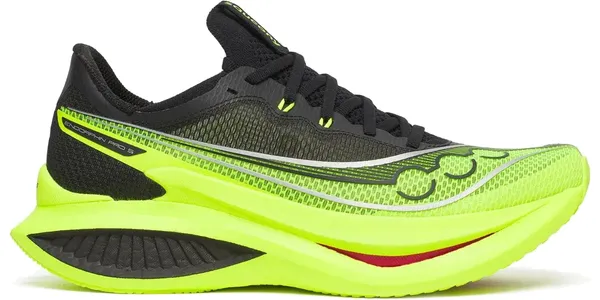
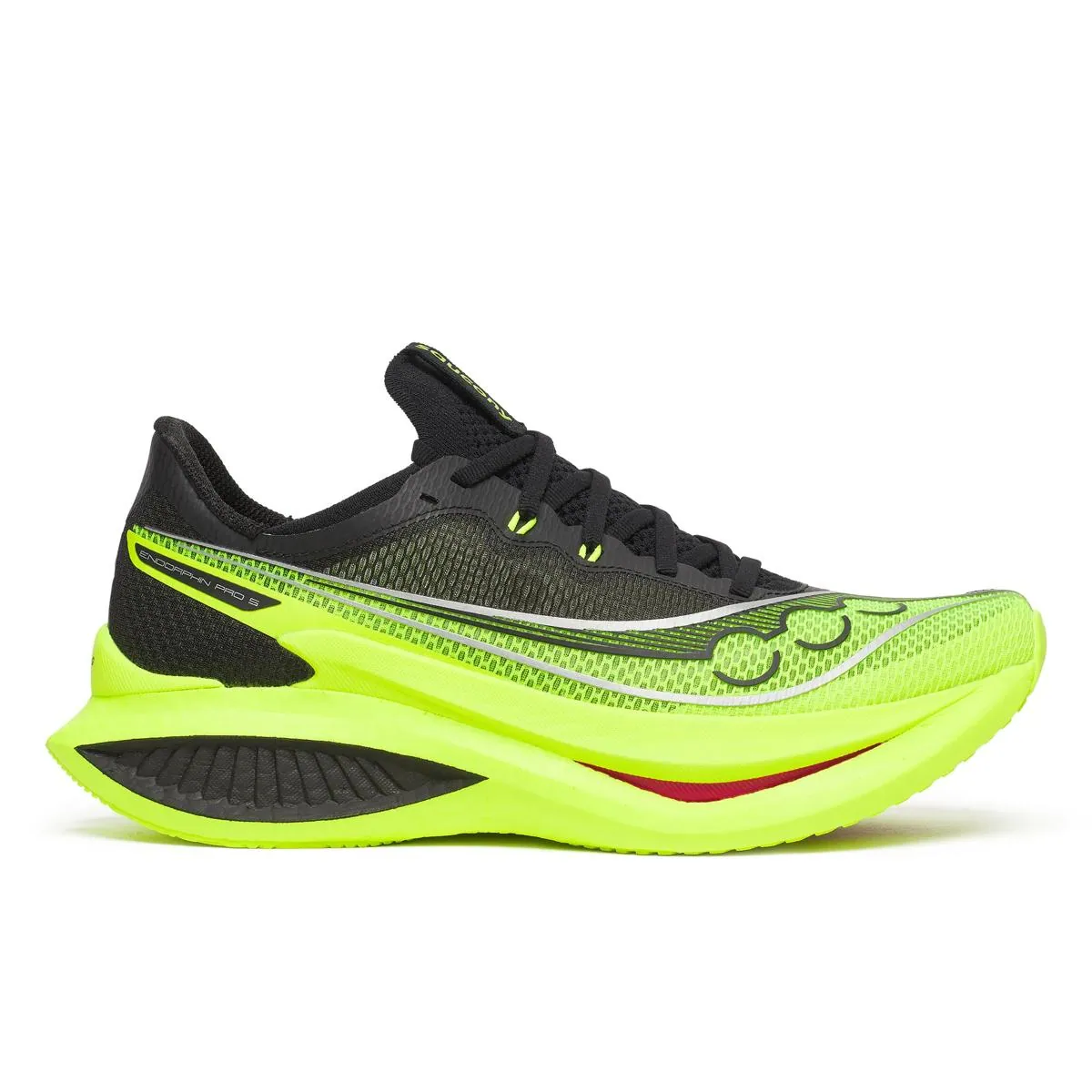
There are three main parts underfoot. The first is the midsole (the foam layer between your foot and the rubber outsole), where Saucony combines PWRRUN PB and Super Critical PWRRUN HG in two layers. The second is the slotted carbon plate embedded in the midsole; Saucony says it sharpens its SPEEDROLL technology for smoother, quicker transitions. The third is the PWRTRAC rubber outsole, which Saucony says offers grip and durability. The slots matter in use: Doctors of Running’s Matt explains that they split the forefoot of the plate into prongs, so it keeps its stiffness when bending forward but twists side to side more easily. That is why Matt found the forefoot less stable than earlier versions; the sensation eased as the plate broke in, but it is still not as stable as prior versions. RTINGS says the plate adds a lot of snap to the forefoot and helps maintain the midsole’s mildly rockered shape so your foot rolls through each stride. Stack: Saucony lists 39.5 mm under the heel and 31.5 mm under the forefoot, with an 8 mm drop (the difference between heel and forefoot thickness). RunRepeat measured a thinner sole: 36.5 mm under the heel and 27.8 mm under the forefoot, for an 8.7 mm drop. Saucony classes both the women’s and men’s styles as Neutral and rates cushioning 3 of 5 on its own scale. Doctors of Running’s Matt notes there are no traditional stability elements, only guidance features such as sidewalls and a central groove. Matt found the ride much firmer than previous versions and says the foams took 25 to 30 miles to break in.
Upper and heel collar: roomy or narrow depending on the foot, and a heel to check with your running socks
RunRepeat calls the upper razor-thin and gave its durability 1 out of 5, and Doctors of Running’s Matt lists a harsh upper among the cons. Toe box: RoadTrailRun’s Sally calls it generously roomy, unusual for a super shoe; Running Warehouse finds it noticeably less tapered than the Pro 4; and Matt Kolat, whose feet are slightly wider than average, says it accommodates them very well. But Run To The Finish says it runs a little narrow and the updated upper is less stretchy. RunRepeat’s measurements show both roomy and tight areas: RunRepeat measured an inside width of 95.2 mm at the ball of the foot in its gel mould and calls it one of the roomier super shoes there, but measured 69.3 mm of width in the toe box, which it calls tight, like the usual super shoe. Heel collar: Doctors of Running’s Matt says the heel fits slightly snug with no collar padding and a small, flexible heel counter (the stiff structure wrapping the heel), but the heel tab comes up high. Matt made it only half a mile sockless before the tab started to tear the skin at the Achilles, and says tall socks are required with this shoe. RoadTrailRun’s Sally had serious heel rubbing on the first run, with both Achilles areas bleeding after 6 miles. A week later Sally ran in it again with thicker socks and adjusted lacing, and the rubbing became less noticeable with each run, but Sally now has scabs on both heels and, in the comparison with the Brooks Hyperion Elite 5, says the heel rub persists as a problem for Sally in the Pro 5. Believe in the Run’s Meg took it straight out of the box for an 18-mile treadmill workout in the dead of winter and got nasty heel blisters, which Meg puts down to extra sweating plus a sock that sat a little too low; it was not an issue on later runs. Run To The Finish’s Stacey got a few blisters on a few runs when the socks did not come up high enough, and Coach Amanda found the heel really uncomfortable initially. Some testers had no trouble: Matt Kolat had no Achilles rubbing at all, though Matt Kolat says the heel counter is fully collapsible and does not give the best hold, and Running Warehouse found a touch too much looseness in the heel. Separately, one Running Warehouse reviewer says the shoe’s longitudinal stiffness seemed to result in Achilles issues for that reviewer. If your heels rub easily, wear tall socks from your first run in it.
On the run: grippy in the wet, but views differ on softness, footstrike and stability
Views on softness differ. Running Warehouse calls the ride on the firm side, Doctors of Running’s Matt finds it much firmer than previous versions, Fordy Runs says it is not the softest but responsive, stable and dependable, and Believe in the Run says it is not the softest or most energetic option in the category but feels light, efficient and fast. On the other side, RoadTrailRun’s Jen found the ride both pillowy and responsive, and Matt Kolat calls the midsole very soft and the plate not very rigid. Footstrike reports point in opposite directions: Doctors of Running’s Matt finds it feels better for heel strikers, and RTINGS says the platform feels noticeably more stable than many super shoes, especially for midfoot and heel strikers; but Matt Kolat found it bouncy yet relatively unstable when heel striking, and very smooth and stable on landing and toe-off when striking with the midfoot or forefoot. Doctors of Running’s Matt also notices that landing farther forward pitches the foot a little toward the inside. Best distance is also seen differently: RTINGS sees it as well suited to 5K and 10K racing and says it can work for marathon racing if you want a predictable, stable plated racer, but finds the cushioning lacking for the marathon distance, so runners who want a plush ride for the final miles may find it harsh. Doctors of Running’s Matt says most will find it best for 5K to half-marathon efforts; RoadTrailRun’s Sally finds it forgiving enough for the full marathon even when form starts to suffer; and Run To The Finish says you could absolutely use it for a marathon because of its stability. Over a 10-mile run, Believe in the Run’s Thomas felt the foam’s liveliness fade as the miles went on. Fordy Runs, after racing the Hatfield 5 and a handful of training efforts, says that even around 10K pace and sometimes harder, the shoe gave everything asked of it. Doctors of Running’s Matt says the shoe worked far better for fast intervals (fast repeats with recovery) and quick tempo runs, but felt awkward and clunky on easier efforts. Wet grip draws consistent praise: RunRepeat measured 0.68 on wet concrete, a clear improvement over 0.52 for version 4; Doctors of Running’s Matt ran a workout in a rainstorm with complete confidence even while turning; Fordy Runs found the grip excellent on very wet race-day roads; Matt Kolat tested it in very rainy conditions and took corners without fear; RoadTrailRun’s Jen found traction great on dry and wet roads; Northern Runner’s writer praises a sticky rubber for wet and dry conditions; and Run To The Finish’s Stacey, whose testing included snowy conditions, says the PWRTRAC outsole really helped prevent slipping and sliding. On durability, Doctors of Running’s Matt saw no outsole wear after 40 miles, RoadTrailRun’s Sally saw no signs of wear after 40 miles, Run To The Finish saw very little outsole wear after two months, and RunRepeat calls its lab durability result of 0.6 mm outstanding.
The key numbers: drop, stack, and weight checked against size
Drop and stack: Saucony’s July 2026 page lists 39.5 mm under the heel, 31.5 mm under the forefoot and an 8 mm drop. RunRepeat measured a thinner sole: 36.5 mm under the heel and 27.8 mm under the forefoot, for an 8.7 mm drop. Both put the sole under the heel roughly 8 to 9 mm thicker than under the forefoot. Cushioning and rebound: Saucony rates cushioning 3 of 5 on its own scale. RunRepeat measured energy return at 72.8% in the heel and 75.8% in the forefoot, above the 61.5% forefoot average of the shoes RunRepeat has tested. Weight: Saucony lists 178 g (women’s) and 206 g (men’s). Pairs testers actually weighed came in heavier, such as 188 g (women’s US 7.5–8) and 230–232 g (men’s US 10–10.5), and Fordy Runs weighed 237 g (UK 9.5). Doctors of Running considers it on the heavier side for super shoes now. Compare weights only at the same size and gender.
What an 8 mm drop and a 39.5 mm heel stack mean
Drop is the difference between heel and forefoot sole thickness: Saucony lists 8 mm and RunRepeat measured 8.7 mm. Stack is a separate number that tells you how high your foot sits above the road: Saucony lists 39.5 mm under the heel and RunRepeat measured 36.5 mm. RoadTrailRun’s Jen found it very stable despite the high stack. One number alone does not tell you who the shoe suits; if you usually run in low-drop shoes, do some short runs in it before racing.
Compare weight at the same size
Saucony lists 178 g for the women’s shoe without a size, and sources disagree on whether that is a women’s 8 or a UK 5. Testers report 188 g for women’s pairs in both US 7.5 and US 8. Compare weight with other shoes only at the same size and gender.
Check width and heel when trying it on
Saucony lists only M (Medium) width, testers feel very differently about the toe box, and the heel tab comes up high, so the heel is the other thing to check.
Before you buy: check the heel, the width and the exchange terms
On width, Saucony’s pages for both the women’s (60804W) and men’s (60803M) styles list only M (Medium). RTINGS and Run To The Finish also say there is no wide version; only RunRepeat’s product facts list Normal and Wide. If a seller says it has a wide version, ask to see the exact style code. When trying it on, wear the socks you actually run in and check where the heel tab meets your Achilles area, wiggle your toes to see whether there is enough room, notice any side pressure, walk or jog to see whether your heel slips, and if you have a high instep, check whether the laced-up shoe presses on the top of your foot. Before paying, ask the seller to confirm it is the Endorphin Pro 5 rather than the Pro 4, whether the sizes offered are women’s or men’s, and what the size-exchange terms are, since testers differ widely on toe-box width and heel hold.
Sizing: true to size in length; width and heel feel differ
Women’s pairs: Believe in the Run’s Meg (US 7.5) found it true to size, secure but still pretty accommodating; RoadTrailRun’s Sally (US 8) found it comfortably true to size; and Run To The Finish’s Stacey found it true to size, with a women’s 11 that felt just like previous models. Men’s pairs: RTINGS (US 9) found the length spot-on, Doctors of Running’s Matt found it true to size in a normal US 10, and Matt Kolat went true to size in UK 11 / US 12 and found the fit good. RunRepeat lists it as true to size, as does an owner poll on the same page (44 votes), and Running Warehouse also lists it as true to size. Where people differ is width and heel, not length. Doctors of Running’s Matt says the upper is a bit wider with a little extra volume, though not nearly as much as version 4; for the first several runs Matt had to loosen the laces to avoid pinching the tendons on top of the foot and dealt with mild internal sliding, and advises runners with a high instep to keep the laces loose. Northern Runner’s narrow-footed writer noticed slight foot movement that was noticeable rather than problematic, while shop manager Craig, who has a higher-volume foot, did not. Running Warehouse found that tightening the laces on narrow feet made the tongue fold in on itself. Try on your usual size with the socks you run in, and check that the sock cuff sits above the heel tab.
60803M-S21064-130 · 2026-11-24 · Recorded sizes, not current stock