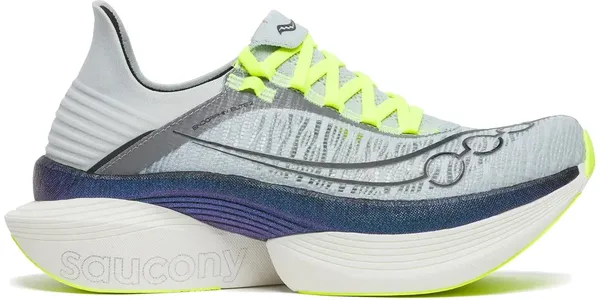
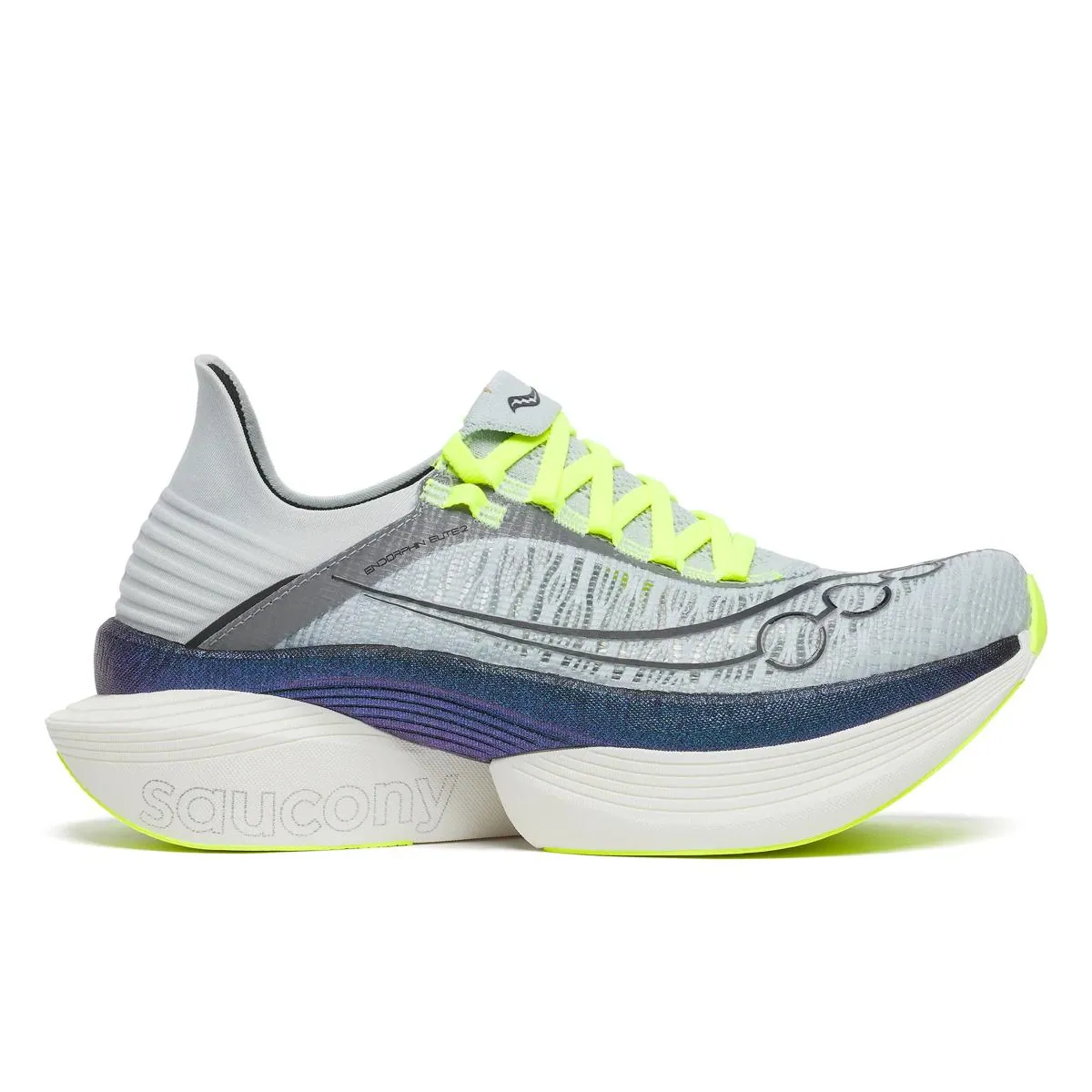
The details that matter
Underfoot: IncrediRUN foam, a slotted carbon plate and a stack close to the racing limit
The midsole is IncrediRUN foam, which Saucony calls its next-generation superfoam and rates 4 of 5 cushioning bars on its product page.
Inside the foam sits a full-length slotted carbon fiber plate. Saucony says it gives a smooth underfoot transition with a propulsive feel.
The stack is close to the 40 mm legal racing limit.
Saucony classes it as Neutral, meaning there is no added structure to guide how the foot rolls, and RunRepeat notes it lacks specific support for heel strikers.
On the outsole, RoadTrailRun’s Sam says there is an extensive cover of thin rubber, and Sally says even the thin rubber over the impact areas is soft and pliable. In short, this build puts soft bounce ahead of guiding the foot.
The upper: light and fitted, but with a narrow, tapered toe box
The upper is a knit and mesh that Saucony calls featherweight. Running Warehouse’s Kaitlyn calls it fitted and breathable, as racing shoes are designed to be, but found it a bit too tight because of slightly wider feet and a high instep.
The toe box is the part to check. RunRepeat says that when it laced up the pair it bought, it immediately noticed this was not a spacious super shoe, and its lab measurement shows the shoe limits natural toe splay. The Run Testers say it is a narrow shoe that tapers sharply in the toe box, so the upper can rub the outside of the little toe. RoadTrailRun says the toe box is not particularly broad because the mesh does not stretch.
The midfoot and heel are different. A Running Warehouse tester found it roomy in the midfoot and borderline loose at the heel. Doctors of Running warns that this is absolutely not a shoe to wear sockless.
On durability, a Tom’s Guide tester saw no undue wear after around 35 miles, and a Running Warehouse tester sees practically zero evidence of wear. Marathon Handbook has durability concerns, particularly about the mesh upper and for runners planning extensive or wet use.
On the run: springy at every pace for some, a careful ride for others
The bounce is what people like most. The Run Testers found it very springy at all paces. Marathon Handbook used it for 10K-pace workouts totalling over 50 km (31 miles) and found a responsive, propulsive ride. Run To The Finish’s Jeff Ruane logged 75 miles in it, including recovery runs, intervals and a few long runs over 15 miles. A Doctors of Running tester, though, struggled at any pace faster than half-marathon effort.
Stability is where people differ most, and it shows more on longer runs. Doctors of Running’s Matt Klein has limited runs in it to 12 miles or less because it is not stable enough for Matt. George Parker bought it to race a marathon, but after about 10 miles the ride felt uncomfortable rather than fast. The Run Testers say they were always wary of where they placed their feet, which can start to drain you mentally over a long run. A Believe in the Run tester would not call it unstable but says the squishy foam paired with the high stack caused unease around tight corners, especially when trying to hold pace.
Others do not feel this. RTINGS says it performs amazingly for marathon racing. A Running Warehouse tester found it easily controllable and not unstable. Believe in the Run’s Thomas, who lands midfoot, did not notice the instability Meaghan did.
On wet ground, some have no trouble and some slip. A Running Warehouse tester ran several times on damp pavement with puddles without a single slip. RunRepeat says its lab traction was reliable on dry and wet surfaces, although its 0.48 score is below the 0.53 average RunRepeat shows. RoadTrailRun found grip good if not the best because the rubber is not particularly sticky, and had minor traction issues on wet pavement, but not a deal breaker. Tom’s Guide found wet-pavement traction less reliable than in other super shoes, and Find My Footwear’s Kieran Alger says the grip at times wasn’t great in some really wet conditions. RoadTrailRun also notes a loud squishy sound that worsens when it is wet. If you often run in the rain, take corners slowly on your first few runs.
The numbers: what Saucony lists, what labs measured and what testers weighed
Saucony lists a 39.5 mm heel stack, a 31.5 mm forefoot stack and an 8 mm drop (the difference between heel and forefoot thickness). RunRepeat’s lab measured 39.9 mm at the heel and a 7.5 mm drop, slightly different from Saucony’s figures. Both point the same way: the stack sits close to the 40 mm racing limit.
On weight, Saucony lists 199 g for the men’s version and 183 g for the women’s, without stating sizes. Single-shoe weights from labs and testers: RTINGS 201.9 g (men’s US 9), RoadTrailRun’s Sam 203 g (US 8.5), Find My Footwear’s Kieran Alger 213 g (men’s US 9.5), The Run Testers 216 g (men’s UK 8.5 / US 9.5) and Believe in the Run’s Thomas 221 g (men’s US 10.5). In women’s sizes, RoadTrailRun’s Sally 182 g (women’s US 8) and Believe in the Run’s Meaghan 6.2 oz (women’s US 7.5).
When comparing with other shoes, compare weights in a size close to yours.
What a 39.5 mm stack and Neutral support mean
Stack is the sole thickness under the heel or forefoot. Saucony lists a 39.5 mm heel stack. A Believe in the Run tester says the squishy foam paired with the high stack caused unease around tight corners. Neutral means the shoe has no added structure to guide how the foot rolls; if you are used to shoes with that kind of help, do some short, easy runs in this one before racing in it.
What the 8 mm drop tells you
Drop is the difference between heel and forefoot sole thickness. Saucony lists 8 mm, and RunRepeat measured 7.5 mm. The number tells you how much higher the heel sits than the forefoot, not which activity the shoe suits. If your usual training shoes have a very different drop, ease in with shorter runs first.
Compare weight in the same size
Saucony lists 199 g for the men’s version and 183 g for the women’s. In men’s sizes, single-shoe weights from labs and testers range from 201.9 g in men’s US 9 (RTINGS) to 221 g in men’s US 10.5 (Believe in the Run). When comparing with other shoes, use weights from a size close to yours.
What to check when trying it on, and what to compare if it does not suit
Wear the socks you will race in when trying it on. Believe in the Run’s Meaghan first laced it up with a thick sock and put the shoes back in the box almost immediately, but with a thinner sock they worked out fine.
Lace it snugly before deciding, then check three things: can your toes still move, is the upper rubbing the outside of your little toe, and does your heel stay put as you step? A Running Warehouse tester found the heel borderline loose. If the shop lets you run in it, take a few turns on a smooth surface to see how secure it feels.
Saucony designed it for the road, and Doctors of Running says it should only be used on smooth man-made surfaces.
Before buying, ask the seller to confirm it is the Endorphin Elite 2 and not the first Elite (Tom’s Guide says the Elite 2 launched in limited numbers in July 2024 before general sale in March 2025). Ask whether the size offered is men’s or women’s sizing, since it is sold as a unisex style, and check the size-exchange terms, since several sources say it runs short and there is no wide version.
If it does not suit, let the problem you found guide your choice: if it felt wobbly, look at race shoes testers describe as having a more stable platform; if the toe box pinched, look for a model with a roomier toe box or a wide option.
Sizing: true to size for some, short for others
True to size: Doctors of Running’s Matt Klein (men’s US 10), another Doctors of Running tester (men’s US 9.5), Run To The Finish’s Jeff Ruane (men’s US 11, though the toe box feels a bit narrow) and Find My Footwear’s Kieran Alger, who recommends going true to size for a good race fit.
Short: Believe in the Run’s Meaghan says it runs short but seems to stretch out with wear. RoadTrailRun’s Sally Reiley found a sample pair in Sally’s usual women’s 8 fits a bit short; at the time of writing Sally had four runs in it and was still playing around with the fit. The RoadTrailRun review also says the toe box is just short of true to size in length, in large part due to the toe bumper (the firm material wrapping the tip of the toe box). Running Warehouse lists it as running small, and a RunRepeat reader poll (128 votes, a poll rather than a test) says it fits half a size small.
Tom’s Guide’s Jane McGuire sized up to UK 5.5 (US 7.5) and was glad of it because the shoe fits well, while Nick Harris-Fry chose the smaller of two usual sizes, found it a little too small and thinks the normal larger size would have been OK.
For advice, The Run Testers say wider feet might benefit from going up a half size, RoadTrailRun says runners with broader, higher-volume feet should consider sizing up, and Jeff Ruane suggests a half size up for a half marathon or marathon because feet tend to swell a bit during longer efforts. At the heel, a Running Warehouse tester found it borderline loose, and there is no wide version. If you can, try on both your usual size and a half size up with the socks you race in.
59824U-S30994-95 · 2026-11-24 · Recorded sizes, not current stock