The details that matter
Underfoot: one foam, no plate, a curved sole
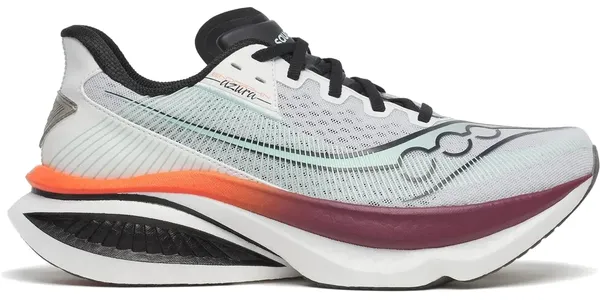
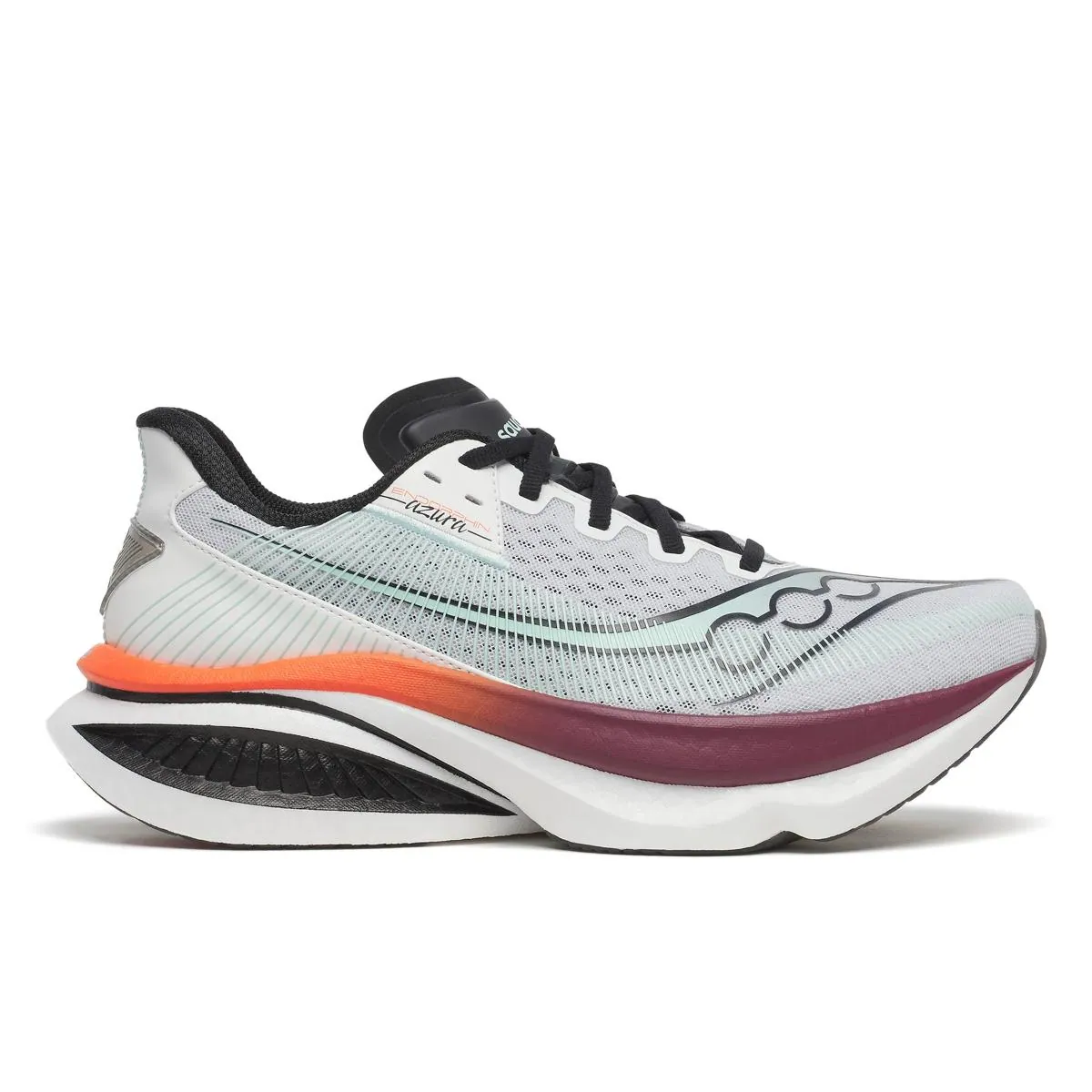
Underfoot there is a single foam, PWRRUN PB, a beaded PEBA-based material, with no plate or stiffening element. Run To The Finish notes the Azura is the only Endorphin shoe to use PWRRUN PB without a plate.
No plate does not mean soft. RunRepeat measured the foam at 40.2 AC at room temperature, matching the slightly firm feel on runs. RTINGS found the forefoot resists bending very well, creating a rigid lever at toe-off. Separately, it found the forefoot cushioning firm enough to give a stable base at toe-off, but not so firm that it is unpleasant.
SpeedRoll is the upturned forefoot rocker. marathons.com describes it as the same very pronounced rocker found in the Endorphin Speed, and RTINGS measured 47 mm of toe spring. The heel is curved too, and RTINGS praises how that heel rocker moves heel strikers smoothly into midstance. RunRepeat considers the shape suitable for all footstrikes, including forefoot landers.
The forefoot platform is very wide: RunRepeat measured the midsole width at the forefoot at 123.4 mm, wider than some stability shoes, which helps the foot feel planted despite the tall stack.
The outsole uses XT-900 rubber only in high-contact zones, the heel and toe-off, with foam exposed between the pads. Doctors of Running sees large rubber coverage, while RunRepeat and RTINGS find a fair amount of exposed foam. RoadTrailRun describes the outsole as mostly a cast polyurethane (CPU) type material with small patches of conventional rubber at the heel and toe-off.
On outsole wear, the two labs disagree, and so do the wearers. RunRepeat measured only 0.5 mm of wear in its rubber abrasion test, while RTINGS rates outsole durability as mediocre. On foot, Doctors of Running saw no rubber wear at 25 miles (about 40 km) and Run To The Finish saw little wear at close to 100 miles (about 160 km), but the two marathons.com testers saw outsole wear by about 100 km and 200 km. Clément, a midfoot striker who supinates when tired, expects about 600 km but likely not much more. Both marathons.com testers said the foam still had its bounce, and The Run Testers expects the thin rubber to wear through long before the midsole loses its bounce. If you run a lot and use only this pair, keep an eye on the outsole.
Upper: breathable with a secure hold
The upper is a dual-layer mesh with good breathability. RunRepeat gave it 4/5 in its smoke test, with the forefoot venting especially well. Clément at marathons.com found ventilation excellent even after runs of over two hours, but the second tester on the same site felt the ventilation comes at the expense of comfort, and Clément himself hopes the next version gets a more comfortable mesh.
The tongue is gusseted, attached to the upper on both sides. It is thin but has padded zones to keep the laces from pressing on the top of the foot. Andrea Myers of Doctors of Running locked the shoe down easily without much lace adjustment. Run To The Finish likes the extra padding in the side gussets, and there are three top eyelets for more lacing options.
The flat laces stretch a lot. RTINGS notes lockdown may feel less secure for runners who like a race-style fit, though it found no issues in testing. RunRepeat says the fit stayed secure every mile.
On the heel counter, sources describe it differently. Doctors of Running calls it stiff (the firm cup around the heel) with minimal padding, RunRepeat rates it 3/5 and found it more flexible than it looks, and RoadTrailRun calls the collars well padded and the heel hold very solid. David Salas and Clément report no heel slippage or movement on their runs.
One small point: Run To The Finish felt slight irritation at the front of the ankle when wearing socks that were too low.
On the run: fun when fast, split opinions at slow paces
It may not impress straight away. Run To The Finish says both its testers found the first few runs firm and not that fast, and the shoe felt better after a little break-in. RoadTrailRun notes the rocker can take a few runs to adjust to if you are not used to one. On comfort, RoadTrailRun found it comfortable right out of the box.
When you want to pick up the pace, David Salas of Doctors of Running says the foam and forefoot rocker respond clearly better and the stride lengthens almost immediately. The second marathons.com tester says the shoe shows its full potential in tempo sessions. If fast intervals are your main goal, though, RunRepeat sees the Endorphin Speed 5 as the better choice. The Run Testers felt it lacks a little liveliness versus rivals at faster paces, and Andrea Myers found it felt terrible for strides at mile race pace, like falling off the front of the shoe instead of pushing off strongly through the forefoot.
Slow and long runs are where runners differ most. Clément ran two long runs over 30 km and found the foam rather firm but still enjoyable, with little muscle soreness the next day. The Run Testers says there is enough cushioning for easy runs of any length, and one RoadTrailRun tester found it light and super responsive like the Endorphin Speed, yet soft enough for easy miles on pavement.
On the other side, Andrea Myers found the ride much too harsh on a 10-mile (about 16 km) easy run and could not wait to take the shoe off. RTINGS notes the heel can feel harsh for lighter runners at easy paces, and the second marathons.com tester felt the fairly rigid sole gives a sharper ground impact, especially at slower speeds.
A marathons.com tester sees it as a shoe for running only, not for walking.
For grip, RTINGS measured a 0.86 coefficient of friction on dry concrete but found it struggles on fine gravel and grips little in mud. On wet roads, RoadTrailRun found the outsole sticky, while marathons.com would like better XT-900 grip on wet surfaces. RTINGS also found a soaked pair takes 33.4 hours to dry fully; if you often run in the rain, have another pair to rotate.
How to read this shoe's numbers
Saucony lists 40 mm of foam under the heel and 32 mm under the forefoot, so the drop (the height difference between heel and forefoot) is 8 mm. RunRepeat measured exactly 8 mm; RTINGS measured 7.3 mm in a men's US 9, a difference of under 1 mm. Andrea Myers also felt the drop matched the stated 8 mm. Drop only tells you how much thicker the heel is than the forefoot; it does not tell you whether the ride is soft or firm, or what kind of running the shoe suits.
Sources label the 40 mm stack differently: RoadTrailRun calls it moderate, RunRepeat calls it very high. The stack here gives protection rather than squish; Andrea Myers calls it remarkably firm for a PWRRUN PB stack of 40 mm at the heel and 32 mm at the forefoot.
Weight only means something alongside size. Saucony lists 212 g in a women's US 8 and 240 g in a men's US 9. RTINGS weighed 242.0 g in a men's US 9, close to the listed figure. RunRepeat found it 18 g heavier than the adidas Adizero EVO SL, mostly due to a more structured upper and thicker outsole rubber.
Other lab results that help the decision: RTINGS rates its running economy as mediocre, making marathon pace slightly less demanding on average, with some tested runners seeing no gain over the control shoe. For energy return, RunRepeat measured 70.6% at the heel and 74.7% at the forefoot, while RTINGS measured 80.9% at the heel and 82.8% at the forefoot. The two sets come from different labs, so do not compare them directly.
40 mm heel / 32 mm forefoot stack, 8 mm drop
The stack here brings protection rather than squish. In a try-on, run slowly to see whether heel landings feel too firm for you, then do a short faster effort to see whether you like the upturned toe.
Read weight together with size
Saucony lists 212 g in a women's US 8 and 240 g in a men's US 9. Compare other shoes in the same size, and when trying it in store, hold it against the pair you run in now.
Narrow, but roomy above the toes
Lace it snugly first, then check side pressure at the midfoot, beside the little toes and on the inner (arch) side of the heel. If the sides feel tight, try thinner socks or look at a roomier model.
What to check in a try-on, and what to look at if it doesn't suit
This shoe feels different at different paces. If the store lets you run, try both slow running and short faster efforts and see whether you like the upturned toe. Check three spots: the side of the little toe at midfoot (Clément had rubbing there on long runs before his feet adapted after a few runs), the inner (arch) side of the heel, and the front of the ankle if you like low socks. Lace it snugly before deciding, as the laces stretch a lot.
If you want more cushioning, RTINGS finds the ASICS SUPERBLAST 3 better cushioned and lighter, though the Azura is better for faster running. If you want softer foam, RoadTrailRun says the Saucony Triumph 23 has softer foam, a plusher upper and a more stable ride, but weighs about 1 oz more in a US 8.5.
If you have wide feet, a wide-footed RoadTrailRun tester found the Saucony Ride 18 much more accommodating.
If fast intervals are your focus, RunRepeat and RTINGS point to the plated Endorphin Speed 5, which RTINGS says is lighter.
If you want more bounce, RTINGS says the ASICS MEGABLAST is lighter, more cushioned and bouncier, while the Azura is more stable and significantly snappier at toe-off.
Size and fit: snug and narrow, with room above the toes
The upper has a snug, performance fit. RoadTrailRun says it is relatively narrow with non-stretch mesh, so broad feet may struggle. A wide-footed tester on the same site found the mesh fairly snug, prefers thinner socks with it, and notes the toe box tapers, suiting narrower feet. Run To The Finish finds it a little less narrow than other Endorphins but says it may not suit people who need midfoot room, while Clément found it neither too narrow nor too wide. David Salas of Doctors of Running found the heel and midfoot width normal and the forefoot slightly wide, and The Run Testers found a good amount of toe-box room without sizing up or down.
There is room above the toes. RunRepeat measured toe box height at 28.3 mm, enough to avoid feeling cramped on long runs while still holding the foot when the pace picks up. RTINGS also found a roomy toe box height and arch, and measured an internal forefoot width of 93 mm and internal length of 278 mm in a men's US 9.
Heel hold is good: David Salas and Clément report no heel slippage or movement, and RoadTrailRun calls the heel hold very solid. The second marathons.com tester found the foot well locked in, though forefoot hold could be slightly better. Andrea Myers felt the inner (arch) side of the rearfoot narrowed by a significant raised wall built into the sockliner on that side, and did not find it comfortable.
RunRepeat found the 4.4 mm insole is not glued in and removes easily, so runners with custom orthotics can try the Azura.
On sizing, RunRepeat, RTINGS and Run To The Finish say it fits true to size, and four testers at The Run Testers had no fit problems in their normal sizes. Andrea Myers went up half a size for length, as with every Endorphin. RoadTrailRun suggests wider feet might try a half size up. There is no wide version. If your usual size feels tight at the midfoot, try thinner socks, try half a size up, or look at a roomier model.
60807M-S21070-172 · 2026-11-24 · Recorded sizes, not current stock