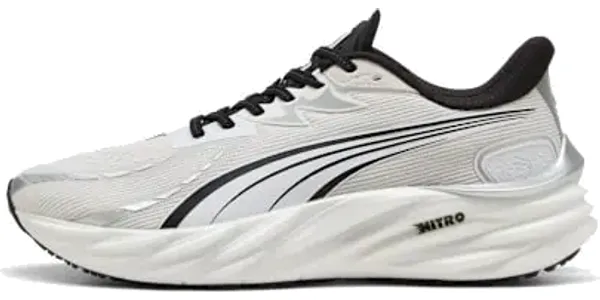
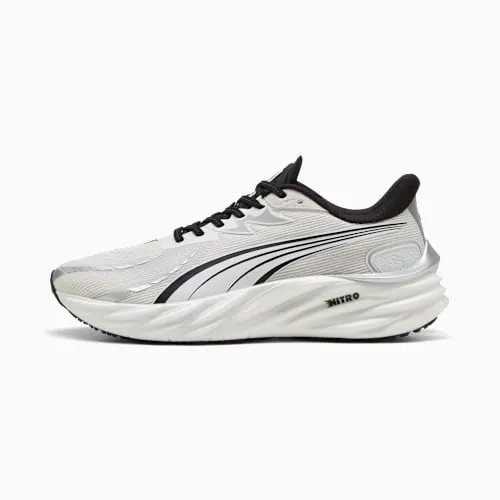
The details that matter
One slab of NITROFOAM on a sole that bends easily
Under your foot is a single slab of NITROFOAM running the full length of the midsole (the foam layer between your foot and the rubber). Version 3 used two foams; RunRepeat thinks the change was smart, since the old design felt too firm and low on bounce. PUMA describes it as a nitrogen-infused foam designed for maximum energy return. RunRepeat measured energy return of 67.5% in the heel and 74.2% in the forefoot.
RunRepeat measured the foam's hardness at 41.8 AC, firmer than the lab average of 35.4 AC (higher means firmer). RunRepeat says this gives a controlled feel that matches the stack height, rather than a super-soft one, and that the foam gets firmer in the cold. Testers describe it differently. One Believe in the Run reviewer calls the foam soft but with a bit of the previous version's firmness, much less pronounced, while Robbe from the same site says the ride is not bouncy, not soft, just great. The Run Testers call it fairly soft. Andrea of Doctors of Running felt moderate cushioning at initial contact and a firmer feel at push-off. Matt, from the same site, says the foam compressed a little over 30 miles (about 48 km), making the forefoot a little snappier.
The sole barely curves. RunRepeat calls it non-rockered (a rocker is a sole that curves up to help your foot roll forward). Matt describes a low forefoot rocker; Andrea says the rocker sits later in the forefoot and is muted by how easily the forefoot bends. In RunRepeat's test, the sole bent 30 degrees with only 8.9 N, against a 15.5 N average. Andrea says the shoe just protects your feet and lets you do the work, and Matt says runners with good toe mobility will do best in it. If you're used to curved soles that carry you forward, this one asks your feet to do more.
The outsole is PUMAGRIP, which PUMA describes as a durable rubber compound for traction on many surfaces. RunRepeat measured the rubber at 3.9 mm thick, against a 3.1 mm average, and recorded 1.1 mm of wear, which it calls a decent mark. Andrea saw no visible outsole wear after 25 miles (about 40 km), and Robbe of Believe in the Run saw none after 50 miles (about 80 km). Robbe notes PUMA says the shoe should last 500 miles (about 800 km) and sees no reason to doubt it.
The rubber goes beyond roads too. Believe in the Run took it on a semi-technical, muddy trail run, climbing over dicey, chunky rocks and running down a muddy slope, and it performed surprisingly well. Tom's Guide and The Run Testers say it is good on light trails. The downside of thick rubber is weight: Karl of Believe in the Run feels there might be a bit too much rubber, with the weight sitting at the bottom, so the shoe feels heavier than it really is.
An engineered knit upper with PWRTAPE and middling airflow
The upper (the fabric that wraps your foot) is an engineered knit that PUMA says is designed for breathability and stretch, with PWRTAPE added for durability and lockdown. Tom's Guide says the PWRTAPE adds support and structure. PUMA Thailand's Baltic Sea Blue-Emerald Ice page lists the upper as 59.73% textile, 37.40% synthetic and 2.87% cow leather, with a 100% textile lining and insole. PUMA says the upper uses at least 30% recycled material.
PUMA says the new mesh improves breathability, but in RunRepeat's smoke test it scored 3 out of 5. Under the microscope, RunRepeat found the lower mesh layer blocks the ventilation holes, and says the shoe struggles on very warm days. Testers who ran in the heat felt better about it: Robbe wore it in sweltering July conditions and it felt good overall, and Nick Harris-Fry of Tom's Guide found it breathable enough in a heatwave. In short, breathability is middling: fine for hot-weather runs, but not the most breathable shoe.
The tongue is thin. RunRepeat says it is attached by small pieces on both sides, and Andrea found it stays in place, with padding placed to stop the laces pressing on the top of the foot. At the back there is a heel counter (the firm cup around the heel) and a lot of internal padding. Andrea calls the counter small and semi-rigid, and says the padding makes the heel narrower still. Doctors of Running noticed the moderately stiff counter despite the padding: runners with sensitive heels may not do well in it long term, while those who like a plush, secure heel will like it. Believe in the Run finds the heel collar well cushioned but not overly padded. For running in the dark, RunRepeat notes hi-vis laces and a reflective piece on the heel.
Easy days and faster sessions, with a heel some find clunky
This shoe works for easy days and days you want to run faster. Nick Harris-Fry of Tom's Guide enjoyed cruising through relaxed runs in it and says it has a light, poppy ride when you ramp up the pace; Nick's two progression runs from 7:00 down to around 5:45 per mile (about 4:21 to 3:34 per km) felt great throughout. The Run Testers say it handles tempo and interval runs as well as easy outings. Believe in the Run says the foam shifts smoothly from daily-trainer mode to tempo and back. RunRepeat says it works well for walking and everyday wear, and for easy jogs at slow paces.
Doctors of Running's criticism is the heel. Matt (men's US 10) found the heel bevel (the rounded-off heel edge) faces slightly inward, with extra flare on the outer side, making the heel transition clunky. With flare only on the outside, the shoe pushes the foot inward, which Matt struggled with as someone who needs medial stability. Matt says it does well at easy paces, fartleks and uphill efforts, but at tempo pace the heel gets in the way, and it isn't stable enough for Matt to use on long runs. Andrea (women's US 9.5) also found the heel slightly clunky, kept to easy paces, and felt the shoe was well tuned for them. As a midfoot striker, Andrea noticed the 10 mm drop and wished PUMA had made the heel bevel a little larger.
Views on long runs differ. RunRepeat says it isn't ideal for long runs but delivers a reliable ride for short or medium weekday sessions. A Doctors of Running tester ran 4–6 miles (about 6–10 km) per run and wouldn't hesitate to go longer, probably up to an hour, but says the clunky heel would keep the tester from using it for longer or faster runs. The Run Testers, though, found it always comfortable on longer runs, with foam that didn't bottom out on extended hard runs. Nick Harris-Fry will keep using it as a daily trainer for easy and long runs and thinks it works best in rotation with a faster shoe, but also says it is a good enough all-rounder to be your only running shoe, and a great option for beginners.
The forefoot is thin. RunRepeat measured 24.0 mm under the forefoot, says you clearly feel the ground, and doesn't see it as the best option for runners who want lots of foam or forefoot strikers needing strong shock absorption. The Run Testers also found it less comfortable under the forefoot than the Novablast 5.
Reading the numbers: drop, sole thickness and weight by size
Drop is the difference between the sole thickness under the heel and under the forefoot. PUMA lists 10 mm and RunRepeat measured 9.7 mm, so they agree closely. A 10 mm drop doesn't mean the shoe is only for heel strikers, but testers notice it: Matt calls it quite apparent, and Andrea, a midfoot striker, noticed it too.
For sole thickness, PUMA lists 36 mm under the heel and 26 mm under the forefoot, the same figures Believe in the Run, Tom's Guide and The Run Testers use. RunRepeat measured less: 33.7 mm under the heel and 24.0 mm under the forefoot. Either way, it is thinner than many modern daily trainers, which The Run Testers say often have over 40 mm of foam at the heel. Andrea says the 26 mm forefoot feels more protective than that number suggests.
Weight always needs a size next to it. PUMA Thailand lists 250 g at UK 8, The Run Testers list 247 g at men's UK 9 / US 10, and Karl of Believe in the Run lists 8.8 oz (241 g) for Karl's US 10.5. Compare other shoes at the same size. Several sources find it clearly lighter than version 3: the men's US 10 Tom's Guide tested weighs 8.7 oz (about 247 g) per shoe, against 10 oz for version 3 in the same size.
Drop and sole thickness measure different things
Drop is the difference between the sole thickness under the heel and under the forefoot; sole thickness tells you how much shoe sits under each part of your foot. Drop doesn't tell you whether the foam is soft or firm. If you land on your midfoot or forefoot, check on a test jog whether the heel gets in the way.
Narrow at the midfoot, roomier at the toes
Interior width, toe-box width and the upper's height above your toes are three different measurements. RunRepeat measured all three below its lab averages. Most testers felt the narrowness at the midfoot more than at the forefoot. When you try it on, check for pressure on the sides of the midfoot and for the upper pressing on top of your toes.
Compare weight at the same size
Sources give weight at different sizes. When comparing with other shoes, use figures at the same size, or pick them up side by side when you try them on in a shop.
Before you buy: check the midfoot and the room in front of your toes
Try on your usual size with the socks you run in, lace it snugly as you normally would, and pay attention to the sides of the midfoot. Karl of Believe in the Run felt pinched there, found the shoe a pain to put on, and doesn't think sizing up would fix it. If you feel pressure on the sides of the midfoot when you walk or jog in the shop, try the Wide version instead.
Then check your toes. Matt of Doctors of Running found the tapered toe box pressed lightly on the toes at first. Doctors of Running says the thick heel padding pushes the foot forward, so the shoe feels short at first. Andrea had nearly a full thumb's width between the big toe and the front of the shoe. When you try it on, check for about that much room in front of your longest toe. If you need more, RunRepeat found the insole comes out easily, and a thinner one may free a few millimetres in the toe box.
If you buy from PUMA Thailand's website, the product page says you can return items within 30 days of receiving them, subject to its conditions. Read the conditions first, and try the shoes indoors before running outside.
True to size in length, narrow at the midfoot, roomier up front
Length is mostly true to size. RunRepeat's reader poll of 126 votes says true to size. Nick Harris-Fry wore the usual running size, the same as for every earlier generation. Karl says the length is true to size, and Matt found the usual men's US 10 mostly true to size. Andrea (women's US 9.5) also found it true to size. Ryan, a Believe in the Run reader with a long, narrow foot, ordered the usual size and the toes bump the end of the toe box.
Check width zone by zone. The midfoot is the narrowest part, and Believe in the Run, The Run Testers and Doctors of Running agree on that; the forefoot has more room. All three The Run Testers runners found a good amount of room in their normal size, though it is still quite narrow through the midfoot. Karl found the toe box and heel broad enough for the toes to splay, but the midfoot very narrow. Matt found the forefoot normal to slightly wide. Andrea says the toe box is wider than earlier versions, while the midfoot and heel are narrow but snug and secure.
RunRepeat's measurements lean narrow: interior width 93.0 mm against a 95.2 mm average; toe-box width 71.6 mm, a little more than version 3, against a 73.2 mm average; and upper height above the toes 25.9 mm against 27.0 mm. RunRepeat says the fit leans narrow. Tom's Guide says it is a little wider than version 3 but still quite narrow, and runners who want a wider toe box might find it a little tight.
Narrow-footed runners love it. Robbe, who has a narrow foot, says it wraps the midfoot with suction-like tenacity before opening up a bit for the toes, and calls a fit this good very rare. Robbe warns that wide-footed runners will probably have issues. There is a Wide version too: if the standard width pinches at the midfoot, find the Wide version and try it on.
311140-02 · 2026-11-24 · Recorded sizes, not current stock