The details that matter
What's underfoot and how it feels
There are three layers underfoot. On top is an OrthoLite insole, 4.4 mm thick by RunRepeat's measurement and easy to remove. Below it, RunRepeat describes a thin layer of IMEVA foam. It compresses a little, enough for basic comfort, but it isn't springy: RunRepeat measured rather limited heel shock absorption and below-average energy return.
At the bottom is a tire-tread rubber outsole: a flat pattern for maximum ground contact, with many small sipes. The rubber is only 2.7 mm thick, but RunRepeat found above-average grip and sure footing on tiles or wet concrete. RunRepeat ground the outsole with a Dremel and it wore only 0.8 mm, better than an average sneaker.
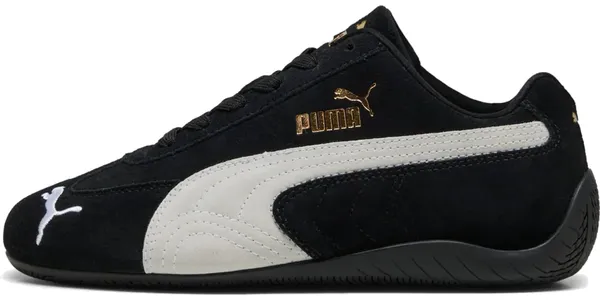
The whole sole bends very easily, taking 60% less force than an average casual sneaker and less than the adidas Samba, and it twisted more easily than any other sneaker RunRepeat has tested. RunRepeat says this flexibility makes the shoe feel agile and gives very smooth heel-to-toe transitions. Separately, the sole is completely flat with no rocker, which gives a planted, ground-connected feel from heel to toes. The Sole Supplier explains that the minimal cushioning is by design: the shoe was intended for race drivers who needed maximum pedal feel.
The women's wedge version (408117) differs: PUMA's product page lists a hidden wedge heel for extra height, a hook-and-loop strap, and IMEVA, which PUMA describes as a lightweight material for comfort.
Upper: soft suede, little airflow
Most Speedcat colourways use suede, which RunRepeat confirmed as genuine with a torch test; Decaf Journal describes it as soft and supple. The side Formstrip and overlays are leather, and the toe cap carries an embroidered cat. Materials vary by version and colour: some are almost entirely cow leather, some have a mesh upper with suede overlays, and the ballet version uses metallic leather with an elastic strap over the instep. Check the materials on the product page for your chosen colour.
For airflow, RunRepeat pumped smoke into the shoe and none passed through the toe box, so it scored breathability 1 out of 5 and does not recommend it for summer.
The tongue is not gusseted and is fairly long. RunRepeat found it prone to sliding sideways, especially for overpronators. Tongue padding is 4.4 mm: not plush, but a decent buffer on top of the foot. Decaf Journal praises the ankle padding as excellent, but the collar is fairly loose, so it adds little ankle stability. In RunRepeat's manual test, the heel counter (the stiff shell around the heel) scored a middle-range 3 out of 5 for stiffness, giving basic heel support.
There are no pull tabs, but RunRepeat found it easy to slip on and off thanks to the low-cut collar. For durability, RunRepeat rated both the toe box and the heel padding 4 out of 5.
How it feels in everyday wear
How comfortable it feels depends on what you use it for. Decaf Journal found it remarkably lightweight, almost slipper-like, agile out of the box, and ideal for casual walking or a relaxed-dress-code office. The reviewer also says it wouldn't be a first choice for all-day outings, and it isn't their everyday go-to because of its modest arch and ankle support.
The Sole Supplier wore it for about a month and says comfort is medium, similar to a Converse or adidas Gazelle. It says fans of terrace-style shoes (classic low-sole sneakers) will feel right at home, while people used to Y2K mesh runners or bulkier Y2K trainers may need time to get used to the slimmer profile.
RunRepeat and SneakerLens are more direct: impact protection is not enough if you walk or stand for long hours. SneakerLens calls it completely unsuitable for high-impact activities and says arch support is virtually zero. PUMA says the OrthoLite insole provides all-day comfort, but RunRepeat, Decaf Journal and SneakerLens see it as better suited to days with less walking.
For stability, the firm, low platform feels remarkably planted, but the relatively unstructured upper offers limited lateral support. RunRepeat found the foot shifts during side-to-side movements.
Whether it needs breaking in, sources say different things. Decaf Journal found no break-in needed at all, The Sole Supplier says little to none, and SneakerLens calls it moderate, with the upper softening slightly while the arch stays rigidly flat.
Reading the Speedcat's numbers
RunRepeat measured a 23.0 mm heel stack and a 15.4 mm forefoot stack, both below average. The drop (the difference between heel and forefoot sole thickness) is 7.7 mm, also below average. These numbers tell you the foot sits close to the ground with clear ground feel, not how soft it is. For softness, RunRepeat found the foam compresses only a little and heel shock absorption is rather limited.
RunRepeat weighed 340 g per shoe (men's US 9), on par with the adidas Samba and Handball Spezial. It calls the shoe light for a sneaker and says it could have been lighter still without the all-suede upper.
RunRepeat made a gel cast of the shoe's interior and measured it: 87.8 mm at the widest part of the forefoot, 66.4 mm toe-box width at the big toe, and 25.2 mm toe-box height, tapering sharply toward the front. The sole itself measured 87.6 mm wide at the forefoot and 73.0 mm at the heel.
Check toe-box room
RunRepeat measured a 66.4 mm toe-box width at the big toe and 25.2 mm toe-box height, tapering sharply to the front. When trying it on, wiggle your toes to check for room and feel for pressure from above or the sides. If it's tight, compare with a pair half a size up.
Low stack, close to the ground
Heel stack 23.0 mm, forefoot 15.4 mm and drop 7.7 mm are all below RunRepeat's averages. They indicate strong ground feel, not softness. Walk on a hard floor in the store for a while to see how your feet handle it.
Weight depends on size
RunRepeat weighed one shoe at 340 g in men's US 9, on par with the adidas Samba and Handball Spezial. Other sizes will weigh more or less, so compare models at the same size.
Try it on carefully before buying, and alternatives if it doesn't fit
When trying it on, lace it snugly first, then check whether your toes can move, whether your toes touch the front, whether you feel pressure along the side seams, and whether the top of your foot is pressed. RunRepeat warns the toe box can feel claustrophobic and press on the toes. If you use your own insoles, bring them: RunRepeat found the insole easy to remove but swapping in another tricky given the tight fit, and SneakerLens says the already shallow interior leaves little room for an extra insert. Walk on a hard floor for a while to see whether your feet are fine with the thin sole.
If the forefoot is too tight, RunRepeat suggests the adidas Gazelle, which keeps a sleek suede shape with a little more forefoot space. SneakerLens notes the Onitsuka Tiger Mexico 66 has a wider toe box. If you'll be walking or standing all day, look for a shoe with a thicker sole and more impact absorption.
Size and fit
Sizing reports disagree, and foot shape is the main factor.
• RunRepeat: true to size, but one of the snuggest sneakers it has measured; suits narrow-to-medium feet, and wide feet are very likely to find the toes cramped.
• The Sole Supplier: true to size; if you have slimmer feet and are fine with a snug fit, your standard size works; go up half a size if you have wider feet.
• Decaf Journal: the reviewer wore their usual size 10 and felt slightly cramped toward the toes, so recommends most people go half a size up; width felt somewhat narrow but not uncomfortable by any means.
• SneakerLens: runs short and narrow; about 60% of buyers size up at least half a size; go half to a full size up if between sizes or wide-footed; only very narrow or slim feet should buy their normal size.
• Perfitt: summarising Reddit and review pages, many buyers say it runs small; some are happy at true size, others go half or a full size up; it sees length rather than narrowness as the main issue, and wide feet or high insteps tend to feel tight in the toe box.
The Sole Supplier says most colourways are suede, which stretches and moulds to the foot with wear, and leather editions also form to the foot given enough wear. SneakerLens disagrees on leather: it says suede relaxes and moulds to a wider foot within minutes, while leather stays rigid and can cause painful pressure points, so wide-footed buyers may want to try a suede version first. PUMA sells standard width only, and the PUMA Youth kids' version is designed for ages 8–16.
UK 3
401698_01 · 2026-11-24 · Recorded sizes, not current stock