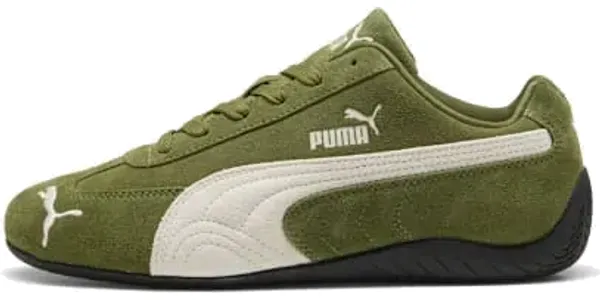
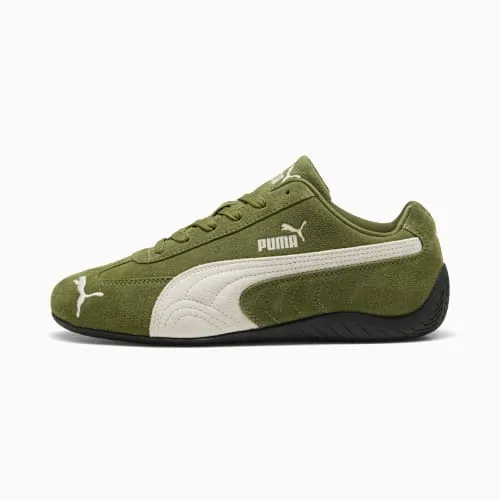
The details that matter
A thin sole with a clear feel of the ground
Decaf Journal counts Speedcat OG among thin-soled shoes. The reviewer found the feel of the ground excellent but the forefoot cushioning minimal. If you like a thick, soft sole that keeps you from feeling the road, try walking in it against the pair you wear now before buying.
For the outsole, PUMA lists 100% rubber. For the midsole, PUMA's own information disagrees: the materials list says 100% synthetic, while the product description says rubber.
An upper that is almost all cowhide leather
PUMA's record for model 398846 lists the upper as 97% cowhide leather and 3% textile, so it is almost entirely leather. It has a suede PUMA Formstrip and an embroidered PUMA CAT at the toe. Inside, PUMA lists a 100% textile lining and a 100% textile insole.
The suede stripe is part of the appeal, but if your usual route is dusty or wet, ask the shop how to care for the materials on the colour you choose.
An easy workday and a full walking day are very different
Picture the day you will actually wear them. Walking into the office, sitting at work and going out for a meal is very different from hours of continuous sightseeing. The Cosmopolitan reviewer wore them on the first kind of day, from the office to dinner, sitting and walking at intervals, and never felt the urge to take them off.
On r/PUMA, one OG owner found them super comfortable for casual wear but painful on long walks. See how each person wore them and whether that is close to how you will, rather than going by the word “comfortable” alone.
A low profile does not tell you the drop
The silhouette only tells you whether a shoe looks thin or thick. REI explains drop as a shoe being taller in the heel than in the toes. Knowing this pair's drop needs both sole thicknesses measured, so a photo is not enough to call it a zero-drop shoe.
PUMA lists the material of each part but does not list weight, heel or forefoot sole thickness, or drop. In the shop, lift them to compare weight with the pair you wear now, then walk in them and notice how heel and forefoot height feel.
Check there is enough room at the toe end
One reviewer felt slightly cramped at the toe end in their usual size. When trying them on, move your toes, check whether your toes touch the front of the shoe or the sides feel squeezed, and if you go up a size, make sure the heel still holds.
Drop must be measured, not judged by shape
Drop is the difference between sole thickness under the heel and under the forefoot. It needs both points measured and cannot be read from photos. When trying them on, walk and notice how heel and forefoot height feel.
A unisex shoe still needs a size-chart check
Unisex describes who the shoe is for, not how wide it is. Before ordering, check which sizing system (US/UK/EU) the shop shows and compare it with your foot length.
Before buying, walk in them and check the room at the toe end
Wear the socks you will actually use, put on both shoes and walk around. Check whether your toes touch the front of the shoe or the sides of your feet feel squeezed. If you go up a size for toe comfort, also check whether the heel is loose or the shoe is too long, and walk on a hard floor to see whether a sole this thin suits you.
If it does not suit you, look at casual shoes with more room for the toes at the toe end and a thicker, softer sole.
Start with your usual size, then try the next size too
The Decaf Journal reviewer chose the size 10 they usually wear but felt slightly cramped towards the toe end. Their size 10 may be on a different system from the shop's, so check the shop's size chart against your foot length before ordering. Treat this account as a reason to try sizes side by side, not a rule that everyone must size up.
398846-66 · 2026-11-24 · Recorded sizes, not current stock