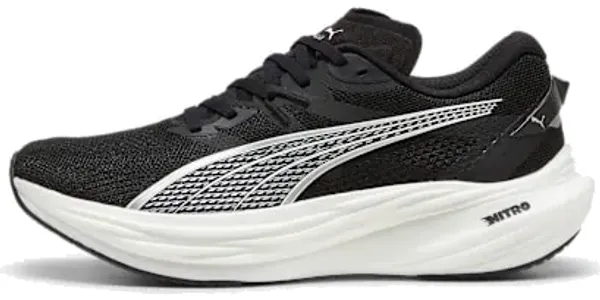
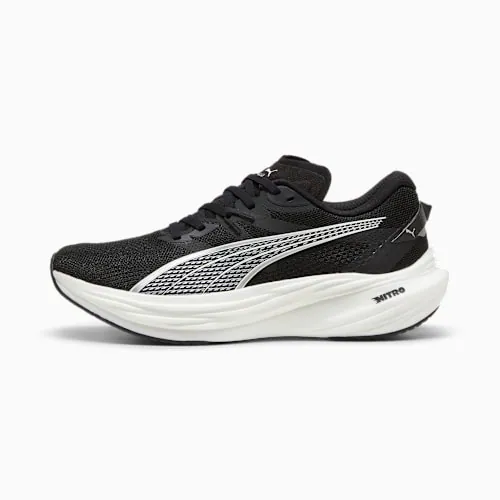
The details that matter
Two foam layers and a carbon plate: how they feel on the run
Under the foot are two layers of foam with a carbon plate between them. What you notice most is how stiff the shoe is.
PUMA says the midsole uses NITROFOAM, a nitrogen-infused foam designed for responsiveness and cushioning while staying light, and a carbon fibre plate engineered to stabilise the midsole and maximise energy transfer. The plate in the sole is called PWRPLATE; PWRTAPE is reinforcing tape on the upper.
Tom's Guide describes a top layer of PEBA-based Nitro Elite foam, a bottom layer of TPEE-based Nitro foam, and a forked, carbon-infused plate between them. Run to the Finish also describes a softer Elite layer on top, but says the plate spans the full forefoot. At the bottom is the rubber outsole, which RunRepeat measured at 3.2 mm thick.
In RunRepeat's 30-degree bend test the shoe took 20.6 N, more than the 15.5 N average, though RunRepeat still finds it a definitely gentler ride than version 2. Doctors of Running's checklist rates the shoe extremely stiff and answers no to whether it is good for walking or standing. If you also want a shoe for walking or standing for long periods, this one doesn't meet that need.
A snug upper and a well-padded heel collar, with middling breathability
The upper is snug and locks the foot in well, the heel collar is nicely padded, and breathability is middling.
PUMA uses an engineered mesh with at least 20% recycled material. The upper is roughly 66–73% textile with the rest synthetic, depending on the product page; if the material matters to you, check the label on the pair you choose. The lining and insole are fully textile. Tom's Guide says strips of PWRTAPE add structure in certain areas, such as the inside of the midfoot.
The tongue is partly attached to the sides, which RunRepeat says stops sideways movement at faster paces. Run to the Finish and OutdoorGearLab also found the lockdown good.
At the heel, Running Shoes Guru loves the well-judged collar padding and had no ankle rubbing at all. The heel counter (the stiff structure that wraps the heel) is soft and flexible; RunRepeat says this reduces rear support. Doctors of Running expects runners with sensitive heels to do fine, but the Tom's Guide reviewer had Achilles irritation from the heel on every run. The reviewer fears a plastic strip around the back of the heel contributed, pulled the external plastic heel counter off one shoe without much difference, and isn't sure whether the padding shape or the internal heel counter is the cause. The reviewer notes being prone to Achilles irritation, so it may not affect everyone.
The liner is extremely comfortable against bare skin except for the PUMA logo on the inner forefoot. Doctors of Running got hotspots from it fairly quickly without socks but had no issues with socks, so it highly suggests wearing socks with this shoe.
On heat, RunRepeat's smoke test gave it 3 out of 5: airflow suffers somewhat and may fall short in excessively hot conditions. Run to the Finish found the mesh not especially light or quick to dry, but the shoe didn't feel hot on the run.
Smoother than version 2 and versatile across paces, with less punch at fast paces
This shoe rides more smoothly than version 2 and works at both easy and tempo paces, but it isn't at its best when you want to run flat out.
Doctors of Running finds the midsole softer, especially at the heel. The forefoot rocker (the upturned curve of the sole under the forefoot) starts early, so the transition from heel to toe is smooth; the extremely stiff toe-off of version 2 is gone, but the shoe feels less snappy. OutdoorGearLab found the foam soft and bouncy at the heel but the forefoot firm and very stiff when landing farther forward, and warns that the early rocker may feel unnatural for some midfoot or forefoot strikers. It sees the shoe as best for long runs with uptempo sections and for easy mileage.
Views on comfort differ. The Tom's Guide reviewer found the ride firmer and a little slappier, with the forefoot hitting the ground harder and more loudly, perhaps because of the higher drop. It was uncomfortably stiff for the first couple of runs before easing. The verdict: versatile, but not outstanding for any one kind of run. Amanda Brooks of Run to the Finish wasn't impressed on the first run, but a few runs later it felt pretty good. Justin Alpaugh of Running Shoes Guru has used it for every kind of run and sees a do-it-all trainer that could even be a budget racer. But if your feet aren't narrow, Run to the Finish doesn't recommend it for longer runs.
The outsole earns plenty of praise. RunRepeat measured 0.65 in its wet grip test against a 0.53 average, and OutdoorGearLab had no issues on wet pavement, snow or even ice. The catch is the cutout in the middle of the sole: RunRepeat, Doctors of Running, OutdoorGearLab and Run to the Finish all had stones caught there, so Doctors of Running would use the shoe only on smooth surfaces.
The outsole wears faster than average in the lab but should still last. RunRepeat measured a 1.5 mm indentation against a 1.1 mm average, but says the 3.2 mm of rubber should give at least decent mileage. Doctors of Running saw only mild wear after 30 miles (about 48 km), and Run to the Finish sees no outsole wear at all. Run to the Finish puts the cushioning's top-end lifespan at around 300 miles (about 480 km), though it also knows runners taking the shoe well into the 400-mile mark.
On stability, PUMA recommends it for neutral runners. RunRepeat measured the sole 82.7 mm wide at the heel, against a 91.1 mm average, and says it is absolutely not for anyone with stability issues. Doctors of Running finds the narrow midfoot makes it slightly unstable for runners who need some guidance, and OutdoorGearLab found it a little unsteady around turns and wouldn't recommend it to runners who tend to roll their ankles.
The 10 mm drop matches lab results; stack and weight figures vary
Drop is the difference between how thick the sole is under the heel and under the forefoot. PUMA lists 10 mm, and RunRepeat measured 10.1 mm, above the 8.4 mm average of the 486 shoes it has measured. RunRepeat sees this drop as better suited to rearfoot strikers while still workable for all runners. Tom's Guide notes version 2 had an 8 mm drop, so if you've worn the previous version, the heel is now 2 mm thicker relative to the forefoot.
PUMA lists the sole at 39 mm under the heel and 29 mm under the forefoot. Measurements from other sources don't match: RunRepeat measured 37.4 mm under the heel and 27.3 mm under the forefoot, OutdoorGearLab measured 41 mm and 29 mm of foam, and Running Shoes Guru's facts box gives 44 mm and 34 mm. RunRepeat and Tom's Guide both say the sole is thicker than before; RunRepeat measured the heel about 5.7 mm thicker than version 2.
Weight is around 250–270 g in UK8, going by PUMA's figures, and Doctors of Running lists 265 g for men's US 9. When comparing with other shoes, compare at the same size.
What the 10 mm drop tells you
Drop is the difference between sole thickness under the heel and under the forefoot. This shoe has a 10 mm drop; RunRepeat measured 10.1 mm, above the 8.4 mm average, and sees it as better suited to rearfoot strikers while workable for all runners. Version 2 had an 8 mm drop. Drop doesn't tell you how thick or soft the sole is. If you're used to low-drop shoes, start with short runs to see how different it feels.
A narrow toe box and a low toe box are different problems
RunRepeat measured the toe box at 69.7 mm wide (average 73.2 mm) and 24.6 mm high (average 27.0 mm), below average on both counts. When trying it on, check both side pressure at the little toe and pressure on top of the toes. If the problem is on top, a longer size may not help: RunRepeat says sizing up won't give you more room inside.
How to compare the weight
When comparing weight with other shoes, compare at the same size. In the shop, lift it against the pair you run in now.
What to check when you try it on, and what to look for if the shape doesn't suit you
Try it on with the running socks you actually use, and try both your usual size and half a size up: some reviewers were fine in their usual size, but OutdoorGearLab recommends going up half a size and RunRepeat's size poll (209 votes) says it fits slightly small.
While trying it on, check two things separately: squeezing along the little-toe side and pressure on top of your toes. If your toes are pressed from above, a bigger size may not help, since RunRepeat says sizing up won't give you more room inside. Walk and jog for a while and check whether the heel rubs your Achilles tendon, especially if yours irritates easily. If you order online, check the size chart and the exchange terms before you order.
If the toe box feels too tight or too low, look for a trainer with a wider, taller toe box. If you need stability, choose one with a wider base and a firmer heel counter. If you often run on gravel or dirt, pick a shoe without a cutout in the middle of the sole.
Length depends on the runner, but nearly every source finds the forefoot narrow and the toe box low
On length, reviewers split into two camps. On width and height inside, they agree more.
Fine in their usual size: Doctors of Running was true to size in a usual men's US 10, the Tom's Guide reviewer found a normal size (US 10) right for length and toe room, Running Shoes Guru rates it true to size, and Amanda Brooks of Run to the Finish felt generally fine in a usual size 11.
Size up: OutdoorGearLab found it about half a size short, RunRepeat's size poll (209 votes) says it fits slightly small, Run to the Finish athlete Tina Mosley wished she had gone up at least half a size, and one reader under the Running Shoes Guru review found the forefoot a bit tight and went up half a size.
Inside, it is narrower than most shoes. From a gel replica of the interior, RunRepeat measured 91.5 mm at the widest point (average 95.2 mm), a toe-box width of 69.7 mm (average 73.2 mm) and a toe-box height of 24.6 mm (average 27.0 mm). Doctors of Running describes a snug fit along most of the shoe and a knit upper with mild stretch that sits low over the toes (less noticeable on the run), with a narrower, mildly compressive, sock-like forefoot. Running Shoes Guru felt pressure on top of the toes and the front of the foot, causing minor hotspots on the bottom of the feet, especially at faster paces. OutdoorGearLab had rubbing on the small toes, and Run to the Finish says it runs narrow from heel to toe with a really shallow toe box. PUMA lists it as a regular fit.
Amanda Brooks has found that male runners tend to find the width fairly normal, while female runners say it feels narrower and possibly short.
309707-01 · 2026-11-24 · Recorded sizes, not current stock