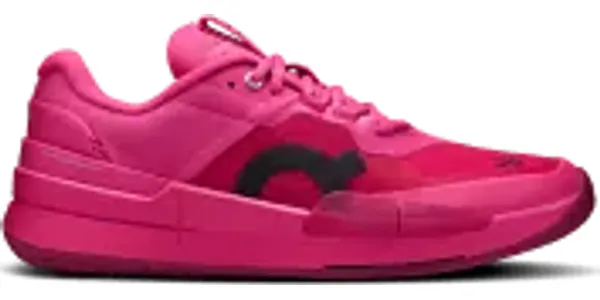
The details that matter
Underfoot: firm foam, a carbon plate and thick rubber
Midsole foam: On describes it as a shock-absorbing foam that keeps you connected to the court. RunRepeat measured the foam at 51.6 AC, 6% firmer than average. In its shock-absorption test the forefoot scored a standard 64 SA, while the heel scored 84 SA against a tennis-shoe average of 99 SA, so RunRepeat concludes the heel is clearly less protective.
Carbon Speedboard plate: it sits at the bottom of the midsole and shows through at the inner midfoot, where On cut the rubber away. RunRepeat says this plate is the main reason the shoe is so stiff: it needed 24.3 N to bend the shoe 30 degrees, twice the average tennis shoe. The side TPU clips make it even harder to twist. The result is a planted foot in lateral moves, and a stiff heel-to-toe transition as well.
On says the carbon adds energy return, but RunRepeat measured very low energy return (40.7% heel, 42.3% forefoot): little bounce, more of a grounded feel. A Tennis Warehouse tester of the women's version, by contrast, felt the carbon made the shoe springy and clearly improved its performance.
Outsole: an open herringbone pattern in a more durable rubber. RunRepeat measured 5.6 mm of rubber under the forefoot and 4.3 mm under the heel, one of the stoutest it has seen. That helps durability: its abrasion test left a 0.8 mm dent, an average result. But the hard rubber takes up about 5.5 mm of the forefoot stack, so the forefoot is not very cushioned. RunRepeat measured the forefoot base at 115.1 mm wide, wider than average.
The insole is 4.5 mm thick at the heel and removable, so a custom orthotic can go in its place.
Upper: thin, breathable and locked down in several places
The upper is a very thin mesh; RunRepeat says it is nearly see-through. The tongue is perforated all over. RunRepeat gave breathability 5/5 in its smoke test. One Tennis Warehouse men's tester said his feet never ran hot, and a tester of the women's version and WearTesters also praised the ventilation. Another men's tester found it adequate but nothing special.
On calls the mesh abrasion-resistant, but RunRepeat disputes that, calling it paper-thin. In its abrasion test with a small rotary tool (Dremel), the toe-box mesh had a hole after the 12-second test and scored 1/5; the rubber toe reinforcement was worn through and also scored 1/5. Heel padding scored 3/5. In real play, a Tennis Warehouse tester of the women's version saw no wear on the upper or toe bumper after about 10-plus hours.
Lockdown features: inside is a half-bootie construction, and the semi-gusseted tongue meant RunRepeat had no tongue sliding or foot twisting. WearTesters says cables on both sides, rising from the footbed into the lacing, give solid midfoot lockdown. Extra eyelets let you lace for a tighter heel. The heel has an internal heel cup, an external heel clip and a molded heel counter (the stiff structure wrapping the heel); RunRepeat rated the counter's stiffness 4/5.
On the outer forefoot is a TPU (hard plastic) clip that braces the foot in lateral moves. The same spot is where several testers felt pressure on the little toe. Most padding is around the ankle collar; the rest is thin and feels like a second skin. RunRepeat measured a standard 6.7 mm tongue, enough to block lace pressure, while a tester of the women's version found the tongue very thin.
How it plays on court
It is built for hard-court tennis, and WearTesters played pickleball in it for several weeks.
Every source agrees on stability. RunRepeat felt confident cornering, sprinting forward and stopping hard to change direction. WearTesters says lateral moves and sharp changes of direction happened without thinking. A Tennis Warehouse men's tester recovering from an ankle injury found great stability both with and without an ankle brace.
On grip, opinions differ. RunRepeat found a very strong grip on hard courts with effortless sliding. One Tennis Warehouse men's tester found ample grip on aggressive lateral cuts and could pivot easily without the shoe feeling stuck; another found it nearly impossible to slide out of shots. A tester of the women's version felt a little stuck in place for about half a second a couple of times when starting to change direction. If you like to slide on hard courts, keep this in mind before buying.
Opinions on speed differ too. RunRepeat found it quick despite its weight, thanks to its stable, responsive and grippy build. WearTesters felt quicker on its feet the whole time. One Tennis Warehouse men's tester said the shoe has some weight but still feels fast; another said it did not feel heavy but did not feel fast either, with the forefoot slapping down; another said the flat design made it extremely difficult to pivot off the toes. In the women's review, one tester found the heel-to-toe transition on the stiff side, which gave a slappy feel; another comment in the same review describes a loud, slappy feel most noticeable when returning serve.
Comfort is the biggest question. One men's tester found it a little too boardy. A tester of the women's version was ready to take the shoes off after an hour on court because her feet hurt. The WearTesters reviewer, a heavier player, would like a touch more cushion but said it was not a dealbreaker given the court feel.
In real play the outsole holds up well. One men's tester saw hardly any wear after nearly 30 hours; another played about 10 hours on a gritty indoor court with little wear. One tester saw the rubber under the big toe smoothing and rated durability middle of the road.
Reading the drop, stack and weight
Drop (the difference between heel and forefoot stack): sources give different figures. The launch article gives 7 mm; RunRepeat cites an official 8 mm and measured 9.1 mm itself, saying the gap between 8 and 9.1 mm is hardly noticeable. A tester of the women's version at Tennis Warehouse felt the shoe was flat, without much drop. Use the number to compare how much the heel is raised over the forefoot against the shoes you wear now.
Stack: RunRepeat measured 29.2 mm under the heel and 20.1 mm under the forefoot, both average for tennis shoes. Thick does not mean soft here: part of the forefoot stack is hard rubber and the foam is firmer than average, so it rides firmer than the numbers suggest.
Weight: RunRepeat weighed 407 g in a men's US 9, about 40 g heavier than average. Tennis Warehouse lists 15.2 oz (about 431 g) in a men's 10.5, slightly heavier than average for men's court shoes. The two figures are from different sizes, so do not compare them directly. On foot, impressions differ: in the women's review one tester found it super light, while another felt the weight was significant during play.
Drop: 7, 8 or 9.1 mm?
The drop figures span about 2 mm (7 to 9.1 mm). RunRepeat says the gap between the official 8 mm and its measured 9.1 mm is hardly noticeable. When you try it on, stand in it next to your current shoes and compare how raised the heel feels, rather than relying on one figure.
Average stack, firm feel
The 29.2 mm heel and 20.1 mm forefoot stack are average, but part of the forefoot stack is hard rubber. Hop lightly and split-step in the store; if the forefoot feels harsh, the stack numbers will not make it softer.
Read weight with its size
407 g is a men's US 9; about 431 g is a men's 10.5. To compare with other shoes, use weights at the same size, or pick them up side by side in the store.
What to check when trying it on, and what to compare
When you try it on, check three things.
The outer little toe: step hard to the side as if chasing a ball, and see whether the outer forefoot plastic clip presses on your little toe.
Toe-box height: lift your toes. If your toe knuckles hit the top of the upper, long sessions may hurt.
The heel: lace through the top extra eyelets and tie snugly, then rise onto your toes and stop hard to see whether the heel lifts or slides.
If this shoe feels too stiff or squeezes your forefoot, look at softer, more flexible hard-court tennis shoes. RunRepeat suggests the ASICS Court FF 3 and Nike Vapor 11 as softer options with excellent durability scores and more reasonable prices. A Tennis Warehouse men's tester found the adidas Ubersonic 5 quicker but less stable, and the Nike Vapor Pro 3 more comfortable. A tester of the women's version found the New Balance 996v5 more flexible, with The Roger Pro 2 more stable.
Size and fit
Length: RunRepeat found its usual size (men's US 9) fit well and agrees with On's advice to buy your usual size. WearTesters also calls it true to size. However, RunRepeat's sizing poll (39 votes) comes out as 'consider sizing up'. Tennis Warehouse's testers of the women's version thought the shoe should be slightly longer. One tester found her usual size 8 a little short, tried an 8.5, found too much room in the toe box and stayed with her usual size. Another comment in the same review suggests going up a half size if you like wiggle room for your toes.
Width: results differ by where it is measured. RunRepeat measured 94.7 mm at the widest point inside, slightly wider than average, and a standard 70.7 mm near the big toe. But height above the toes was 20.7 mm, one of its lowest readings, which RunRepeat warns could aggravate toe problems such as black toenails. WearTesters found too little room in the toe box, restricting toe splay a bit, and says it is not quite wide-foot friendly. Among Tennis Warehouse's men's testers, one found the forefoot a bit wide, while another found it narrower than the original, close to a true medium. A tester of the women's version with medium-width feet had constant pain on the outer side by the little toe, even after 15-plus hours on court.
Heel: RunRepeat found a firm heel hold with no slipping. WearTesters needed a short break-in before the heel locked down. A tester of the women's version needed to lace through the extra top eyelets before it felt secure, while a men's tester wearing an ankle brace had a lot of heel slip during play even with the extra eyelets.
Arch: one men's tester found a little more arch support than similar Nike, ASICS and adidas shoes; another found the arch low enough to cause some discomfort.
If your toes touch the front in your usual size, or you want wiggle room, try a half size up alongside it and check the toe box is not too roomy. If the problem is a squeezed little toe or knuckles hitting the top, try shoes with a taller, roomier toe box instead.
414242.5434444.5454647
3ME10303602 · 2026-11-24 · Recorded sizes, not current stock