The details that matter
A stability-leaning sole, not max-stack
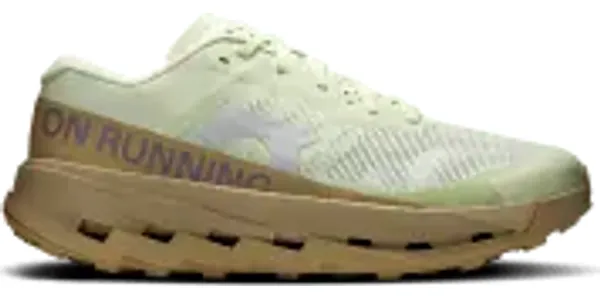
On says its CloudTec cushioning system is for stability and efficiency, and its Helion HF hyper foam is for energy return and impact absorption. CleverHiker says the Helion HF foam used as this shoe's midsole is dual-density, with 32 mm under the heel.
On the run, CleverHiker found the ride more stable than soft or cushy. RunRepeat said runners who prefer firm foam underfoot should feel right at home, but was disappointed by the energy return, measured at 50.9% in the heel and 54.0% in the forefoot. Kurt describes it differently: the stack is not particularly high, but he never felt it lacking; the ride is balanced and controlled with a strong connected-to-the-ground sensation, and the cushioning is ample for ultra-distance efforts.
RunRepeat got a moderate result in its shock absorption test, and said the forefoot staying below 30 mm makes the shoe easier to maneuver and more appealing for hiking.
The outsole is Missiongrip, which CleverHiker reports On designed for mixed terrain.
The tongue locks the midfoot; check the ankle area
Kurt said the tongue is a sock-like neoprene material, slightly stretchy and fully gusseted; with the laces, it gives a snug, soft and comfortable midfoot. RunRepeat describes the tongue as semi-gusseted but with a very generous fabric panel running almost its entire length, which keeps debris out and provides excellent lateral foothold. The two sources describe the construction differently but agree it holds the foot well.
At the heel, CleverHiker's tester found it secure and locked in. Kurt, however, found the shoe lacking lateral support in the ankle area. He wanted the heel cap slightly higher so the sides of the heel collar would sit slightly higher too, and said a higher, reinforced heel collar would help.
Most of the upper is mesh you can see through in places, with reinforced areas for durability and protection. RunRepeat gave it a perfect 5/5 in its smoke-pumping test, while CleverHiker rated its breathability right in the middle of the trail shoes it tested, and said it is not a sweatbox, but not the most breathable either. If you often run in hot, humid weather, run in it for a while before deciding.
From gravel to the Alps: where testers differ
Kurt at Road Trail Run wore a men's US10/EU44 pair for shorter, faster sessions and longer high-elevation days, including a 30 km run with 2,000 m of climbing in the Alps. He called it a reliable, versatile partner in every scenario: grip felt secure and confident on technical, dry terrain, and even on wet rocks the outsole kept a reliable hold. He said 316 g per shoe is not exactly lightweight but does not feel sluggish. He had not tested it in mud yet and suspects the relatively low-profile lugs will not shine there.
CleverHiker found the shoe excelled on gravel and packed dirt, easily handled pavement, and coped with all but the steepest and most technical terrain. In RunRepeat's SATRA TM144 lab test it scored 0.56. RunRepeat called that good grip but well short of what it expects at this price, and said the 3.0 mm lugs point to gravel roads and easy trails.
On durability, CleverHiker has run nearly 100 miles in it, mostly on gravel and packed dirt, with no issues so far.
Read the numbers with their size and method
RunRepeat weighed the shoe at 278 g per shoe in men's US9, the size it always tests, and called that very reasonable. Road Trail Run reported Kurt's US10/EU44 shoe at 316 g per shoe. The two figures are from different sizes, so do not average them, and compare against other shoes at a similar size.
RunRepeat measured 32.1 mm of stack under the heel and 26.7 mm under the forefoot, close to the 32 mm heel figure CleverHiker reports from On. RunRepeat said the forefoot still gives good protection while staying below 30 mm.
Drop (the difference between heel and forefoot stack) is 6 mm according to On; RunRepeat measured 5.4 mm, just 0.6 mm off. Drop only tells you how much the sole slopes from heel to forefoot. It says nothing about foam softness and does not decide which distance or activity the shoe suits.
Check width before other numbers
RunRepeat measured shoe width at 93.4 mm (below average), toebox width at 72.4 mm and toebox height at 29.0 mm. If your feet are wide, try the shoe on and check that your toes can spread and the sides of your feet are not squeezed; generous height above the toes does not add width.
Read weight with its size
RunRepeat weighed men's US9 at 278 g per shoe; Road Trail Run reported Kurt's US10/EU44 at 316 g per shoe. Compare against other shoes at a similar size, and do not average the two figures.
What stack and drop tell you
RunRepeat measured 32.1 mm heel stack, 26.7 mm forefoot stack and a 5.4 mm drop (On lists 6 mm); it is far from max-stack. These numbers do not describe softness, so run in it alongside a familiar shoe to see whether you like a firm feel like this.
What to check in a try-on, and what to compare
When trying the shoe on, wear your running socks, lace it snugly, then check three things. First, whether your toes have room to move and spread, since RunRepeat found a tapered toebox. Second, whether the midfoot squeezes. Third, whether your ankle feels stable enough when you turn or step sideways.
If your usual routes are often muddy, or mostly steep and technical, compare with trail shoes that have deeper lugs and are made for those conditions.
If you have wide feet, RunRepeat suggests Altra or Topo Athletic instead. If you want a softer, bouncier ride, compare with shoes that use softer foam with higher energy return.
A tight, tapered fit: wide feet should try before buying
Go by On's size chart and try on both shoes. Check that your toes can move, the sides of your feet are not squeezed and your heel does not slip. If buying online, check the exchange policy first.
RunRepeat says the Cloudultra 3, like most On shoes, has a tight fit. It measured shoe width at the widest point (between the big-toe and little-toe joints) at 93.4 mm, below average, and toebox width, taken 28.3 mm from the tip, at 72.4 mm. The toebox has a classic taper, if not slightly more aggressive, and RunRepeat concluded that runners with wide feet will likely struggle. Toebox height measured a particularly generous 29.0 mm compared with other trail shoes, but height above the toes does not give more room for toe splay.
On-foot impressions differ in part. Kurt felt the toe box gives the forefoot decent space to expand on a long trail run without pressure points. CleverHiker found the toe box on the wider side of its tested trail shoes, but its main tester, who has wider, flatter feet, found the midsection a bit narrow; the team expects narrower feet, especially in the midsection, to stay comfortable. CleverHiker's testers found the heel secure and locked in.
41434444.5
3MF30234882 · 2026-11-24 · Recorded sizes, not current stock