The details that matter
Helion foam and CloudTec Phase: a sole that compresses in sequence and rolls you forward
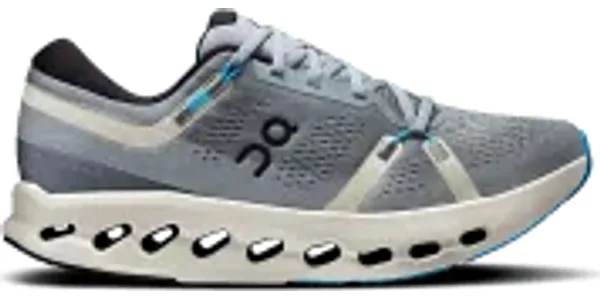
Under the foot is Helion foam, which On describes as soft and comfortable mile after mile. It is shaped into CloudTec Phase, a midsole with diagonal holes along its length. Doctors of Running explains that these help with shock absorption and propulsion; RunRepeat describes them as a computer-optimized sequence of collapsible pods.
There is no Speedboard plate of the kind On shoes usually have, and David of Doctors of Running feels the midsole deforms a little more under load. RunRepeat measured the foam at 43.8 AC against a 35.4 AC average (higher means firmer), but says CloudTec Phase compresses with each stride, so it feels somewhat softer than the number.
The sole is rocker-shaped. RunRepeat found a modest heel curve that helps heel strikers and a forefoot rocker that starts early and rises quite high.
On flexibility, the lab result and the feel on foot differ. In RunRepeat's lab the shoe needed 11.5 N to bend against a 15.5 N average, so it bends more easily than the average shoe. David, though, found the shoe generally stiff, with some flex just past the metatarsals toward the toes. That is also where the toe spring is most aggressive. If your toes don't like being pushed to bend upward, pay attention to this area.
The outsole has two rubber sections, at the heel and the forefoot. Treeline Review says there are large areas of exposed foam between them. RunRepeat measured the rubber at 3.0 mm thick, and its wear test removed just 0.6 mm against a 1.1 mm average.
Very thick padding at the tongue and collar, and split opinions on the upper itself
The first thing you notice is the thick padding. RunRepeat measured the tongue at 10.6 mm against a 5.8 mm average and praises the pillow-like padding around the heel. Tom's Guide calls the upper very comfortable. Drew of WearTesters likes the mesh, which looks and feels premium and uses 88% recycled polyester, but the heel collar and tongue padding made Drew think of a Brooks shoe. Annie, from the same site, finds the padding a bit much.
Believe in the Run doesn't like the upper at all. Robbe finds it stiff, uncomfortable and thick without really being padded. Another tester compares it to cardboard and says the tongue is so wide and thick that it sticks up off the upper.
A gusseted tongue is joined to the upper along both sides, so it doesn't shift. RunRepeat, Robbe and Andrea of Doctors of Running say this tongue is not gusseted, and RunRepeat calls that a big letdown at this price. Andrea says a lace loop holds the tongue fairly securely. Treeline Review, on the other hand, says the tongue is gusseted.
Lockdown is easy. Annie didn't need to cinch anywhere carefully, David had no foot movement or heel slippage, and Treeline Review says the heel cup holds the foot firmly.
The lacing is unusual. RunRepeat describes flat laces through reinforced eyelets, with two stitched fabric loops replacing one pair of eyelets. This spreads pressure evenly across the foot, but there is no extra eyelet for a heel-lock lacing (runner's knot), and RunRepeat has some durability concerns about this lacing design. Andrea finds the fabric loops look pretty durable, but the loops nearest the toes are much wider than the other eyelets. That stiffens the upper there and irritated the tops of Andrea's 4th and 5th toes, keeping runs to 6 miles (about 10 km) or less.
RunRepeat scored breathability 3 out of 5. The outer mesh has large oval holes, but beneath it sits a tighter mesh that blocks most of the air. RunRepeat finds it fine year-round, though it may feel a bit warm on hot days. Treeline Review wore it under the Arizona sun on 90°F (about 32°C) days and says it breathes well, though not clearly better than other mesh running shoes. Andrea ran in it at no more than 50°F (10°C) but finds the mesh on the thick side and expects it to get warm in summer.
Smooth at easy paces, but firmer, less bouncy, and split on longer runs
At easy paces most testers are happy. Tom's Guide mostly used it for easy runs during marathon training and calls it perfect for them. The Run Testers find it comfortable for easy runs of any distance. A Believe in the Run tester names the smooth heel-to-toe transition as their favourite thing about it, and David of Doctors of Running says the shoe's shape makes you settle into a rhythm.
On softness, people feel it differently. Several testers find it firmer than the previous version, but by different amounts. A Believe in the Run tester finds it significantly firmer and says that if you like really soft marshmallow foam, this likely won't be for you. Treeline Review finds it slightly firmer but still plush. Tom's Guide finds it still softer than most On shoes. Drew of WearTesters would like it slightly softer, and Annie found the foam firmed up a touch more in bitter cold. Andrea of Doctors of Running feels a moderately bouncy, cushioned midsole.
On bounce, RunRepeat measured energy return of 52.6% at the heel and 54.1% at the forefoot, where the average is 61.5%. The Reddit poster who ran 9 km in it also found it firmer on impact without much energy back. In the same thread, though, u/jakubdr feels the opposite: nimble and flexible, and now a go-to daily trainer.
When you want to run faster, Tom's Guide felt the rocker flatten out and the foam lack bounce. Treeline Review doesn't use it for speed work. Drew, though, found it picks up speed easily, for example strides at the end of an easy run, even if WearTesters concludes it isn't built for workouts.
On distance, views split in two. One Believe in the Run tester found it cumbersome beyond 3 miles (about 5 km); another found it monotonous beyond 6 miles (about 10 km). Running Shoes Guru rates it good for up to 5 miles (about 8 km). On the other side, Treeline Review used it on runs up to marathon distance and says it excels on long runs. Tom's Guide says the 2023 model started to feel flat late in long runs, and the new shoe doesn't. If you run long often, use it on shorter runs first, then build up.
The outsole is durable. Running Shoes Guru saw little to no wear after well over 100 miles (about 160 km), and Annie says the rubber still looks brand new. Watch out for the central channel: Treeline Review found marble-sized rocks get stuck in it on gravel, though less so on paved roads.
RunRepeat measured grip at 0.39 against a 0.53 average but still rates it rain-ready. Several testers had no trouble on wet ground: The Run Testers ran in the wet, cold British winter, Karl ran in a little rain and snow flurry, and Andrea ran on wet or sandy roads and rates traction above average. Annie had problems only on ice, which Annie says is expected with just about any road shoe.
This is a neutral shoe, with no added structure to support feet that roll inward. RunRepeat notes there is no wide base, no firm heel counter (the stiff structure that wraps the heel) and no raised midsole walls, though it feels stable enough for runners whose feet don't roll inward. David says the platform is a little narrow at the heel and midfoot.
Drop, stack height and weight: brand figures and measurements differ
Drop is the difference between the sole's thickness under the heel and under the forefoot. Most sources list 9 mm (RunRepeat's review text says On lists 8 mm), but RunRepeat measured 10.4 mm against an 8.4 mm average. On the run, Annie of WearTesters and Andrea of Doctors of Running both felt it was lower than 9 mm; Andrea thinks the heel bevel and compliant midsole likely contribute.
Stack height comes in two sets of figures. The brand specs list 32 mm under the heel and 23 mm under the forefoot, while Doctors of Running, Believe in the Run and Running Shoes Guru give 37 mm and 28 mm. RunRepeat measured 37.5 mm under the heel (average 35.6 mm) and 27.1 mm under the forefoot, and believes the brand leaves out the 4.5 mm insole. When comparing with other shoes, use figures from the same source.
Weight needs a size next to it. Doctors of Running and Believe in the Run give 255 g in men's US 9; Tom's Guide and The Run Testers give about 266 g in men's US 9.5. Tom's Guide, Believe in the Run and RunRepeat find it heavier than the previous version, though RunRepeat still places it in the lightweight daily-trainer category.
A listed 9 mm drop, measured at 10.4 mm
Drop is the difference between the sole's thickness under the heel and under the forefoot. Most sources list 9 mm. RunRepeat measured 10.4 mm, above the 8.4 mm average, but calls it a common setup for daily trainers, while Annie and Andrea felt it was lower than 9 mm. Drop doesn't tell you how thick or soft the sole is. If you're used to low-drop shoes, start with short runs.
Listed stack height versus lab figures
The brand specs give 32 mm under the heel and 23 mm under the forefoot. RunRepeat measured 37.5 mm and 27.1 mm and believes the brand leaves out the 4.5 mm insole. The measured heel figure is a little above the 35.6 mm average. When comparing with other shoes, use figures from the same source measured the same way.
Read weight together with size
Men's US 9 weighs 255 g according to Doctors of Running and Believe in the Run; men's US 9.5 weighs about 266 g according to Tom's Guide and The Run Testers. Compare with other shoes at the same size, since larger sizes usually weigh more. RunRepeat still places it in the lightweight daily-trainer category, even though it is heavier than its predecessor.
What to check when you try it on, and what to look for if it doesn't suit you
Start with your usual size. If your feet run slightly large for your usual size, or you like plenty of toe room, try half a size up as well.
When you try it on, check three things. First, whether the fabric lace loops nearest the toes press on top of your 4th and 5th toes. Second, whether the sides of your toes feel squeezed. Third, lace up snugly and walk to check that your heel stays put. If you like a heel-lock lacing (runner's knot), this shoe has no extra eyelet for it.
Discomfort from the upturned toe may not show up in a short try-on, so start with short runs. The men's Apollo | Ivory colour comes in EU 40 to 49 (US 7 to 14). If you buy online, compare the size chart and check the exchange and return terms before ordering.
If it doesn't suit you: for more bounce or faster training, compare trainers with foam that returns more energy; for stability, look for a wider base and a firmer heel counter; if you often run on gravel, choose a sole without a deep central channel; and for more toe room, look for a wider toe box.
True to size in length for most testers; toe-area width gets both snug and roomy reports
Length: most people take their usual size. David of Doctors of Running was true to size in his usual men's US 9.5. Andrea, in a usual women's US 9.5, had a full thumb's width in front of the big toe. Believe in the Run, WearTesters, Treeline Review, Tom's Guide, The Run Testers and the Reddit poster also call it true to size. On the other side, Running Shoes Guru says it runs small and suggests going up half a size, and the vote on RunRepeat's page (108 votes) says it fits slightly small.
Width: RunRepeat's measurements sit near average. Interior width is 93.6 mm, just a touch narrower than the 95.2 mm average. Toe-box width at the big toe is 73.5 mm, close to the 73.2 mm average. Toe-box height is 28.0 mm, above the 27.0 mm average. Even so, RunRepeat describes the shape as tighter and more tapered.
Testers feel it differently. On the snug side, Tom's Guide found it quite tight around the toes, The Run Testers say the toe box is not the roomiest, and Running Shoes Guru rates the toe box tight and the shoe a little narrow. David likes the extra forefoot volume but can still feel the material on the sides of the toes. On the roomy side, Drew of WearTesters calls it pretty wide-foot friendly; Annie calls the fit deceptively accommodating but suggests true wide-footers try it on first; Sam of Treeline Review, with slightly wider than average feet, didn't find it too narrow; Robbe of Believe in the Run finds the upper a bit roomy; and Andrea rates the toe box normal to slightly wider than average.
Andrea thinks it works best for people with normal big-toe joint movement (not for hallux rigidus, a stiff big-toe joint), who prefer a softer midsole and have a narrower forefoot, the last point because of where and how the eyelet row nearest the toes is made. At the heel, David had no slippage and Robbe had no heel lift.
On makes a men's wide version (style 3MF3102) in Black | Black, while the Apollo | Ivory colour is standard width (style 3MF3111). If the standard width feels tight around the toes, try the wide version.
3MF31114525 · 2026-11-24 · Recorded sizes, not current stock