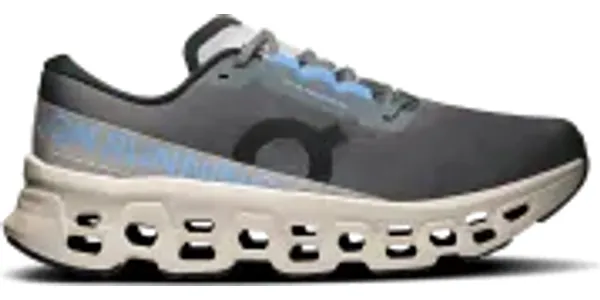
The details that matter
What is underfoot and what each part does
Foam: the midsole is full-length Helion foam, the same compound as version 2, shaped into hollow pods On calls CloudTec. This version stacks them in three layers; earlier models had two. On says this improves impact absorption and responsiveness. RTINGS explains that the hollow pods compress deeply and absorb impact, but the foam itself is firm and returns little energy. RunRepeat measured energy return of 58.7% at the heel and 56.8% at the forefoot, below most premium daily trainers. RoadTrailRun's Adam says the shoe's advantage is not bouncy foam but how the CloudTec pods work with the rocker.
Speedboard: a plastic plate inside the midsole. On says it adds push at toe-off. RoadTrailRun's John felt a real rebound at toe-off, though subtler than the marketing suggests. Run to the Finish says it is not as dramatic as a carbon plate in a race shoe.
Rocker: the bevelled heel eases heel strikers into the stride, and the upturned forefoot tips you forward at toe-off. RTINGS found the rocker flattens under moderate force, so the effect fades when you push hard.
Bending and twisting: RunRepeat measured 20.5 N of force to bend the sole, meaning it is hard to bend, and found it more torsionally rigid than most daily trainers. John says the forefoot is not flexible, but Sam says the CloudTec pods give the forefoot some flex, and Doctors of Running says flexibility has increased: good if you want mild flex, but not stiff enough for hallux rigidus (limited big-toe movement). Strong forefoot strikers should try running in it before buying.
Outsole: compressed rubber that On says is for traction, laid out in ten large pods. RunRepeat describes rubber on the main contact zones and reinforced foam elsewhere. Its grip score of 0.51 means reliable grip on dry and wet concrete, though RunRepeat calls the score low for the price. Slowtwitch ran on icy, wet roads without trouble. Meta Endurance found it fine on dry roads and in rain, but not standout. Off road, Doctors of Running says dirt trail is fine but warns gravel and mud can get stuck in the pods, while John found the pods shed small rocks reasonably well on his regular gravel paths; packed gravel and light off-road were no problem, but he would not take it on technical trail.
Upper: snugger, thicker tongue, low over the toes
The upper is an all-new engineered knit. RTINGS says it has more structure and a snugger fit, and Run to the Finish says version 2's baggy fit is gone and the upper fits snugly. RunRepeat looked at the mesh under a microscope and found it solid quality and very comfortable. RoadTrailRun's Sam says the upper disappears on the foot: lace once and run.
Tongue: RunRepeat measured 5.3 mm of tongue padding, up from 1.5 mm. Sources differ on how the tongue is attached: RunRepeat lists it as semi-gusseted, while RTINGS and Meta Endurance list it as fully gusseted. Doctors of Running says it locks the midfoot without much lace tightening.
Laces: a small elastic band holds the spare lace. Slowtwitch thought the laces looked short at first, but they stayed put even on the longest runs. Meta Endurance, by contrast, found they came undone often, especially in the wet. If you often run in rain, double-knot them or tuck the ends under the elastic band.
Heel: RunRepeat rated how structured the heel counter (the stiff shell around the heel) is at 4 out of 5 and found it does not collapse at all. John says it is firm enough to hold the foot without irritating the Achilles on long runs. Sam says the collars are low and could use a touch more padding on the top edge. Run to the Finish's Coach Laura found the collar low and stiff against her Achilles when trying them on and walking, but noticed no rubbing once she picked up speed.
Toes and instep: RTINGS found the upper sits low over the toes, so tall toes, or toes that flex upward on landing, will feel pressure. Doctors of Running says the instep is lower and may not work for high insteps.
Breathability: RunRepeat rated airflow 2 out of 5, better for cool weather than hot days. Doctors of Running calls it mildly breathable. John ran on sunny days in the 60s °F (about 16–21°C) without hot feet, and the mesh kept debris out.
Durability: RunRepeat's toe-box abrasion test gave the lowest score, 1 out of 5, while the heel padding scored a full 5. Meta Endurance worries the toe-box mesh could rip, as it has on On shoes with similar mesh. Reflective details add visibility at night.
How it feels: walking, easy runs, long runs and faster running
All-day walking: here the reviews agree. Doctors of Running loves it for walking and finds it comfortable for a full workday. RoadTrailRun's John wore it for errands after runs without a second thought. Gizmodo Japan's writer found landings very soft when walking and easy jogging, without feeling the hardness of the asphalt.
Very slow runs: RoadTrailRun's Sam says it is a bit too firm for recovery runs. John (130 lb, about 59 kg) noticed the firmness more than his fellow tester did at his 8:30–10:00 per mile recovery pace (about 5:17–6:13 per km). Meta Endurance, a lighter runner, says it had to work a bit to get the best from the midsole and expects heavier runners to benefit more. RoadTrailRun's review, with testers from 130 to 197 lb (about 59–89 kg), also suggests that, to a point, the heavier the runner, the more effective the geometry and cushion feel. Gizmodo Japan's writer felt the rebound was a bit lacking at slow paces, without the strong forward push of earlier models.
Long runs: opinions differ. RTINGS found the cushioning bottoms out and turns harsh within the first 10 km, and the weight shows late in long runs. Slowtwitch, by contrast, found it comfortable from mile one to beyond mile 10 (about 16 km). Run to the Finish says it is not plush but has plenty of cushion for longer runs, and that runners in the middle of the pack could easily race long distances in it, yet Coach Laura says it won't be her pick when she wants a softer ride for long runs.
Faster running: this is where they differ most. RoadTrailRun's three testers together found it responsive down to sub-5-minute-mile pace (about 3:06 per km), and Adam was at home in track intervals at 5:30 per mile (about 3:25 per km), but Sam, from the same team, finds it a bit too heavy for faster running. Gizmodo Japan's writer sped up when the pacer encouraged it and found it clearly more fun to run. On the other side, Doctors of Running finds anything quicker than uptempo awkward, Meta Endurance would not take it beyond steady pace because it feels clunky and overly firm when pushed, and RTINGS says the shoe is heavy, so it feels flat and sluggish when you pick up the pace.
What reviewers say about the sole: RoadTrailRun's Adam says the shoe works through its sole shape and CloudTec pods more than through bouncy foam, and Meta Endurance and RoadTrailRun expect heavier runners to get more from it, to a point. If you like a firm ride that rolls you forward, you are more likely to enjoy it. If you want foam that springs back on its own when you run fast, it may feel like something is missing.
Reading the numbers: drop, stack and weight
Drop (the height difference between heel and forefoot): On lists 6 mm. RunRepeat measured 6.4 mm, very close to the brand figure, and classes it as a moderate drop. RTINGS measured 7.3 mm in a men's US 9. On foot, though, Doctors of Running found it feels lower than 6 mm, because the heel pods compress more than the forefoot ones; some people even get a negative-drop feeling. A Doctors of Running tester who heel strikes and already has Achilles tendinopathy felt a significant stretch and strain in the calf and Achilles. If you are sensitive to this, run a few steps in the store and notice whether the heel sinks more than the forefoot.
Stack: the figures in reviews differ because they are measured differently. The On figure quoted by several reviews is 35 mm at the heel and 29 mm at the forefoot, and Doctors of Running notes this excludes the insole. RunRepeat measured 38.6 mm at the heel and 32.2 mm at the forefoot; RTINGS measured 40.1 mm at the heel and 32.8 mm at the forefoot in a US 9. RunRepeat says the forefoot sits well above the average running shoe. RoadTrailRun's Adam calls it sub-max because competitors run beyond 40 mm, while Meta Endurance felt it was taller than the listed 35 mm. RunRepeat measured the forefoot midsole width at 113.7 mm, average overall but narrower than most max-stack shoes, yet RTINGS, Meta Endurance and RoadTrailRun's Sam find it stable.
Weight: only comparable at a stated size. RTINGS weighed a men's US 9 at 296.6 g; Doctors of Running lists 295 g for a men's US 9; RoadTrailRun weighed its test pairs at 284 g (US 8.5) and 333 g (US 11). RunRepeat calls it heavy by today's standards and about 3% heavier than version 2. Run to the Finish says the slight increase is unlikely to be noticed at easy or marathon pace, and Adam and John say it runs lighter than its weight.
6 mm drop that may feel lower
Drop is the height difference between heel and forefoot. On lists 6 mm; RunRepeat measured 6.4 mm and calls it moderate. Because the heel pods compress more than the forefoot ones, Doctors of Running found it feels lower than listed. When trying it on, jog a little and notice whether the heel sinks more than the forefoot and whether your calves feel more stretch.
High stack doesn't mean more cushioning
The stack is higher than an average running shoe: RunRepeat measured 38.6 mm at the heel and 32.2 mm at the forefoot. But the foam reads 49.9 on the Asker C scale, and RunRepeat says the hollow CloudTec pods make it less cushioned than shoes of similar height. If you are used to soft high-stack shoes, try them on side by side on the same day.
Compare weight at the same size
RTINGS weighed a men's US 9 at 296.6 g, and RunRepeat calls it heavy by today's standards. To compare with other shoes, use weights at the same size, or hold them side by side in the store. RTINGS says the weight shows most when you speed up or late in a long run.
What to check when trying it on, and what to look at if it doesn't suit
When trying it on, walk and jog for a while and check four things. First, firmness: it is firmest at first and softens after some wear, so if day one feels acceptable it is likely to get better. Second, toes and instep: the upper sits low, so flex your toes upward to see if the mesh presses, and check for pressure on the top of your foot. Third, the heel collar: wear your usual socks, walk around and see whether it presses on your Achilles. Fourth, try quick turns: Doctors of Running found mild sliding when turning at faster paces.
If it doesn't suit you, reviewers mention these. For something lighter and more energetic, RTINGS finds the Cloudmonster 3 Hyper lighter, better cushioned and more energetic, and Meta Endurance finds the Hyper snappier and better for faster paces. If you mainly land on your heel, RTINGS finds the HOKA Clifton 10 has better heel cushioning, while the Cloudmonster 3 is better cushioned in the forefoot. For recovery days, Adam finds the Brooks Glycerin Max V1 better suited, and Meta Endurance says the Nike Vomero Plus is softer. RunRepeat points to the ASICS Novablast 5 and Saucony Endorphin Azura for a lighter, more responsive ride. For fast workouts and racing, Adam prefers the Hoka Mach X3.
Size and fit
Length: most reviews say it fits true to size. RunRepeat reports true to size from its lab and user votes. RTINGS tested a men's US 9 and says most runners can stick to their normal size. Doctors of Running fits true in its usual men's US 10. RoadTrailRun's John, with a slightly narrow foot, found it true to size, and Gizmodo Japan's writer found their usual size just right. One source differs: Meta Endurance found it almost half a size long and suggests going down if you are between sizes. Adam, in a US 11, found the length right but a little roomy until the laces were cinched.
Width: RunRepeat measured a width of 94.3 mm at the widest part of the forefoot, narrower than the 98.5 mm of version 2, and 71.0 mm in the toe box (74.5 mm in version 2), so it says there is less spare room than before. Doctors of Running, by contrast, felt the upper slightly wider, with a little extra forefoot volume and a slightly snug midfoot. The two do not match: RunRepeat's is a measurement, Doctors of Running's is how it felt on foot. RTINGS finds ample width through the arch and forefoot without bagginess. Run to the Finish says the forefoot is not very wide but leaves plenty of room for the toes. Meta Endurance, with wide feet, enjoyed the toe-box room. Doctors of Running suggests narrow feet may not suit it.
Heel: Adam and John had no heel slip, and Run to the Finish's Coach Amanda had no heel fit issues.
When to choose the wide version: the Cloudmonster 3 comes in standard and wide. If you liked version 2's roomier fit, or have very wide or high-volume feet, try on the wide. Gizmodo Japan's writer had to go down half a size in version 2 but fit their usual size in version 3, so if you sized down in version 2, start by trying your normal size.
414242.5434444.5454647
3MG10054857 · 2026-11-24 · Recorded sizes, not current stock