The details that matter
Two foams, a plate between them and a strong rocker
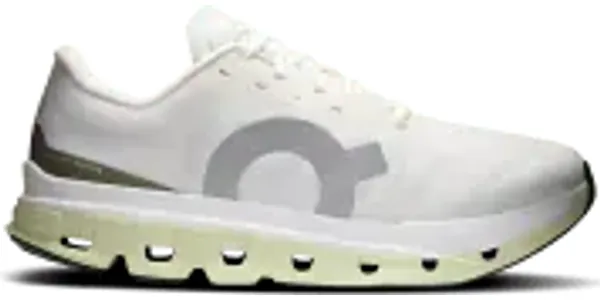
On's product page names two technologies: the CloudTec cushioning system and Helion HF foam, which On says delivers “max energy return”. Fleet Feet describes the sole layers from the bottom up: regular Helion foam, then the Speedboard, then Helion HF on top, directly under the foot. Road Trail Run and RunRepeat both describe the Speedboard as a blend of nylon and glass fibre, and RunRepeat says it adds guidance without the harsh stiffness you would expect from carbon fibre.
The top foam layer is thinner than it looks. Courtney at Road Trail Run says the Helion HF foam appears to be about 16 mm thick but is more like 7 mm underfoot, because the outside of the foam wraps up around the upper as side walls. RunRepeat measured that top layer at 48.3 HA on its durometer (a hardness gauge) and calls it firm, even though it was the softer of the two foams.
The sole also curves up strongly at the toe, a shape known as a rocker that helps the foot roll forward. RunRepeat says it works best for fast running but can feel awkward at easier paces or for slower runners. Caroline at Fleet Feet found the midsole a bit too firm for personal taste, but says the aggressive rocker helps make the shoe more fun to run in.
Grip is the strength the sources agree on most. RunRepeat's wet-concrete grip test gave 0.52, which it says is not outstanding but is enough for reliable traction on most days of the year. Peter calls the grip excellent, Jeff found the outsole confidence-inspiring on wet pavement and in tight turns, and Olivia ran on road, track, gravel and concrete without slipping.
On wear, the signs are mostly good. RunRepeat's lab gave the upper 4 out of 5 in its toebox durability test and 5 out of 5 for the heel padding; its abrasion test removed 1.3 mm of outsole rubber, which it says is not a deal-breaker. Running Shoes Guru lists 'durable' as a pro, Peter says durability is good so far in testing, and Jeff calls the outsole grippy and durable. Alastair points out that areas of exposed foam on the outsole, with no rubber covering, will wear down faster than the rubber.
A woven mesh upper, and clearly different views on breathability
People who ran in it mostly liked the upper. Olivia describes an engineered woven mesh that is ultralight and extremely breathable, says you can feel wind coming through on breezy days, and found the shoes dried fairly quickly after a run in the rain. Peter calls the upper very comfortable and very breathable, Road Trail Run's pros list credits breathability to Courtney as well, and Alastair says it feels sleek and breathable.
The lab result points the other way. RunRepeat scored breathability 2 out of 5, found no ventilation holes in the toebox and a tightly closed mesh that blocks air movement, and believes ventilation may become a real issue for summer running. Jeff sits in between: more breathable than many other On models, though not the best option for hot summer miles. If your feet run hot, try the shoe on with the socks you actually run in and do not assume the mesh will keep you cool.
Hold is good once the laces are set. The tongue is attached to the upper on both sides so it stays in place, and a second row of eyelets near the ankle lets you lace for a firmer heel lock; Caroline used them to tie a marathon loop. RunRepeat describes a secure, pressure-free lockdown, and Jeff says heel lockdown was effortless with no slipping, even during faster runs. Courtney's first run went differently: she felt some slipping, especially at the heel, and had to adjust the tightness mid-run.
Fun when you speed up, sluggish when you slow down
At speed, the testers are mostly positive. Peter says the firm foams and the plate combine to create a propulsive and fun ride at higher speeds, and that the shoe shines at “MGP or HMGP”, marathon and half-marathon goal pace. Peter found it a bit clunky at slower paces and a little harder to turn over for 5K pace work. Jeff ran about 35 miles (about 56 km) in it, from relaxed runs to 400 m repeats and tempo efforts, and found it firm, responsive and built for quicker days. Alastair tested it in tempo sessions, fartlek runs (unstructured mixes of fast and easy running) and structured workouts.
It may take several runs before the shoe makes sense. Olivia's first run, an interval workout on the treadmill, was not great: the shoes felt overly firm and “off”. By the fifth run they started to make sense, and when used for speed, the purpose they were built for, she says they came alive.
Slow down and the picture changes. Courtney first took it out for 9 miles (about 14 km) of 1 km repeats and 6 x 800 m at her 3K-5K pace and came in slower than her 3K target. She then wore it for her Sunday run, normally a speedier short run with strides at the end, and found the shoe coming into its own at around 7:15 per mile (about 4:30 per km). Courtney says the aggressive toe spring becomes something you have to get up and over with every stride, and you feel this especially at slower paces, where the toe spring just seems to drag. Courtney adds that the shoe is also too firm for slow paces. Alastair found the ride pretty firm when the pace dips or when landing on the heels. Caroline does not think the firm cushion or the pronounced rocker would feel very enjoyable on easy days or recovery runs.
Weight divides the reviewers. Peter sums it up as a shoe that feels much better at faster tempos but is a bit too heavy to want to wear for faster tempo workouts. RunRepeat says a modern shoe built for tempo sessions should not weigh 271 g. Road Trail Run's cons list credits Courtney, alongside Peter, with 'a bit heavy for a speed shoe', and Alastair finds its 9.5 oz a little heavy next to other tempo shoes. Caroline felt the additional underfoot protection over the Cloudflow 4 was worth the added weight. Others feel it less: Jeff says that at 9.8 ounces (about 278 g) it is not the lightest tempo trainer but runs lighter than it looks, and feels lighter than its weight once you pick up the pace. Running Shoes Guru lists 'lightweight and breathable' among its pros and says the shoe isn't very heavy, though it isn't super light either.
On stability, RunRepeat reports a planted, stable ride despite the compact build. Alastair says the white foam sidewall wrap does a very good job of providing stability and support, Jeff describes a supportive, balanced feel through the heel and ankle, and Running Shoes Guru places it at 'some stability' on its neutral-to-stable scale. For heel strikers there are points on both sides. RunRepeat says the aggressive heel bevel helps offset the low drop (the difference in sole thickness between heel and forefoot) and keeps heel strikers moving forward, but given the narrow heel and the low drop it measured, it also says the shoe may not be the most sensible choice for runners who land on the heel.
Reading this shoe's weight, stack and drop
The figures below come from reviewers, and they do not agree.
For weight, RunRepeat's scale showed 271 g without stating the size, and the brand-spec table on the same page lists 269 g for men and 221 g for women. Road Trail Run lists about 278 g for a men's US 9 and weighed its own samples at 299.8 g for a men's US 11 and 248 g for a women's US 9. Alastair lists 269 g for a men's US 9. When you compare with another shoe, use figures for the same size and sex, and if you can try it in a store, pick it up next to another speed shoe.
For stack and drop, Road Trail Run, Fleet Feet and Alastair list 36 mm of sole under the heel, 28 mm under the forefoot and an 8 mm drop, and RunToTheFinish lists a 36 mm stack and an 8 mm drop. RunRepeat, measuring at the official World Athletics reference points, measured 32.8 mm under the heel, 28.7 mm under the forefoot and a 4.1 mm drop, and says this is lower than the brand's stated 6 mm. Running Shoes Guru gives 37 mm under the heel and 31 mm under the forefoot. RunRepeat also explains that midfoot and forefoot strikers may feel a higher drop than measured, because of the toe rocker and the curved heel. With figures this far apart, do not choose this shoe for its drop number; pay attention to how the heel feels when you try it on and run in it.
Weight only means something with a size
Men's figures run from about 269 g to 299.8 g depending on the size weighed. Road Trail Run lists about 278 g for a men's US 9 and weighed 299.8 g for a men's US 11, Alastair lists 269 g for a men's US 9, and RunRepeat weighed 271 g without stating the size. For women, Road Trail Run weighed a US 9 at 248 g and RunRepeat's brand-spec table lists 221 g. Compare with another shoe only at the same size and sex. Testers also feel the weight differently: some call it heavy for a speed shoe, while Jeff says it runs lighter than it looks.
Stack and drop figures conflict
Drop is the difference in sole thickness between heel and forefoot. Road Trail Run, Fleet Feet and Alastair list an 8 mm drop (36 mm under the heel, 28 mm under the forefoot); RunRepeat measured 4.1 mm and says the brand states 6 mm. RunRepeat explains that midfoot and forefoot strikers may feel a higher drop than the number because of the sole's curved shape. Judge by how the heel feels on a test run rather than by one number.
Toe room: check the sides and the top
RunRepeat measured the toe box at 77.2 mm wide, wider than average, but only 24.5 mm high above the toes, lower than average. Testers range from spacious to tight. When you try it on, wiggle your toes to check side room and press on the upper to see whether it sits on top of your toes. RunRepeat notes the insole is removable; if you replace it, choose a thinner one.
What to check before you buy, and what to compare
If you can try it on, bring the socks you run in, since Olivia had to be selective about which socks she wore with her pair. Try on your usual size and a half size up on the same day, stand up, and notice first whether the midfoot squeezes: that is where several testers describe the fit as snug or narrow, though Alastair found it fine for medium-width feet.
Then check the toes in two directions, room at the sides and room above. RunRepeat measured a toe box wider than average but lower than average above the toes, and testers range from spacious to tight. Wiggle your toes to check side room and press on the upper to see whether it sits on top of your toes. Lace up snugly, jog a few steps and watch for heel lift; Courtney noticed heel slipping on her first run before adjusting the laces. If the heel lifts, try lacing through the second row of eyelets near the ankle.
Testers describe the shoe as firm and awkward at slow paces and better when running fast, so if the store lets you run, try it at the pace you plan to use it for. If you order online, read the seller's exchange terms first, because the sizing advice differs between sources.
If it does not suit you, work out what put you off. If you want one shoe that also handles easy and long runs, compare softer daily trainers. If you still want a speed-day shoe but dislike the firmness or weight, compare lighter tempo shoes with a bouncier foam, the kind Jeff, Alastair and RunRepeat each point to in their reviews. If the standard width squeezes your midfoot, look for a model that clearly offers a wide fit.
Mostly true to size; width reports lean narrow
On length, most sources say it is true to size. On's page says the fit is regular and true to size. Peter found it true to size, Jeff says the sizing is spot on and a men's 11 fit perfectly, and Caroline, who has low-volume feet (feet that take up little space inside the shoe), found the standard width true to size. Olivia disagrees: her review says the shoe runs small and advises buying half a size bigger. RunRepeat's on-page reader poll also says it fits slightly small, but with only 12 votes it should not carry much weight.
On width, the accounts lean narrow, but not all of them. RunRepeat measured the interior width at 92.7 mm, which it calls on the narrow side. Olivia found the shoe extremely narrow when she first put it on, rates the midfoot as tight, and thinks a wider foot would likely be a no-go. Peter says it is not a super tall shoe but feels on the narrower side. Jeff, who has a low-volume foot, says the midfoot gets a little snug and personally loves that, but it may feel tight on a wider midfoot. Courtney found the midfoot snug, yet her fit score note calls the shoe very accommodating to many different foot types. Alastair finds the fit dialed in for medium-width feet and warns that, with no wide option, runners with broader feet might feel pinched. Alastair, RunToTheFinish and Fleet Feet say it does not come in wide, while RunRepeat's spec table lists Normal for men and Normal and Wide for women.
Toe room is described differently depending on who is talking and which direction they mean. RunRepeat measured the toe box at 77.2 mm wide and says that should suit runners who want a bit more room for their toes, but only 24.5 mm high above the toes, a low value that it takes as another sign the shoe suits short efforts better than long runs. Alastair calls the toe box spacious. Courtney calls it somewhat narrow but with enough stretch and space to splay the toes comfortably, Jeff says there is not a ton of room for toe splay, and Olivia rates the toebox as tight, even though her review text says the forefoot has more space than previous Cloudflows. Which of these matches your experience depends on your own foot shape.
414242.5434444.5454647
3MF10114852 · 2026-11-24 · Recorded sizes, not current stock