The details that matter
Under the foot: ZoomX, two Air Zoom units and a waffle rubber outsole
The midsole is full-length ZoomX with no second foam layer. RunRepeat notes this ZoomX is a more durable TPE-based formula, not the PEBA used in race shoes, with lower rebound, so it does not have a springy, trampoline-like bounce.
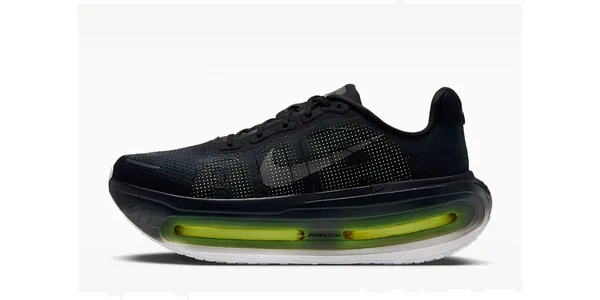
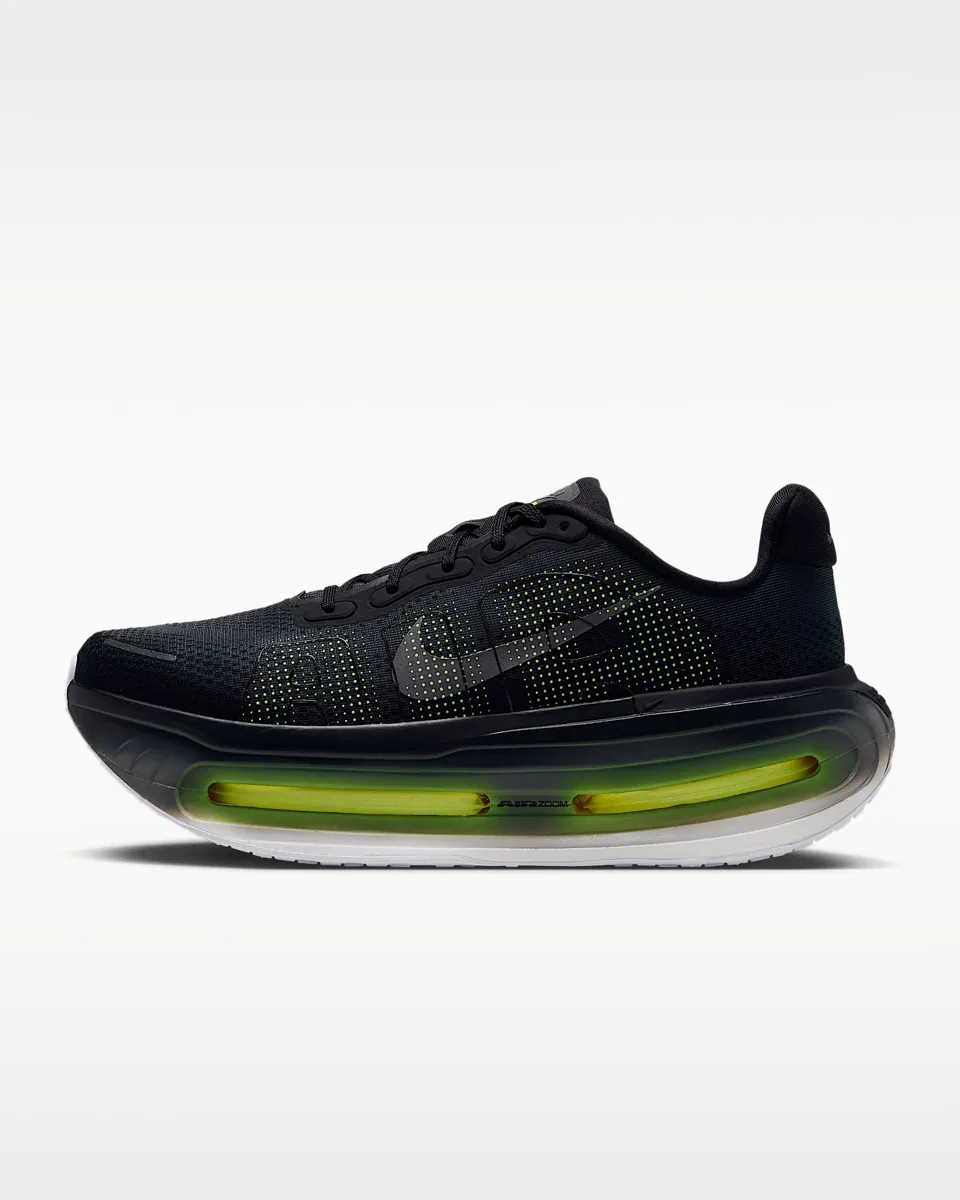
Two large Air Zoom units sit inside the foam at the forefoot and heel; the midfoot has no Air unit. Nike says they are the same Air Zoom units used in its Maxfly 2 and Victory 2 track spikes. A Supwell runner says the bounce becomes clear when you load the forefoot unit.
There is no plate, but the sole resists bending. RunRepeat measured 21.5N of flex stiffness and found it very hard to twist (18.3 Nm), with the Air Zoom units adding some of that stiffness. The toe and heel curve up noticeably (RTINGS measured a 26.2° forefoot rocker), so the foot rolls forward smoothly.
The base is wide: RunRepeat measured the midsole at 118.4 mm at the forefoot and 103.2 mm at the heel. That width helps keep such a tall shoe from rocking too much.
The outsole is a dense layer of small waffle lugs covering nearly the whole bottom, apart from two windows to the Air units and a shallow exposed foam area in the centre. Doctors of Running found grip excellent on wet roads. RunRepeat warns that the exposed Air units could be punctured by sharp stones on packed dirt or light gravel, so keep it on roads, as Nike intends.
RunRepeat found the 4.1 mm insole removable and says it feels like a cheap insert. If you already have an insole you like, you can swap it in.
Upper: fully padded, but you lace it a bit tighter than usual
The upper is Mono mesh, paired with an extra-soft collar and tongue. RunRepeat describes soft padding all the way from heel to tongue.
The mesh is thick but breathes reasonably. RunRepeat scored it 3/5 and says it should handle warm conditions decently, especially when you are not running hard. Doctors of Running says it breathes decently well on the run.
The tongue is 12.4 mm thick, and RunRepeat found you need to pull the laces a bit tighter than usual for a secure fit. RoadTrailRun's Michael also had to pull the laces hard, even in the right size. The flat laces stretch slightly, giving a little when you adjust them without feeling elastic.
The heel has a stiff structure wrapping the back of the foot (the heel counter), firmer than average (RunRepeat: 4/5), plus a support bar around the heel that limits side-to-side movement. Heavy padding keeps it comfortable. Doctors of Running and Believe in the Run report no heel slip and great lockdown.
The heel collar rises up toward the Achilles. Michael had no trouble on 10–14 mile runs, but on a humid 24-mile run the collar cut into his heels. He recommends tall socks, especially for the first few runs. Doctors of Running also does not recommend running sockless.
The upper holds up better than expected: RunRepeat scored toe-box durability 3/5, higher than the 1–2 plush uppers typically get, and heel padding 5/5. There are several reflective details.
On the run: very soft for most testers, but the bounce depends on how you land
Most sources found the ride very soft. WearTesters says you can barely feel the ground, and RoadTrailRun compares it to a giant cloud cradling the foot, yet not ponderous or mushy.
On bounce, testers disagree. RoadTrailRun calls it the softest and bounciest Nike ever, and Believe in the Run describes moon-shoe bounce unlike any shoe it has tried. WearTesters, however, found not much energy return, just soft landings, and RunRepeat says it lacks springy bounce.
Part of the difference comes down to footstrike and effort. A Supwell runner says the bounce becomes very clear when you put power down or get onto the forefoot Air unit. Midfoot and forefoot strikers found it smooth and fun at recovery effort, but heel strikers at recovery pace may feel the foam gets in the way. Doctors of Running felt it mildly firm at landing and surprisingly bouncy at push-off. RunRepeat sees it differently and recommends it for heel strikers on long runs.
On pace, several outlets say it is for easy to unhurried long runs only and not for paces near marathon pace. But RoadTrailRun's Sally easily held 8:30 per mile on long runs, only 30 seconds per mile slower than her marathon pace, and Supwell's Yowana found the shoe at its best for uptempo and Zone 2–3 running; for him it is not a recovery shoe. Doctors of Running and Supwell both found the shoe pushed them to run faster than intended on recovery days.
On stability, most testers found it steadier than expected for 55 mm of stack. RTINGS found it unstable in tight corners, WearTesters felt side-to-side sway beyond about 6 miles (about 10 km), RoadTrailRun's Allison needed time to adjust at first, and fellow RoadTrailRun tester Sam felt the heel wobble at 8:30 per mile. On larger runners, RunRepeat recommends it for bigger or heavier runners, while RTINGS warns the soft midsole could add instability for heavier runners.
For walking and standing, RoadTrailRun's Allison, a nurse who wore it for 9–10 hour shifts, found it really comfortable, though at the end of her longest days she wanted the cushioning a touch more supportive. A Supwell wearer says it is so tall it feels almost ridiculous to walk in.
Reading this shoe's numbers: drop, stack and weight
Drop (the height difference between heel and forefoot): Nike states 10 mm. RTINGS measured 9.9 mm on a men's US 9, while RunRepeat measured 8.8 mm at World Athletics reference points. On the run, a midfoot-striking Doctors of Running tester felt it more like a 6–8 mm drop because of the heel bevel and the Air units compressing. So a 10 mm drop does not mean you must land on your heel.
Stack: Nike states 55 mm at the heel and 45 mm at the forefoot. Lab measurements come in lower: RTINGS measured 52.7 mm heel and 42.8 mm forefoot on a men's US 9, and RunRepeat measured 50.1 mm and 41.3 mm (Nike states 55.5 mm for a US 10). Against rival max-stack shoes, Supwell notes the others have at most 45–46 mm of heel foam, so this one is clearly taller.
Weight: RoadTrailRun weighed a men's US 8.5 at 323 g. Believe in the Run says it is heavier than the Adidas Ultraboost 20 at 12.5 oz in US M10.5. When comparing shoes, compare weights at the same size, or hold it next to your current pair when you try it on in store.
Nike states it is not World Athletics approved, so it cannot be used in races that require approved shoes.
10 mm drop on paper, but it can feel lower on the run
Drop is the height difference between heel and forefoot. Nike states 10 mm; labs measured 8.8–9.9 mm; a midfoot-striking tester felt it more like 6–8 mm. If you land midfoot or forefoot, don't rule it out on the number alone: do a short, easy jog and see whether your foot rolls forward smoothly.
Very high stack: check you're comfortable with the height
Nike states 55 mm at the heel; labs measured 50.1–52.7 mm in a US 9. Rival max-stack shoes have at most 45–46 mm of heel foam. When trying it on, walk and turn; if it feels wobbly or you lack confidence, look at a lower-stack shoe.
Weight: compare at the same size
RoadTrailRun weighed a men's US 8.5 at 323 g. Larger sizes will weigh more, so compare other shoes at the same size. If you prefer a light shoe for faster running, this one will feel heavy.
What to check when trying it on, and what to look at if it doesn't suit
When you try it on, lace it snug first, since the thick tongue needs a bit more lace tension than usual, and check whether the top of your foot feels pressure. Then make sure your heel doesn't move and the tall heel collar doesn't rub your Achilles. Wear the socks you run in; if you prefer low socks, compare with tall socks too.
Wiggle your toes to check for pinching at the tip: RunRepeat measured a sharply tapered toe box, even though other sources found the forefoot roomy. Walk and turn in the store to see whether you are comfortable with the height. Doctors of Running advises extra caution for people with balance or proprioception issues.
If it feels too heavy or too soft, look at lighter, more responsive cushioned shoes. Reviewers mention the Nike Vomero Plus, lighter, firmer and more versatile, and the ASICS Megablast, much lighter with better energy return but a less plush upper. If you want more stability, RoadTrailRun says the Brooks Glycerin Max is more stable, though firmer and less reactive.
Size and fit
Almost every tester wore their usual size. RTINGS found its men's US 9 true to size in both length and volume. Doctors of Running wore true to size in both a men's 9.5 and a women's 9.5, the latter with nearly a thumb's width of toe room. WearTesters says length is true to size and width feels typical for a Nike.
On forefoot width, reports do not match. RunRepeat measured the toe box at just 68.6 mm wide and calls it sharply tapered, tricky for wide feet. But RTINGS found the forefoot accommodating, with enough room through the arch and over the toes. Doctors of Running says the toe box is a little wider and longer than the Vomero 18 or Vomero Plus, and RoadTrailRun's Sally (women's 8) found more forefoot room than the Pegasus line. If you have wide feet or toes that splay, check the very front specifically.
There is plenty of height above the toes: RunRepeat measured 30.8 mm and had no toenail pressure during testing, which helps on long runs or when feet swell.
Heel hold is good in nearly every report, but midfoot lockdown depends on lacing. RoadTrailRun's Michael (size 8.5) found the upper stretchy enough but hard to get snug, needing to pull the laces hard. Believe in the Run's Meg (women's 7.5) says the upper hugs the foot nicely.
77.588.599.51010.511
HQ2050-004 · 2026-11-24 · Recorded sizes, not current stock