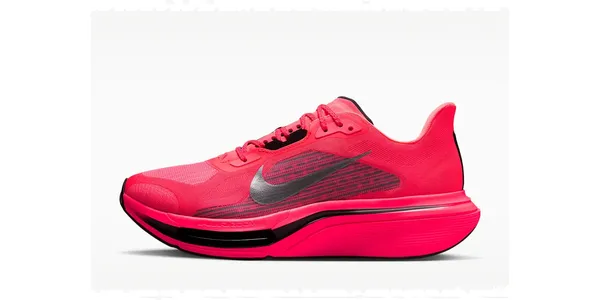
The details that matter
Underfoot: ZoomX foam with a forefoot Air Zoom unit
The midsole is full-length ZoomX. RunRepeat says it is a version tuned for training. Outside says it is a TPU-based foam, not the PEBA ZoomX found in the Alphafly and Vaporfly, while RTINGS describes a TPE/PEBA blend. Believe in the Run says this formulation is slightly denser, still cushioned, just with a little less of the pillowy, springy character of ZoomX elsewhere in Nike's line.
Under the forefoot sits an exposed Air Zoom unit. Nike says it delivers at least 18% more energy return than the first Pegasus Plus. Lab results point a different way: RunRepeat measured 69.0% energy return in the forefoot and 65.5% in the heel, close to the first version, and found the Air Zoom unit did not boost energy return. RTINGS measured 74.0% forefoot energy return and rates it mediocre. There is no plate.
RunRepeat measured shock absorption of 147 SA in the heel and 122 SA in the forefoot (RunRepeat's SA unit; higher means more shock absorbed), both above average and well up on the first version.
The outsole is segmented waffle rubber with flex grooves. Heel and forefoot are well covered, while the midfoot leaves foam exposed. RunRepeat measured the rubber at 2.4 mm, below average. RunRepeat found the grip reliable on dry roads, but says overall traction falls well behind many competitors and suggests looking elsewhere if you often run on wet roads. Doctors of Running, though, ran on wet roads a few times and found traction good thanks to the generous rubber coverage, and a RoadTrailRun tester also found it gripped well on wet and dry surfaces and excelled on a gravel trail.
In RunRepeat's durability test the outsole wore 1.1 mm, acceptable but not impressive. Doctors of Running saw mild wear on the exposed midfoot foam after 25 miles (about 40 km), while Tom's Guide saw no wear after 40 miles (about 64 km) that included several runs on light trails.
Upper: secure and padded, but fairly thick
A midfoot band anchors the tongue to the shoe and helps lock the foot. Lacing is a hybrid: regular eyelets at both ends and fabric loops in the middle, which RunRepeat says reduce pressure across the instep. The laces are sawtooth, normally seen on racing shoes. Sally from RoadTrailRun says the system locks the foot down snugly with ease and the laces hold without slipping. Doctors of Running says the thin tongue stays in place when putting the shoe on and while running. RTINGS, though, says the tongue can slide around on longer runs.
The ankle collar and tongue have just-right padding. The heel counter (the stiff cup around the heel) is small and rigid, and several testers report solid heel hold. Peter from RoadTrailRun found the heel collar a bit high but with excellent lockdown and no rubbing.
On breathability, sources disagree. RunRepeat gives it 3/5, enough for most of the year but possibly short for extremely hot summers. RTINGS says the fairly thick upper doesn't allow much air flow. Tom's Guide calls it quite a thick upper and not the most breathable in hot conditions. Peter, though, found it very breathable. If you often run in the sun or in hot weather, factor this in.
Nike lists reflective design details, but the pair RunRepeat inspected had none. If you run in the dark, check photos of the exact colourway before buying.
On the run: at its best at moderate paces
Most testers agree it runs best at moderate paces. Doctors of Running found the shoe most lively at marathon pace, but at threshold pace (a hard pace you can hold for about an hour) it felt no more responsive and the weight became more noticeable. Sally from RoadTrailRun found it best around 8:30/mile (about 5:17/km), becoming work at much faster than 8:00/mile (about 4:58/km).
A sub-3 Japanese marathoner writing on note.com tells a different story: the ride felt more comfortable when picking up the pace to around 4:30–4:15/km, and the shoe showed its strengths when running faster rather than on slow recovery jogs. The pace where it clicks depends on the runner.
On softness, sources disagree. RunRepeat measured the foam as noticeably softer than average. RTINGS calls the ride firm and dependable, with a very firm forefoot even at easy paces that becomes exceptionally firm when you apply force. Sally describes it as somewhat soft yet resilient, not squishy.
Opinions on the Air Zoom unit differ too. Outside found the forefoot cushioned and snappy, more fun than any Pegasus it has tested. Believe in the Run could clearly feel the unit, but with less pop than in the Alphafly. A RoadTrailRun tester found no big bounce from the Air Zoom pod. The note.com runner, a heel striker, felt the unit's bounce near the base of the big toe at moments when landing on the forefoot, such as on uphills.
RTINGS says lighter runners get great cushioning whether they land on the heel or forefoot, but the forefoot bottoms out much more quickly under heavy force, making it less ideal for heavy forefoot strikers. Tom's Guide found the shoe quite slappy in how the forefoot comes down, which it says is often the case with 10 mm drop shoes.
It is a neutral shoe without support features. RTINGS says the platform is very narrow under the arch, Doctors of Running says the narrow heel and extremely narrow midfoot platform may feel unstable for heel strikers, and RunRepeat says it is not a good match for runners who need extra support.
Reading the numbers: 10 mm drop, 38 mm heel stack
Drop (the difference between heel and forefoot stack): Nike lists 10 mm. RunRepeat measured 10.4 mm and says the difference is virtually impossible to notice. RTINGS measured 10.7 mm in a men's US 9. Tom's Guide calls 10 mm a little higher than today's average, and Outside notes that faster tempo shoes such as the Endorphin Speed, Deviate Nitro and Mach X have 5–8 mm drops. Drop alone does not tell you who a shoe suits, but here heel strikers liked it while midfoot and forefoot strikers felt the heel got in the way.
Several reviews quote 38 mm under the heel and 28 mm under the forefoot, up from 34 mm and 24 mm on the first Pegasus Plus. RTINGS measured the heel itself at 42.2 mm (men's US 9) and, by its own measurements, says the original sat almost 8 mm lower at the heel and the Pegasus 42 about 5 mm lower, which is why its figure differs from the 4 mm gap in the listed specs. Tom's Guide says it is not as maxed out as some rivals but felt cushioned enough.
Weight: Nike lists about 265 g for a men's US 10. Outside lists 9.5 oz, or about 270 g, for the same size and calls it heavier than most tempo shoes. Doctors of Running says version 2 is nearly 1 oz (about 28 g) heavier than the first version because of its added Air Zoom unit and thicker upper. When comparing weights with other shoes, compare the same size.
Does the 10 mm drop suit your footstrike?
Drop is the difference between heel and forefoot stack. Here it is about 10 mm, a little above today's average. RTINGS found the heel rocker transitions heel strikers into midstance very smoothly. Jog a few steps when trying it on: if you land midfoot or forefoot and feel the heel catching early, look at lower-drop shoes.
Check toe room above and at the sides
Toe-box width and height are different measurements. RTINGS says the toe box is slightly low, while RunRepeat says the tight fit limits toe splay. When trying it on, lift and spread your toes; if you feel pressure on top or at the sides, try another size before buying.
Compare weight at the same size
Nike lists about 265 g for a men's US 10. Outside lists 9.5 oz, or about 270 g, for the same size and calls it heavier than most tempo shoes. When comparing with other shoes, use same-size figures, or lift it against your current pair in the store.
Before buying: what to check and what to compare
When you try the shoe on, jog a few steps and notice whether the tall heel and 10 mm drop interrupt your footstrike; this matters most for midfoot and forefoot strikers. Wiggle your toes to check room above and at the sides, since RTINGS says the slightly low-clearance toe box could chafe runners with taller toes. Lace the shoe snugly before deciding: the Doctors of Running tester had to cinch the laces more than usual because the upper is high-volume. If you use custom insoles, the stock insole is removable.
If it does not suit, compare by what you want. For a lighter shoe for fast days, Tom's Guide sees the Puma Deviate Pure Nitro as lighter, more versatile and better for workouts, and Peter from RoadTrailRun says the New Balance SC Rebel is about 2 oz lighter, plated and much bouncier.
If you land on the midfoot or forefoot and are used to lower-drop shoes, Outside suggests thinking twice about this one; compare lower-drop tempo shoes, which Outside says often sit at 5–8 mm. If you want softer cushioning or a bounce that propels you forward, the note.com runner suggests comparing the EVO SL or ASICS NOVABLAST 6.
Size and fit: width reports disagree
Nike says the MR10 2.0 last gives a more accommodating forefoot and toe box, and RoadTrailRun also describes the toe box as unusually wide for Nike. Doctors of Running (tester in a women's US 9.5) calls it the best-fitting Nike trainer it has tested thanks to the wider, higher-volume toe box, but the laces needed more cinching than usual and runners with a narrower forefoot may find it too roomy. RTINGS says it fits more accommodatingly than the PUMA Deviate Pure NITRO.
RunRepeat disagrees: it says the tight fit limits toe splay and that, despite the new last, the shoe remains a poor choice for wide feet. RunRepeat measured toe-box height at 26.8 mm, close to average, while RTINGS describes the toe box as slightly low-clearance.
At the heel, most testers report a secure hold. RunRepeat says heel lockdown has improved, and Tom's Guide found it held the foot securely at faster paces. On length, sources agree it fits true to size: RunRepeat, RTINGS, Doctors of Running, Tom's Guide and RoadTrailRun. Believe in the Run received a men's US 10 and it worked out fine. It comes in standard width only, with no wide version. If your usual size squeezes at the sides or presses on your toes, this shoe may not suit your feet.
77.588.599.51010.51111.51212.5
IM2541-600 · 2026-11-24 · Recorded sizes, not current stock