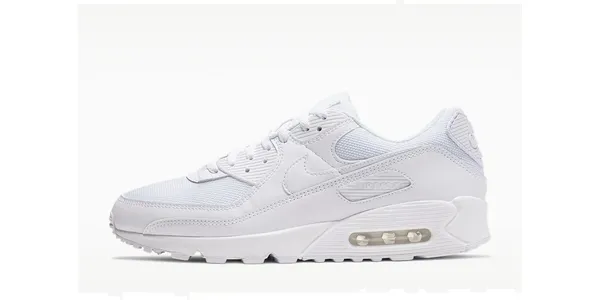
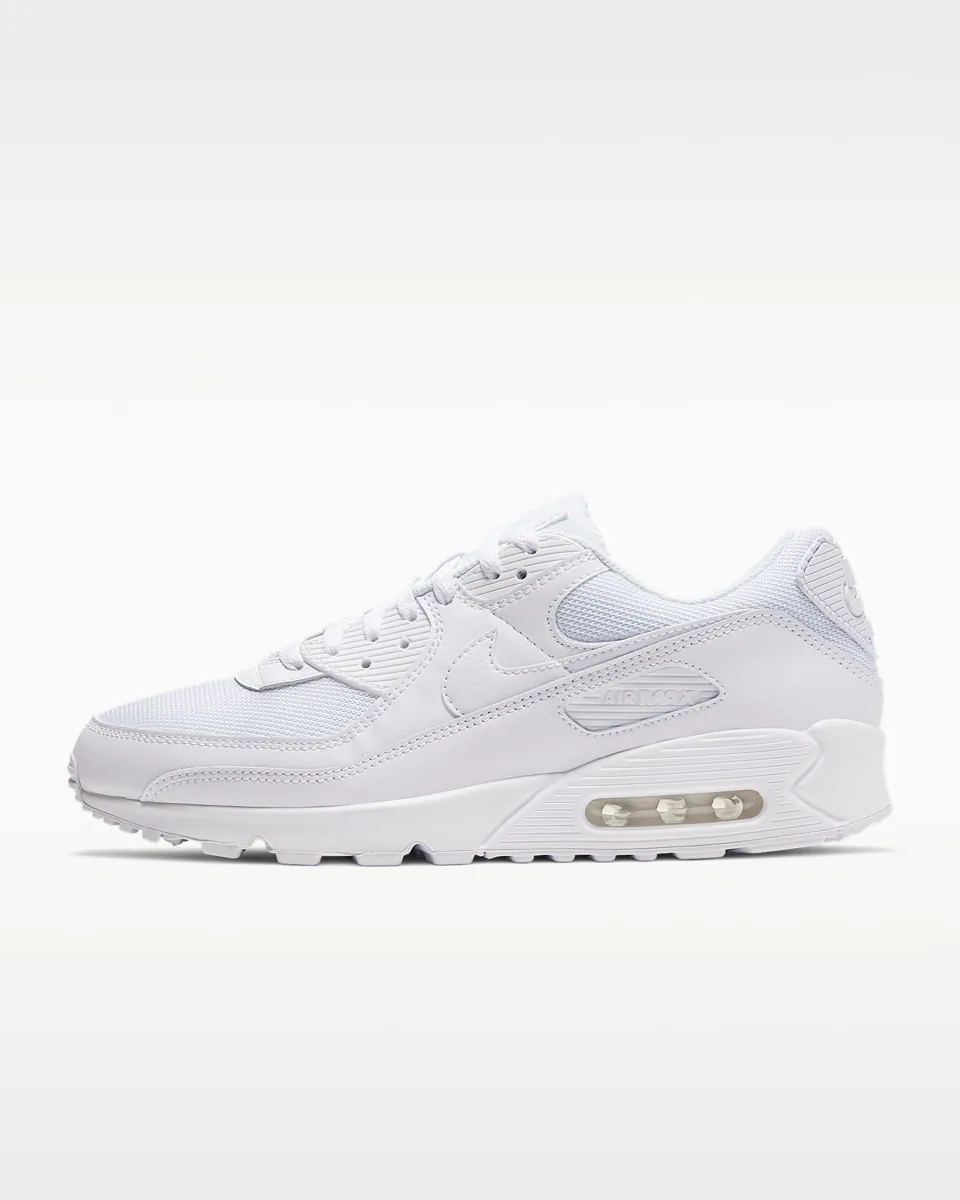
The details that matter
Under the foot: foam, a heel Air unit and a waffle rubber outsole
The sole has three parts: a foam midsole, a Max Air unit in the heel that you can see from the side, and a waffle-pattern rubber outsole at the bottom. Nike says the heel Air unit was originally designed for running shoes.
RunRepeat found the midsole foam much softer than average (34.0 AC on its hardness gauge; lower means softer), with better heel shock absorption than the average lifestyle sneaker and above-average heel energy return of 55%. The testers said this added some bounce to their toe-offs and made transitions slightly easier.
The rubber outsole is 5.5 mm thick, slightly thicker than average. RunRepeat's Dremel abrasion test left a dent of only 0.7 mm, so they expect the outsole to last a long time.
On flexibility, the two sources disagree. RunRepeat found the sole very hard to twist but fairly easy to bend lengthwise, which felt pleasant walking around town. WalkJogRun considers it not very flexible because of the outsole, the heel Air unit and stiff leather, though flex grooves help it bend. If you like a shoe that bends easily, flex the forefoot when you try it on.
The upper: materials vary by colourway, so check the pair you choose
Upper materials vary by colourway. Nike describes some as a textile upper with stitched leather and synthetic overlays plus TPU accents, and others as featuring premium suede. RunRepeat ran a burn test on its pair and found the suede, the Swoosh and the leather-look parts were all synthetic.
Breathability depends on the material. RunRepeat found the mesh very breathable, especially at the toe, gave it a full 5/5, and said feet stayed happy after hours of walking. WalkJogRun, which reviewed the leather version, says breathability is limited, with some airflow through perforations and lighter synthetic areas, and suggests considering another shoe if you live somewhere very hot. If you want an Air Max 90 for hot weather, choose a colourway with plenty of mesh rather than the leather version. For cold weather, RunRepeat says it is not a good fit.
For comfort, the 17.1 mm padded tongue keeps laces from pressing on top of the foot, and the collar is padded. The heel counter (the stiff structure around the heel) is not very stiff, and RunRepeat had no blisters or rubbing.
On durability, RunRepeat's abrasion tool could not break through the mesh at the toe, which scored 3/5, but the heel padding was significantly damaged, scoring only 2/5. If you wear it often, keep an eye on that area. On the plus side, RunRepeat says it is easy to clean.
How it feels: comfortable for all-day walking, fine for jogging and short runs
Walking is where this shoe does best. RunRepeat's testers said walking around town felt like walking on clouds, and that the shoe was not too heavy for running errands or working long shifts. Even though the upper does not lock the foot down very tightly, their ankles felt stable. All About Anthony says it is his favourite Air Max model for comfort.
For running, WalkJogRun says it works for walking, jogging, the gym and short runs, but it is not very responsive when you want to pick up speed. WalkJogRun also reports that some customers said it is not designed for speed or CrossFit.
On grip, the two sources differ. RunRepeat measured the outsole's friction coefficient at 0.33 and says it can slip on wet concrete, cobblestones, wood or tiles. WalkJogRun found no complaints about slipping on wet surfaces. The lab figure is the clearer evidence, so be careful if you often walk on wet ground. Trails, loose gravel and mud are not what it is built for.
Reading the numbers: high drop, thick sole and weight
RunRepeat measured the heel stack at 36.4 mm and the forefoot stack at 22.2 mm, and calculated a drop (the difference between heel and forefoot thickness) of 14.2 mm, which it calls steep. WalkJogRun estimated 10–12 mm by eye without measuring, so go by the measured figure. A high drop means the sole under the heel is clearly thicker than under the forefoot. WalkJogRun says that when running, this kind of drop suits heel and midfoot strikers. If you are used to flatter shoes, walk around in it to see whether you like the feel.
RunRepeat weighed it at 380 g. When trying it on in store, lift it alongside other pairs you are considering. WalkJogRun says it is considerably heavier than modern high-performance sneakers, but not heavy enough to weigh you down.
The insole is 4.7 mm thick, an average thickness, and removable, so you can swap in your own if you want to. All About Anthony says the shoe adds about 3 cm of height, slightly less than the Air Max 1 and Air Max 95.
14.2 mm drop: the sole is clearly thicker under the heel than the forefoot
RunRepeat measured 36.4 mm under the heel and 22.2 mm under the forefoot, a 14.2 mm difference. If you are used to flatter shoes, walk around in it for a while and see whether you feel tipped forward.
Width: check the big toe, the sides and the top of the foot
The toe box is wider than average at the big toe, but RunRepeat says big toes may feel cramped. Lace it snugly, then check for tightness at the big toe and the sides, and on top of the foot. If your feet are wide, walk around to see whether it feels stable, since the sole is narrow at the forefoot.
Weight: compare by hand when trying it on
RunRepeat weighed it at 380 g, and its testers did not find it too heavy for errands and long shifts. Lift it next to other pairs when trying it on in store.
What to check when trying it on, and what to look at if it does not suit
When trying it on, lace it snugly first, then check three spots. First, the top of the foot: see whether it feels snug. Second, the big toe and the sides of the forefoot: see whether they feel cramped. If your feet are wide, walk and shift your weight to see whether it feels stable, since RunRepeat measured the sole width at the forefoot as well below average. Third, the heel: walk around to see whether your heel slips out of the shoe. Colourways with thick leather at the toe can feel stiffer or narrower than mesh or suede ones.
If this pair does not suit you, see the alternatives below.
Size and fit: mostly true to size, but can run narrow
Length: most people wear their usual size. RunRepeat's 341 user votes say it fits true to size, and Nike's review page puts the size rating in the middle, neither small nor big. One customer on Nike's site who wears size 48 or above also said it is true to size.
All About Anthony, whose feet are not particularly wide, finds his usual size comfortable in both colourways, Running Club and Ridgerock. The Running Club pair was slightly snug on top of the foot at first but broke in very quickly. He says that if a pair with a mesh or suede toe box feels narrow, it can break in when laced loosely. He has also heard that some people go up half a size.
Interior width: WalkJogRun says it can run narrow. RunRepeat measured the widest interior point at 90.7 mm, in the medium-width range for casual sneakers. The toe box measured 70.4 mm at the big toe, above average, with a toe-box height of 27.1 mm, which is average. Even so, RunRepeat says wide feet may not get on with this pair, and big toes may feel it is a little too cramped. There is no wide version.
Sole width: RunRepeat measured the sole at only 102.6 mm across the forefoot, well below average, and 81.3 mm at the heel. Their standard-sized feet were fine with it, but they expect wide-footed wearers may find the shoe lacks stability.
Heel: WalkJogRun says the upper and lacing keep the foot from sliding and the heel from slipping.
66.577.588.599.5101111.512
CN8490-100 · 2026-11-24 · Recorded sizes, not current stock