The details that matter
What's under your foot
The top layer is an EVA foam insole built into the shoe, so it can't be removed. If you always use your own insoles, factor that in before buying.
Below it is a thin layer of FloatPro foam. Merrell says it gives exceptional energy return and lasting comfort. RunRepeat describes it as basic EVA: softness measured 39.1 AC, close to average; energy return about 52%, below average; and shock absorption of 61 SA at the heel and 57 SA at the forefoot, both low. On rocky descents you will feel the impacts clearly.
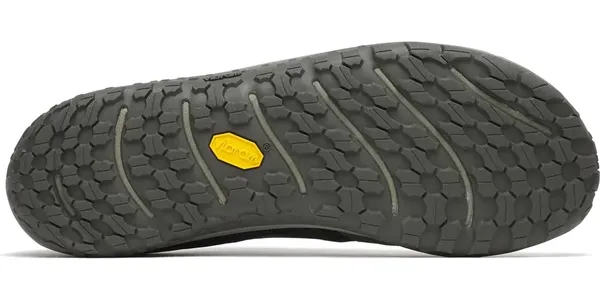
At the bottom is full-length Vibram TC5+ rubber, which RunRepeat measured at 1.6 mm thick. FlexConnect horizontal grooves help the forefoot bend. The lugs are spaced wider than version 7's maze-like pattern, which RunRepeat found somewhat slippery. RunRepeat measured friction at 0.69, and in its abrasion test the rubber wore just 0.8 mm, nearly twice as good as version 7. OutdoorGearLab liked that the rubber wraps up the sides, which cuts damage from rocks and twigs.
Upper: breathable, with a wraparound tongue
The upper is mesh with TPU overlays around the toe, along the sides and across the lacing area, lined with recycled mesh. RunRepeat rated breathability 4/5, and OutdoorGearLab says the mesh keeps the shoe breathable in warm weather. The same mesh is the most likely place to wear through if you walk on loose scree or deep gravel.
Merrell says the toe has an abrasion-resistant cap. RunRepeat's Dremel test on this reinforced toebox scored 4/5, above average. The heel lining scored only 2/5.
The tongue is burrito-style: attached to the shoe and wrapped over the top of the foot. RunRepeat says this keeps it from shifting and keeps debris out. The tongue is much thinner than before, cut from 8.3 mm in version 7 to 3.1 mm, so it feels less plush as you slip your foot in, though still comfortable. Laces run through punched eyelets and lace loops, with a central loop keeping the tongue in place.
Merrell says an external rear sling locks in the heel, but the heel counter (the stiff structure around the heel) is barely there: RunRepeat rated it 1/5, and there is no heel pull tab. Merrell says the shoe is treated with Cleansport NXT for odour control. There are no reflective details, so add a light or reflective clothing for running in the dark.
How it feels depends on what you compare it with
Compared with regular shoes, it bends and twists very easily. In RunRepeat's 30-degree bend test it needed just 9.1 N, and its torsional rigidity measured 7.1 Nm, far below average. The side profile is almost flat, with only a slight rise at the toe. RunRepeat's team enjoyed its natural ride on both trails and pavement.
Compared with other barefoot shoes, OutdoorGearLab's women's review places it among the stiffer ones. It starts stiff and loosens over time, but never becomes as flexible as the most minimal shoes. The men's review says the stiffer, thicker sole reduces ground feel, but the testers felt that was worth it to keep rocks and sticks from poking their feet. RunRepeat sees it differently and lists limited protection against trail hazards.
The two publications disagree on distance. OutdoorGearLab's women's review says the cushion underfoot makes it ideal for extensive walking or running, and impact is less jarring than in shoes with only a few millimetres underfoot. RunRepeat warns that people walking or running longer distances may find the limited shock absorption uncomfortable.
Stability views differ too. OutdoorGearLab found it steady enough on uneven trails, thanks to the zero drop and Vibram rubber that doesn't deform. RunRepeat notes that the shoe offers no assistance to keep the foot centred, and its forefoot platform is only 105.2 mm wide, narrower than average, so stability is up to your feet.
Grip earns consistent praise. OutdoorGearLab says traction is great from loose dirt to rock slabs, and it beat gym-focused barefoot models in mud, though it isn't the most rugged choice for the most intense hikes or trail runs, or for scaling peaks. The lugs are not too tall, so city walking stays comfortable. RunRepeat sees it as a good match for packed dirt, gravel and routes that combine trail with pavement, whether running or hiking.
How to read this shoe's numbers
Drop (the height difference between the heel and forefoot) is 0 mm in every source, and RunRepeat measured exactly 0.0 mm.
Stack height varies by source. Merrell's US product page lists 12 mm under both the heel and forefoot, while RunRepeat quotes Merrell's figure as 14 mm and OutdoorGearLab also uses 14 mm. RunRepeat's own measurement was 15.2 mm at both heel and forefoot. Whichever number you go by, it sits thicker than the thinnest barefoot shoes, such as Merrell's Vapor Glove 7 at 6 mm.
Compare weights only at the same gender and size. Merrell lists 220 g per shoe for the men's version and 173 g for the women's. OutdoorGearLab weighed 437 g per pair for men's US 9 and 394 g per pair for women's US 9. RunRepeat weighed a single shoe at 210 g, lighter than version 7.
Merrell lists the lugs at 2.5 mm; RunRepeat measured 3.0 mm, slightly shallower than average.
What a 12–15 mm stack feels like
Figures vary by source: Merrell US lists 12 mm, RunRepeat measured 15.2 mm. It's thicker than the thinnest barefoot shoes but absorbs little shock. When trying it on, walk on a hard floor and step on something uneven to judge whether the ground feel suits you.
Compare weight at the same size
Merrell lists 220 g per shoe for men's and 173 g for women's. OutdoorGearLab's per-pair figures (437 g and 394 g, US 9) can't be compared directly with single-shoe weights. When trying it on, hold it next to your current pair.
Check instep and toe room
The wraparound tongue can feel tight at first, especially for high-volume feet, so try it on before buying.
What to check when trying it on, and what to look at instead
Lace up snugly and walk around for a while. Check three things: whether the tongue presses on the top of your foot, especially if you have high-volume feet; whether the inner tongue edge rubs below your ankle bone; and whether your toes have room to spread. Some OutdoorGearLab testers who had ankle discomfort said lacing adjustments helped significantly.
If the sole feels too thick, compare it with thinner barefoot shoes. If impact feels too harsh, compare it with shoes that have softer but still low cushioning. If the sides squeeze your foot, look for a wider forefoot shape.
Size and fit: where it's narrow and where it's roomy
Testers who wore it say it runs narrow, but RunRepeat's measurements inside the shoe don't come out narrow, so look at both.
On felt fit, OutdoorGearLab's women's review says it runs narrow. It suits narrow feet that usually slide around in barefoot shoes, and the toe box still leaves room for toe splay, but wide or high-volume feet will feel restricted. The men's review describes a tighter, precise fit that didn't let their toes spread as much, and wider feet got some ankle discomfort, though midfoot and heel security were decent on rougher hikes.
On measurements, RunRepeat found 96.2 mm inside at the widest point, close to the trail-shoe average; 78.3 mm near the big toe, which it calls roomy; and 29.8 mm of height above the toes, which is very generous.
One YouTube commenter who had worn versions 3 and 5 says there is less toe room than before. The women's version in Canada comes in sizes 5–11 including half sizes. If you have high-volume feet, try it on and check whether the tongue squeezes the top of your foot; if it does, this shape may not suit your foot.
77.588.599.51010.51111.512131415
J00005521 · 2026-11-24 · Recorded sizes, not current stock