The details that matter
What is under your foot and how it feels
The midsole is a basic EVA foam (Merrell calls it lightweight EVA). RunRepeat's durometer (a foam hardness gauge) read 38.9 AC, slightly softer than the average hiking shoe. Heel shock absorption is moderate (108 SA in RunRepeat's lab impact test), enough for a few hours of hiking or casual use, and the routinerig reviewer also noticed a cushy feel at the heel. Energy return is 49.9%: the shoe does not feel flat, but there is no noticeable spring.
On a steep three-mile (about 4.8 km) climb over loose dirt and jagged limestone, routinerig found the platform firm enough that you do not feel every pebble, with still enough pop for a quick stride.
The outsole is Merrell sticky rubber. The treads are wide and flat for walking on harder ground, while the perimeter lugs are sharper for grip on climbs and descents.
The sole bends with the foot more easily than average, which smooths the heel-to-toe step, and it twists more than a classic hiker but is still stiff enough to stop excessive midfoot twisting on easier trails.
The insole is a removable EVA footbed, 4.5 mm thick at the heel; Merrell says it is 50% recycled. Users summarised by shoestoryteller say the insole compresses and wears faster than the rest of the shoe after extended use.
The upper: mesh that needs care, a heel that locks in
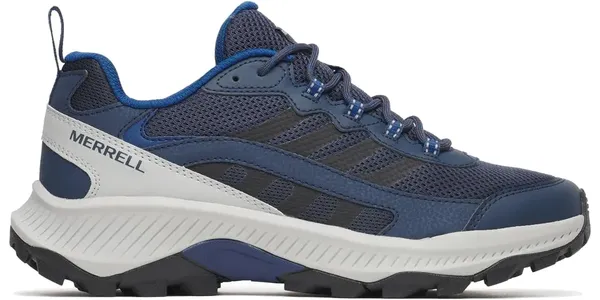
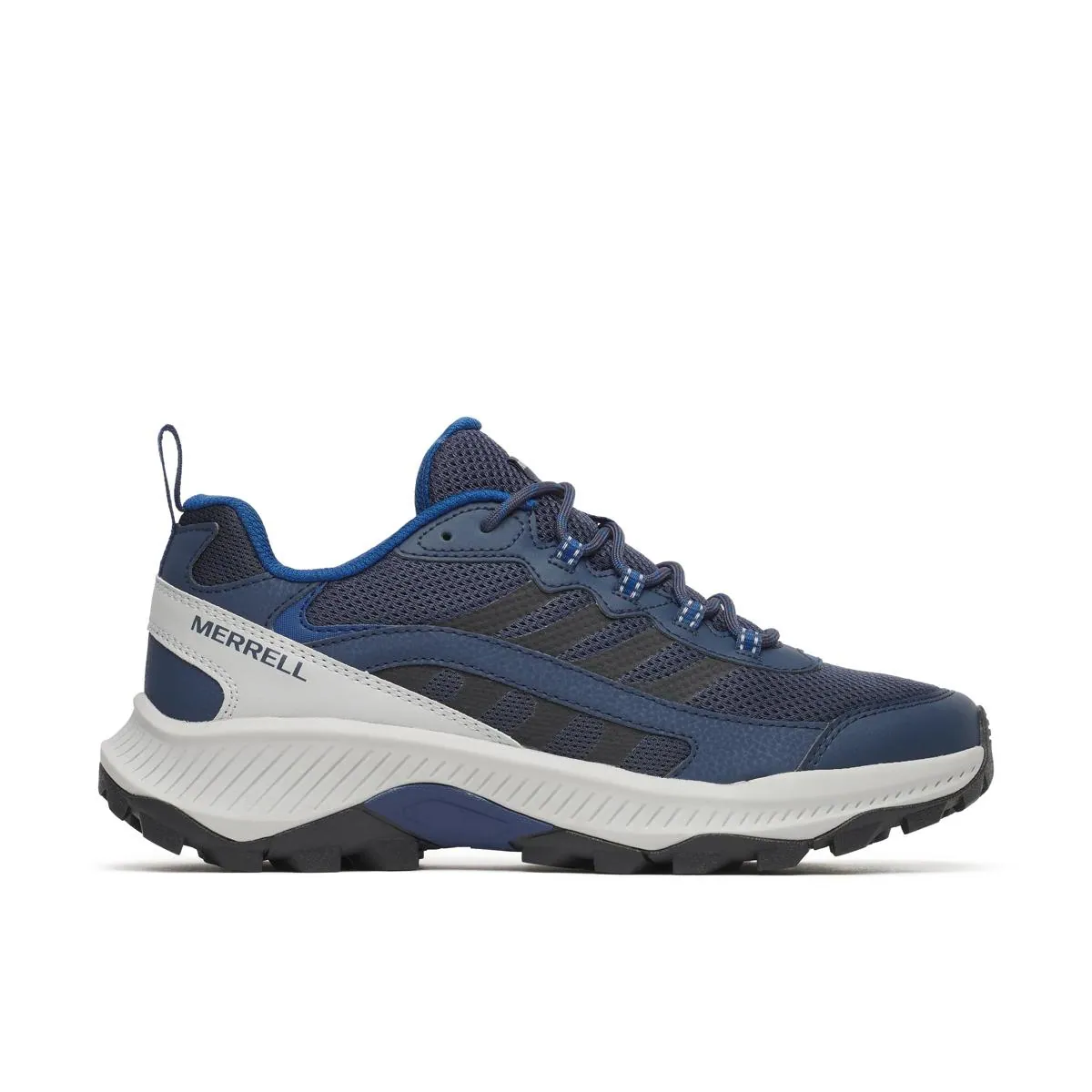
The upper is synthetic and mesh, with a 100% recycled mesh lining. A rubber cap guards the toe; routinerig says kicking a stump or rock did not bruise the toes, and shoestoryteller says the cap does not feel bulky.
On durability, RunRepeat ran a rotary abrasion tool over the toe-box mesh and it tore within seconds (1/5); the mesh lining inside the back of the collar tore almost instantly (2/5). Wearers tell a different story: users summarised by shoestoryteller say the upper materials resist abrasion well, especially around the toe and sides, the toe cap shows no early delamination, and regular trail use gives 350 to 500 miles (about 560–800 km) before significant performance decline. The routinerig reviewer found the mesh surprisingly sturdy to the touch but has concerns about the mesh seams in extremely high-abrasion use, and one user said the seams split after seven months of heavy use. If you often brush past sharp rock or scrub, the mesh is the part to watch.
On heat, RunRepeat's lab breathability test gave a very low score of 54 BR; the materials evaporated 44% of moisture over three hours. The shoe holds in more heat than other hiking shoes (RunRepeat measured 0.279 m² K/W); RunRepeat sees this as keeping feet warm in cooler weather, such as spring and autumn.
The reviewers who wore it describe something else: shoestoryteller reports excellent ventilation on hot-weather hikes, and routinerig says that during a test session in 85°F (about 29°C) humidity, feet stayed noticeably drier than they would have in a leather boot. These measure different things: the lab measures how well the materials pull sweat from the skin, while the reviewers describe wearing it or compare it with a leather boot. If your feet sweat easily, pair it with moisture-wicking socks.
The heel counter (the stiff structure around the heel) scored 5/5 in RunRepeat's manual test, keeping heel and ankle from shifting. A fabric loop at the heel helps you pull the shoe on. Shoestoryteller says the tongue is well padded and stays in place as you move.
The two sources describe the tongue differently. RunRepeat says it is free-floating with no gussets at the sides, which makes the fit a bit more relaxed. Routinerig calls it a bellows tongue (one joined to the sides with fabric) and says it helps keep small stones and twigs out. When trying the shoe on, look at the sides of the tongue yourself to see whether they are attached; on gravelly trails this matters.
Merrell says the footbed cover is treated with Cleansport NXT for odour control.
How it feels on the trail
This shoe does best on day hikes over easy-to-moderate terrain. RunRepeat's wear test found the stability just right for that job. The lugs are a moderate 3.7 mm deep: not too aggressive for streets or hard-packed dirt, but with enough edge to bite into dirt, roots and boulders. A friction coefficient of 0.58 is enough for smooth surfaces such as concrete, stone steps and polished rock.
Routinerig wore it on a steep climb over loose dirt and jagged limestone and said grip on dry rock was almost adhesive, allowing confident movement on light scrambles. The reviewer adds that many hiking shoes feel clunky when you try to pick up the pace, but this one encourages a faster cadence.
On wet ground, shoestoryteller says grip is adequate on wet rock and mud but the shoe is not made for extremely slick surfaces, and the lug spacing lets mud clear relatively efficiently. Routinerig adds that the lugs are not as deep as on a dedicated mud boot but are spaced widely enough to shed debris effectively.
On trail difficulty, shoestoryteller says the shoe excels on moderate mixed trails of dirt, gravel and rock. For more demanding hikes, RunRepeat recommends the Moab Speed 2, and for rocky, technical terrain RunRepeat sees other shoes as a better fit than this one.
Off the trail, multiple users summarised by shoestoryteller report wearing it for 10+ hour shifts on hard surfaces without discomfort. For running, shoestoryteller says it handles light trail running, but dedicated runners may find the support insufficient.
How to read this shoe's numbers
Drop (the difference between heel and forefoot sole thickness): RunRepeat measured 37.0 mm under the heel, thicker than average, and 23.5 mm under the forefoot, mid-range, for a 13.5 mm drop, slightly above the hiking-shoe average. RunRepeat did not find it excessive. Drop only tells you how much higher the heel sits than the forefoot, not which activity the shoe suits. If you usually wear low-drop shoes, walk down a slope when you try the shoe on.
Weight: RunRepeat weighed it at 349 g (men's US 9, standard width), lighter than the hiking-shoe average. Shoestoryteller sees this shoe as a lighter alternative to hiking boots, and the Moab Speed 2, its pricier sibling, is lighter still at 329 g. Other sizes and wide versions of the Speed Strike 2 weigh differently; pick it up next to other pairs when you try it in the store.
Softness: the sole is slightly softer than the average hiking shoe, enough for a few hours of walking.
Lug depth: RunRepeat measured 3.7 mm and shoestoryteller lists 4 mm, a small difference. Both are moderate, not the deep lugs of a mud boot.
How a 13.5 mm drop feels
The heel sits 13.5 mm higher than the forefoot, a drop slightly above the hiking-shoe average. If you usually wear low-drop shoes, walk up and down a slope when trying it on and see whether your ankles and calves feel natural.
Compare weight at the same size
Shoe weight changes with size and width. To compare with another shoe, compare at the same size, or pick both pairs up side by side in the store.
Tall toe box, check the heel
The toebox height (the internal height of the toe box) is a very generous 33.0 mm, while the width at the big toe is medium (73.3 mm). RunRepeat says the tongue is not attached at the sides, which makes the fit a bit more relaxed. Lace it snugly before deciding and check that your heel does not lift as you walk.
What to check when trying it on, and what to look at instead
When trying the shoe on, lace it snugly and walk around: check that your heel does not lift, walk down a slope to make sure your toes do not hit the front, see that the tongue stays in place without sliding sideways, and check whether the sides of the tongue are attached to the shoe. If the standard version pinches at the sides, try the wide version, available for both men and women.
If this shoe does not suit you:
- More demanding hikes: RunRepeat recommends the Moab Speed 2, with much better shock absorption, a more durable upper, better breathability, and less weight.
- Mud, wet ground or heavy packs: routinerig sees the KEEN Targhee 3 as likely the better choice, though the Speed Strike 2 is lighter and more agile.
- Narrow feet: shoestoryteller says the Salomon X Ultra 4 has a narrower fit.
Size and fit
Length: a 15-user vote on RunRepeat says it runs half a size small and suggests going up half a size, while the routinerig reviewer (standard width) and shoestoryteller found it true to size. RunRepeat measured an internal length of 270.5 mm in men's US 9. Measure your foot length and compare it with the size chart, and if you can, try both your usual size and half a size up.
Forefoot: RunRepeat measured an inside width of 73.3 mm at the big toe, a medium width, with no steep taper at the front. The toebox height (the internal height of the toe box) is a very generous 33.0 mm, so toes and nails are not pressed. Shoestoryteller describes a medium-width heel and midfoot with a slightly wider toe box, and says people with very wide feet may need to size up. Routinerig says the toe box is slightly wider than the Columbia Strata Trail Low's.
Heel and instep: the stiff heel counter keeps the heel in place. Routinerig says the laces lock the heel down without pressure points on top of the foot. RunRepeat says the tongue, unattached at the sides, makes the fit slightly more relaxed.
If the standard version is tight through the midfoot or sides, try the wide version.
59768M-J00004938 · 2026-11-24 · Recorded sizes, not current stock