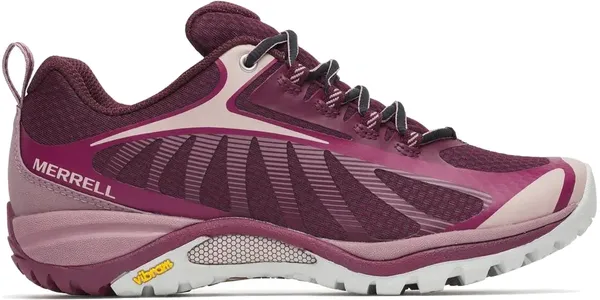
The details that matter
What's under your foot and how it feels
The midsole is lightweight EVA foam. Merrell says it has zones of softer foam and places a Merrell Air Cushion in the heel, which the brand says absorbs shock and adds stability. A molded nylon shank sits under the arch. Switchback Travel says this shank, together with a stable heel cup, gave great support all around the foot, but it also found the foam thin and the sole stiff and rigid. OutdoorGearLab and This Expansive Adventure, by contrast, describe the sole as flexible, and OutdoorGearLab notes lots of flex at the forefoot.
The outsole is Vibram TC5+ rubber formulated exclusively for Merrell, with a mixed tread pattern. Switchback Travel lists 3.5 mm lugs. OutdoorGearLab says the lugs are much softer than on other shoes it tested, giving great short-term traction but less durability, with wear showing toward the heel.
The Kinetic Fit BASE insole is removable. This Expansive Adventure calls it a fairly generic insole with neutral arch support. Switchback Travel found it firm and wished it had swapped it for a more cushioned one. OutdoorGearLab calls the insoles flimsy, and one tester developed a hot spot under the arch on a longer day. If you already have an insole you like, it is easy to swap in.
Upper: airy, with a low collar
The upper is mesh with TPU (plastic reinforcement) overlays and a mesh lining. It is fully synthetic, and OutdoorGearLab notes the materials are vegan. Large vented mesh panels sit on the sides, and there is no waterproof membrane. Switchback Travel wore it in Patagonia at around 70s °F and kept dry, comfortable feet, and says the mesh-and-TPU mix balances breathability and structure.
The flat laces are easy to snug up, and the heel cup is deep and stable. The tongue is a bit thin, though, so the tops of your feet may feel pressure if you lace tight. The collar is low: Switchback Travel says it does little to prevent ankle rolls or keep debris out, and one OutdoorGearLab tester found the collar dug in somewhat on some terrain. If you have bony ankles, check this when you try them on.
The toe has light reinforcement and a small rubber bumper, so toe protection is fairly minimal. This Expansive Adventure says that is in line with other lightweight hiking shoes.
How it feels on the trail
Testers disagree clearly on comfort. This Expansive Adventure says the shoe is light, soft, flexible and comfortable straight out of the box. OutdoorGearLab found the fit somewhat off at first, but it became noticeably comfy after a couple of miles. Switchback Travel wore it out of the box on a 13-mile (about 21 km) hike in Patagonia and ended with achy, sore feet, and the shoe stayed rigid on later outings. Switchback Travel and OutdoorGearLab agree it suits shorter distances: OutdoorGearLab found it supportive enough on 5–10 mile (about 8–16 km) hikes but without enough padding to cushion the foot over many miles.
Stability findings differ too. Switchback Travel rates its stability above average for lightweight hiking shoes, even on off-camber trail, but also found it relatively clunky rather than agile. OutdoorGearLab found ankles rolled on rocky terrain more than in nearly any other shoe in its lineup, while the flexible forefoot let testers pick up speed and respond to the terrain. In its test of 22 women's hiking shoes, OutdoorGearLab ranked it 20th.
On dry ground it grips hardpacked dirt, scree, low-angle slabs and slick sandstone on scrambling approaches at Red Rock well. In mud, Switchback Travel says the lugs are too closely spaced, cake up and slip. This Expansive Adventure says traction falls off dramatically on wet, muddy or icy surfaces, as with every shoe it has assessed.
The tested version is not waterproof. In OutdoorGearLab's test of 5 minutes in 4 inches (10 cm) of water, it soaked through in seconds and absorbed 8 oz of water, but it dried fastest of the non-waterproof shoes in the group.
On durability, Switchback Travel saw almost no wear: no snags in the mesh and intact lugs. OutdoorGearLab saw scuffing at the front within a few months of walking up and down granite and wedging the shoes in cracks. This Expansive Adventure says the light materials show wear quickly, likely cosmetic, but it has concerns about the sole.
How to read the numbers
Merrell lists an 11 mm drop (the difference between heel and forefoot sole thickness), meaning the heel sits 11 mm higher than the forefoot. If you are used to flat shoes, walk around the shop and see whether you like that feel. Merrell does not list stack height, so stand and walk on a hard floor for a while to judge whether the cushioning is enough for your feet.
Merrell lists 280 g without stating the size. Review figures are per pair: OutdoorGearLab measured 580 g per pair in US 8.5 and lists 1.4 lb (about 635 g) in US 10; This Expansive Adventure gives 560 g per pair; Switchback Travel uses the spec figure of 1 lb 2 oz per pair (about 510 g). The numbers vary with size and source, but every source agrees it is very light for a hiking shoe.
Switchback Travel lists 3.5 mm lugs, which is useful for comparing with other hiking shoes; for example, it says the Merrell Moab 2 has 5 mm lugs and grips better.
Match weight to size
Review figures are per pair, such as 580 g in US 8.5. When comparing, match the size and check whether it is per shoe or per pair, or hold the shoes side by side when trying them on.
11 mm drop
The heel sits 11 mm higher than the forefoot. If you are used to flat shoes, walk up and down a ramp in the shop to see whether it feels natural.
3.5 mm lugs
The lugs are 3.5 mm and closely spaced, while the Merrell Moab 2 has 5 mm lugs. They are good on hardpacked dirt and dry rock, but they cake up in mud. If your trails are often muddy, look for deeper, more widely spaced lugs.
What to check when trying it, and what else to consider
When you try them on, lace them snugly first, then check that your toes can move and the sides don't pinch, your heel stays put when walking down a slope, the collar doesn't press on your ankle bones, and the thin tongue doesn't let the laces press on the top of your foot. If you have a softer insole, try it in the shoe as well, since testers from two sources disliked the stock insole.
If you want soft cushioning for all-day hiking, look at hiking shoes with a thicker, softer sole. Switchback Travel says the Salomon OUTline is softer with better traction, the Altra Lone Peak 6 is much more cushioned and comfortable, and the Merrell Moab 2 is more durable, grippier and better cushioned but considerably heavier. If you often hike in rain or cross streams, look at the waterproof Siren Edge 3 with an M-Select DRY membrane, which Switchback Travel says adds 3 oz with everything else the same.
Size and fit
Size reports point the same way: your usual size should work. This Expansive Adventure says it fits true to size and runs from US 5 to US 12. Switchback Travel's tester, with an average foot, wore her standard US 8.5 and found the fit pretty good overall, but with more toe-box room than she prefers, which felt a bit sloppy on steep descents without causing blisters or sore toes.
Testers felt differently about forefoot width. OutdoorGearLab tested the medium width and found the toe box reasonably wide for narrow-to-average feet, but some testers found it not quite wide enough to let toes splay and avoid hot spots and blisters, so it calls this a shoe best suited to narrow-to-average feet. The deep heel cup helps keep the heel in place.
It comes in two widths: standard (44491W) and wide (44492W). Switchback Travel says the wide version is made for higher-volume feet. If the standard version pinches your toes or the sides of your foot, try on the wide version before buying.
44491W-J038994 · 2026-11-24 · Recorded sizes, not current stock