The details that matter
What's under your foot
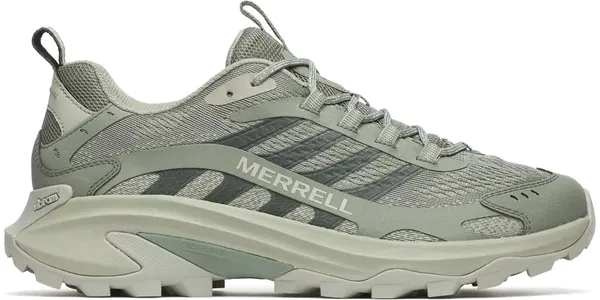
The innermost layer is a removable EVA foam footbed made with 50% recycled material. Below it is a FloatPro foam midsole, and at the bottom is a Vibram TC5+ rubber outsole with 4 mm lugs.
Merrell says the FloatPro foam has exceptional energy return and lasting comfort, and that a lightweight FlexPlate provides torsional rigidity and lateral stability while keeping the forefoot flexible. The TC5+ rubber is formulated exclusively for Merrell, and the lugs are designed to increase traction and shed debris with each step. Merrell also mentions a full-length rock plate and a secure-fit heel counter (the stiff structure around the heel).
RunRepeat, for its part, said not to expect a very bouncy or responsive ride. If you like a bouncy sole, walk in the shoe in the shop first.
Breathable upper, but water gets in
The upper is engineered mesh with TPU, 39% recycled, with a 100% recycled mesh lining. The heel and toe have abrasion-resistant synthetic caps, the collar is padded, and loops at the heel and tongue make it easier to pull on. The tongue is a bellows design, meaning it is joined to the shoe on both sides. Merrell says the upper is breathable and that this tongue keeps out debris. Trail & Kale said his feet stay cooler and the shoe feels less stuffy, but RunRepeat still found small branches, pebbles and dirt got into its shoes.
This version has no waterproof membrane. OutdoorGearLab found the upper so porous that its socks soaked quickly crossing a dewy meadow in the morning. Trail & Kale also said wet grass, puddles and stream splashes will get in eventually. In the rainy season or on wet grass, pack spare socks or look at the GTX version.
On foot hold, OutdoorGearLab said that on steep sideways descents the soft upper is not strong enough to hold the foot firmly, so the foot slides out over the edges of the side lugs, reducing traction, control and confidence.
How it does on the trail
On moderate trails, RunRepeat had nothing but praise for the grip, OutdoorGearLab had no problems on packed dirt, and Trail & Kale, using it on gravel paths, light trails and dog walks, said it rolls smoothly through each step.
On wet or harder ground the outlets describe it differently. OutdoorGearLab said it could still slip on wet rock and stream crossings, but no more than average for this class of shoe. Trail & Kale found grip less convincing on very slick wet rock or deeper mud, and said it is not a super precise shoe for steep scrambling or aggressive off-camber terrain.
On durability, RunRepeat's Dremel left a clear hole in the shoe's inner textile in just 4 seconds. OutdoorGearLab found one fabric eyelet starting to fray after 20 miles (about 32 km), while its lead tester's previous pair went more than 100 light-duty miles (about 161 km) with no eyelet failures. After some use, check the inner textile and the fabric eyelets now and then.
Drop, stack and weight
Drop is the difference between sole thickness under the heel and under the forefoot. Merrell lists 34 mm under the heel, 24 mm under the forefoot and a 10 mm drop. RunRepeat used a caliper on a men's US 9 and measured 38.8 mm under the heel and 23.8 mm under the forefoot, which puts the drop at about 15 mm. The difference is under the heel, which RunRepeat measured thicker than Merrell lists. If you are used to low-drop shoes, walk in it first.
On weight, Merrell gives 340 g per shoe for the men's version but does not say which size. Trail & Kale weighed its own men's US 9 at 329 g (11.6 oz). OutdoorGearLab tested a size 14 and itself notes it is heavier than smaller sizes. If weight matters to you, hold it against other shoes in your size when you try them on.
Drop: walk down a slope
Drop tells you how much higher the heel sits than the forefoot, not how soft the shoe is. Merrell lists 10 mm; RunRepeat measured about 15 mm. If you are used to low drop, walk up and down a slope in it to see whether it feels comfortable.
Weight: compare in the same size
Larger sizes weigh more than smaller ones, as OutdoorGearLab notes for its size 14. When comparing with other models, use weights in the same size, or hold them side by side when trying them on.
Heel: check it on a slope
Trail & Kale rated heel lockdown good rather than exceptional and prefers heel-lock lacing on steeper terrain. When trying it on, walk down a slope and check whether your heel lifts or your foot slides into the front, both before and after heel-lock lacing.
How to try it on, and what to look at instead
Wear the socks you actually hike in when you try the shoes on. If the shop has a ramp, walk up and down it. Check that your toes do not hit the front on the way down, the sides do not squeeze, and your heel does not lift. On steeper terrain, Trail & Kale prefers to cinch the laces a little harder or use heel-lock lacing, so try lacing that way too. If it still does not fit after adjusting, try the next size, and read the exchange policy before ordering.
If this shoe does not suit you, choose by the problem. For routes that are often wet, look at hiking shoes with a waterproof membrane; Merrell offers the low-cut Moab Speed 2 GTX and the Mid GTX boot. For steep side slopes or scrambling, look for a shoe with a stronger upper that holds the foot more securely.
Size, width and heel
RunRepeat and Trail & Kale (men's US 9) found it true to size. RunRepeat added that the fit is accommodating, and Trail & Kale felt a medium width. OutdoorGearLab (size 14) found it runs slightly long. Try it on before buying, then walk down a slope to check whether your toes hit the front.
Alastair Dixon of Trail & Kale rated heel lockdown good rather than exceptional, and on steeper terrain he prefers to cinch the laces a little harder or use heel-lock lacing. OutdoorGearLab's narrow-footed tester found it comfortable on moderate trails.
Merrell also offers a Wide Width version. If you have wide feet or the regular version feels tight, try the wide one.
58711M-J00003607 · 2026-11-24 · Recorded sizes, not current stock