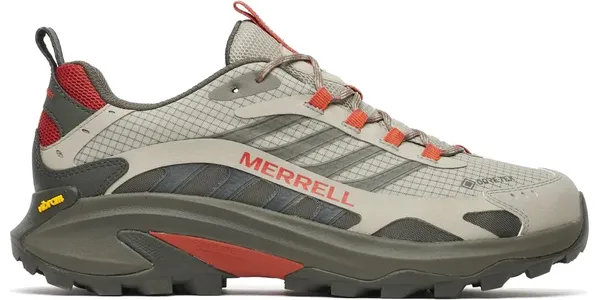
The details that matter
Underfoot: soft foam, a rock plate and a Vibram outsole
The midsole is FloatPro foam, and Merrell says it uses 30% more foam than the previous version. Treeline Review describes it as soft and springy, absorbing impact well on hard surfaces and long descents. RoadTrailRun calls the cushioning high without being maximalist.
Between the foam and the outsole is a full-length rock plate that keeps sharp rocks from pushing through to your foot, plus a FlexPlate that resists twisting and adds side-to-side stability while leaving the forefoot flexible. Switchback Travel says it adds structure without taking away the padded feel.
The outsole is Vibram TC5+ with 4 mm lugs. Merrell says the lugs are meant to add traction and shed debris with each step. RoadTrailRun says it suits moderate trails and transitions well to pavement.
The softness has a downside. Switchback Travel places it at the softer end of the spectrum, which makes it less suited to tricky terrain. The footbed is a removable EVA foam insole.
Upper: synthetic materials, a waterproof lining and how warm it runs
The upper is fully synthetic with TPU overlays on the outside, lined with recycled mesh and a GORE-TEX waterproof membrane. The toecap and heel are covered with abrasion-resistant synthetic material, and the collar and tongue are padded. T3 calls it very comfortable thanks to the padded tongue and heel.
Testers differ slightly on warmth. Believe in the Run found the lining more breathable than expected but still fairly warm. Treeline Review found it very breathable for a GORE-TEX shoe, though on warm, dry days or high-output hikes it felt a touch warmer than a non-waterproof shoe, but not uncomfortably so. Switchback Travel says the membrane and TPU layer reduce airflow and slow drying. If you mostly hike in hot weather, the Moab Speed 2 also comes in a non-waterproof version.
In its second wet season, Treeline Review noticed the outer fabric starting to get more saturated in heavy rain.
The top has double eyelets for cinching the ankle tighter, plus pull loops on the heel and tongue. Small points to know: RoadTrailRun found the tongue a bit narrow at the top and its lower section a bit rough, and Switchback Travel got debris in through the gap between the tongue and upper even when laced tightly.
How it feels on the trail
Testers agree it suits day hikes on easy-to-moderate trails. Switchback Travel climbed Cerro Nani, about 5,000 vertical feet in under 5 miles, and finished the day with no hot spots or pressure points. Countryfile found it comfortable from the first day on a four-hour walk over rough terrain with up- and downhill sections.
Testers disagree on break-in. Treeline Review, RoadTrailRun and Countryfile found it comfortable from the first day, but Believe in the Run found the midsole hard, clompy and unpliable until at least 20–30 miles. If it feels stiff when you try it on in the store, that stiffness may ease after some wear.
On grip, Treeline Review says the shoe felt secure on muddy descents and slick wooden stairs. Countryfile found good grip on wet or algae-covered rocks when crossing streams, and T3 had no slips on steep paths up Pen y Fan. The only time Switchback Travel's pair faltered was on steep rock slabs, which the tester put down to the sloppy fit rather than the outsole.
On stability, RoadTrailRun didn't miss the Mid's added ankle support because the platform is very stable. Switchback Travel suffered a few ankle rolls on Cerro Nani but was overall impressed by how the shoe handled loose and off-camber terrain; it adds that the roomy toe box and insecure heel give a slightly sloppy feel that is not ideal for steep and technical terrain. T3 nearly rolled an ankle once and would avoid it for scrambles or very steep or heavy hikes because of the lack of ankle stability and support.
On durability, Treeline Review wore it daily for about a year and a half and over 250 miles: stitching intact, TPU overlays still attached, outer-edge lugs rounding, cushioning slightly compressed but still stable. RoadTrailRun saw no wear after 100 km. Countryfile, though, found creases in the foam after a few walks and worries regular use could lead to premature wear.
Believe in the Run says it is too heavy and stiff to run in, so keep it to walking paces on trails and sidewalks.
Reading this shoe's numbers
Merrell lists a 34 mm heel stack and a 24 mm forefoot stack, a 10 mm drop (the difference in sole thickness between heel and forefoot) and 4 mm lugs.
Switchback Travel calls the 34 mm heel stack tall and says some hikers may not like it, though the tester never felt off-balance. RoadTrailRun also says the shoe didn't feel too tall. A 10 mm drop means the heel sits 10 mm higher than the forefoot. If your usual shoes have a lower drop, walk up and down a ramp in the store to see how different it feels.
For weight, RoadTrailRun weighed a women's US 9 at 323 g per shoe. When comparing with other shoes, match the size and check whether the figure is per shoe or per pair. If you're choosing the men's version or another size, lift it next to the pair you wear now when you try it on in the store.
Check heel hold
Wear hiking socks, lace normally, and walk up and down a ramp or stairs. If your heel lifts, cinch the ankle using the double top eyelets. If it still slips, try another shoe.
Tall stack and 10 mm drop
The sole is 34 mm thick under the heel and 24 mm under the forefoot, so the heel sits 10 mm higher. If your usual shoes have a lower drop, walk on a ramp in the store and see whether you feel steady.
Weight
RoadTrailRun weighed a women's US 9 at 323 g per shoe. When comparing with other shoes, match the size and check whether the figure is per shoe or per pair.
What to check when trying it on, and what to look at instead
When trying it on, check the heel first, because it is what testers mention most. Wear the socks you hike in, lace up normally, and walk up and down a ramp or stairs. If your heel lifts, use the double top eyelets to cinch the ankle tighter. If it still slips, this shoe may not match your foot shape. Also check that your toes can move and nothing presses on the sides.
If you want more breathability, the Moab Speed 2 comes in a non-waterproof version. If you want more ankle support, T3 points to the Moab Speed 2 Mid. If you often hike rough ground or carry a heavy pack, look at a sturdier, more protective hiking shoe; Switchback Travel and Treeline Review name the Moab 3. For mostly technical terrain, Treeline Review points to the Salomon X Ultra 5 GTX, and Switchback Travel says the Salomon has a stiffer platform and a more secure heel.
If you often hike rural trails, Countryfile says lighter colours will look a bit scruffy after a couple of uses.
Size and fit
Most reports say it fits true to size. RoadTrailRun found it true to size and comfortable. A second RoadTrailRun review found the fit snug, with no blisters after about 70 miles, and a roomy toe box. Treeline Review's women's tester, who has high-volume, D-width feet and usually wears 7.5–8, found the 7.5 spot-on: snug through the heel and midfoot with plenty of toe-box room. Treeline's men's tester, usually an 11.5–12, found the 11.5 fit well without sizing up.
Some reports differ. Countryfile (women's version) says sizes come up big. Switchback Travel's tester, usually a women's 8.5–9, chose a 9; the length fit, but the wide toe box and insecure heel made it feel sloppy. Believe in the Run, even after break-in, struggled a little to lock the heel in without really cinching the laces, and found the heel a little wide even with thicker socks. T3 found the heel a tad loose, slightly shifting up and down with every step; tight lacing helped, but the fit could still have been a little more secure.
Most testers had room in the forefoot; the heel is what to check carefully. If the regular version is tight through the midfoot, Merrell makes wide versions for men and women to try on.
58708M-J00005347 · 2026-11-24 · Recorded sizes, not current stock