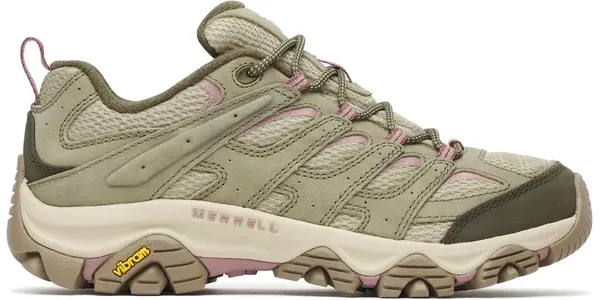
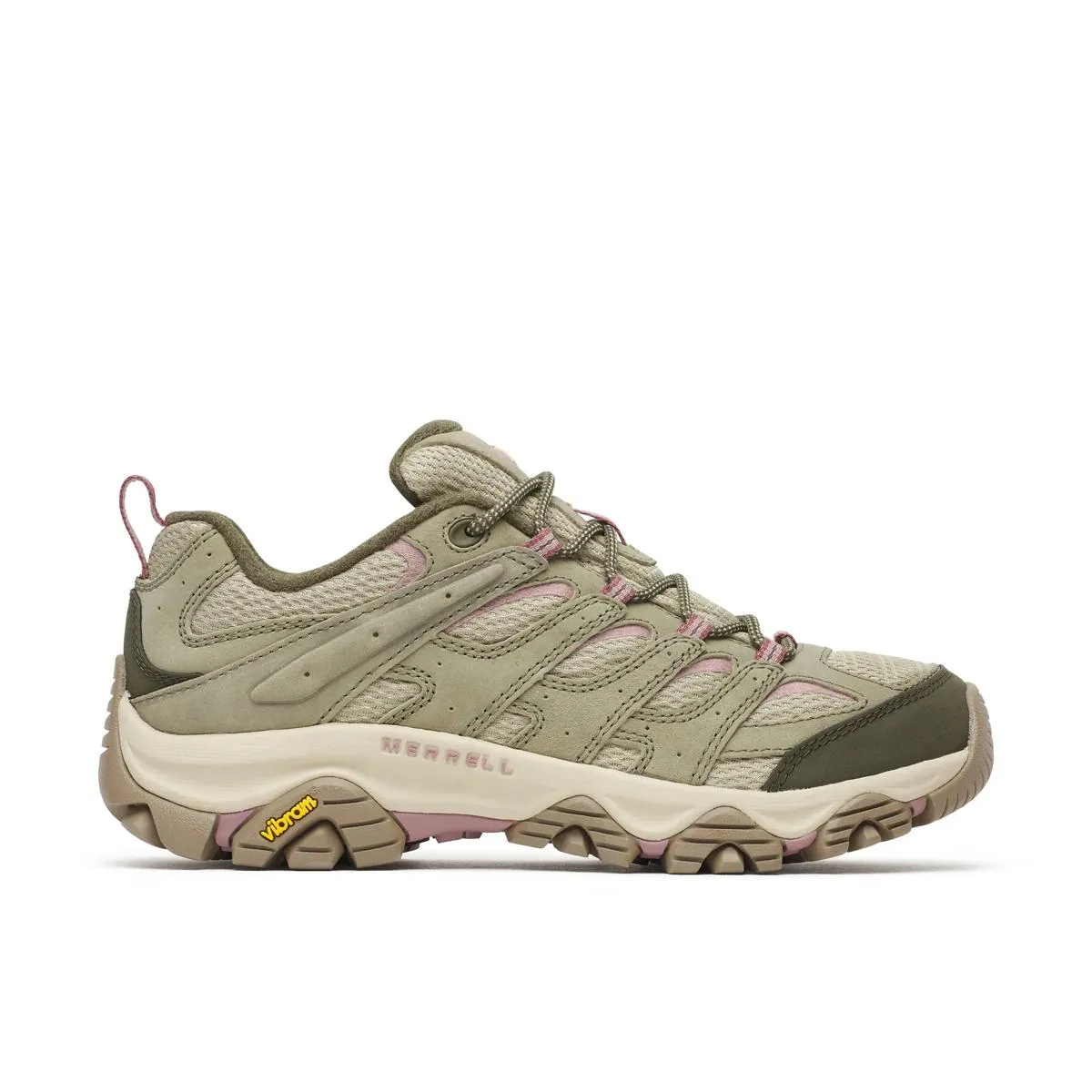
The details that matter
What's underfoot and how it feels
The midsole (the foam layer between your foot and the rubber) is what Merrell calls Super Rebound Compound, which it says absorbs shock, reduces torque and allows a smooth transition into the midfoot. OutdoorGearLab's women's review describes it as an EVA midsole with excellent support, especially for high arches.
The heel holds a Merrell Air Cushion, which the maker says absorbs shock and adds stability. Advnture felt plenty of suspension and some rebound, especially in the heel, and appreciated it on long days on hard, dry trails. A molded nylon shank under the arch gives the shoe a level of structure.
The outsole is Vibram TC5+, formulated exclusively for Merrell, with 5 mm lugs. OutdoorGearLab says this rubber is not as sticky as the Vibram compounds on higher-performance hiking shoes, but still performs above average. Its women's review found the Moab 3 more supportive, with much better traction than the Moab 2.
OutdoorGearLab says the midsole is a lot more robust than in many light shoes. Tom's Guide found the thick sole comfortable on long walks and good at absorbing shock on rocky paths, while CleverHiker calls it bulky underfoot and less flexible than trail runners.
Upper: suede and mesh, breathable but not waterproof
The upper is pig suede leather combined with mesh, with a 100% recycled mesh lining; the laces and webbing are recycled too. Tom's Guide notes that some colourways use pigskin leather and others suede, and wishes there were a vegan version. Advnture also warns that pig leather suede is not suitable for some people. If you avoid pig leather or animal leather, this shoe will not work for you.
The leather panels provide lateral support but flex easily when needed. OutdoorGearLab says the upper materials are soft and hold little shape on their own; they only support the foot once laced snugly. Thick rubber caps at the toe and heel guard against knocks and wear. The bellows tongue, stitched to the upper on both sides, keeps dirt, debris and snow out.
Most lace attachment points are fabric loops, with a metal eyelet only at the top near the ankle. OutdoorGearLab had no durability problems during testing but expects the loops could fail over time from lacing torque, and noted how vulnerable the mesh is on technical trails and sharp rock.
On heat, OutdoorGearLab's men's review found feet stayed relatively cool and comfortable when temperatures went past 90°F (about 32°C), while the same site's women's review says the extra padding creates a bit of heat, especially on long, hot days. Tom's Guide calls it warm but still breathable, and Advnture, testing the Gore-Tex version, found it ran warm in exceptionally hot weather.
How it performs on the trail
Most testers found it comfortable from the first wear. Only OutdoorGearLab's women's review added that, though comfortable out of the box, it took a few miles to hit its sweet spot.
Traction drew the most praise. Tom's Guide walked down a wet, slimy stony path after a spell of wet weather without slipping once, and found uphills easy even in mud thanks to the 5 mm lugs. OutdoorGearLab's men's review says the lugs are soft enough to grab and hold very steep stone without slipping, making boulder scrambling a fun diversion.
On wet ground, mud and snow, results differ by surface. OutdoorGearLab's men's review says the lugs are fairly shallow and wide: good on packed trail and rock slabs, but they clog easily in wet muck. Outdoor Life also found mud and sand clinging to the tread, though it felt the stability was worth some scraping. Advnture (Gore-Tex version) says the shoes kept excellent grip on wet tree roots and mud without collecting much muck between the lugs. OutdoorGearLab's women's review noticed the shoe tending to slip out on lingering snow fields and slippery branches.
On water, OutdoorGearLab's stream-crossing test allowed one, maybe two quick steps before feet got wet. Outdoor Life found water passed through quickly. How fast it dries differs by source: CleverHiker says it dries reasonably fast in warm conditions, OutdoorGearLab says it does not dry as fast as you might expect, and Tom's Guide soaked the shoes in a bathtub and found they took 24 hours to dry indoors at 68°F (20°C).
On distance, testers see it differently. Outdoor Life found it comfortable for days under 10 miles (about 16 km) and says it will not perform optimally on longer or faster outings such as backpacking, summiting or trail running. OutdoorGearLab says it performs well even with a moderately heavy pack on a weekend overnight, but would not be its top choice for a really long-distance hike. Tom's Guide felt the arch support kept feet feeling fresh on longer hikes, though the tester's left arch began aching after about four hours, something that happens with 90% of the tester's footwear.
Around town, Tom's Guide wore it daily for over a month, more than 300,000 steps, and found it cushioned and secure while shopping and exploring, with better balance on uneven pavement than in Converse or Vans. Still, the tester was not convinced it works as an everyday hybrid shoe because it looks too rugged.
OutdoorGearLab placed the men's version 13th of 17 models, and the women's version scored 73 points, 8th of 22 models.
Reading the Moab 3's numbers
Drop (the difference in sole thickness between heel and forefoot) is 11.5 mm, as listed by Merrell, CleverHiker and Outdoor Life; Merrell's men's wide-width page lists 11.55 mm, a decimal-place difference. Outdoor Life considers this a high drop that benefits heel strikers by keeping stress off the feet and calves, but also writes that over time it will make you feel more of the stress in your knees and hips. When you try it on, walk up and down a slope.
Lug depth is 5 mm, as listed by Merrell and the four reviews that give the figure (CleverHiker, Outdoor Life, Advnture and Tom's Guide). Tom's Guide credits these lugs with helping on tricky terrain.
On weight, Merrell lists 350 g, and OutdoorGearLab weighed a size 14 pair at 1.1 kg (2.42 lb). That figure is for a large size, weighed as a pair. When comparing with other shoes, compare at the same size, and pick up pairs side by side when trying them in a store.
11.5 mm drop: how to check it
Drop is the difference in sole thickness between heel and forefoot. Outdoor Life considers 11.5 mm a high drop. When trying it on, walk up and down a slope, check that you feel steady going downhill, and notice how different it feels from your usual shoes.
Weight: always compare the same size
OutdoorGearLab weighed a size 14 pair at 1.1 kg, a figure for a large size. Compare other shoes at the same size, or pick them up side by side in the store.
Forefoot room and ankle collar
Wear your hiking socks, lace up snugly, and check that your toes can move, the sides don't pinch and the ankle collar isn't loose. If the regular width is tight at the sides, try the wide version for comparison.
What to check when trying it on, and what to compare
When trying the shoe on, wear the socks you will hike in, lace it snugly, and check three things:
1) Your toes can move and the sides of your foot are not squeezed.
2) Your heel does not lift on slopes and the ankle collar is not loose. Testers differ here: OutdoorGearLab found it snug, while Tom's Guide found it quite loose.
3) Whether you like a thick sole. The Tom's Guide tester, who usually hikes in Keen Jasper Zionics, was a little put off by the thick sole at first.
If the Moab 3 does not suit you, compare by what you need:
• Lighter and cooler: look at lightweight hiking shoes or trail runners. OutdoorGearLab names the Merrell Moab Speed 2, lighter, full-synthetic and cooler, but less robust. CleverHiker names the Saucony Peregrine 16, lighter, more flexible and more breathable, while the Moab wins on traditional support and durability.
• Lots of time in sustained rain, snow or mud: CleverHiker recommends a waterproof model.
• Heavy packs on rough terrain, or weak ankles: look at a mid-height boot (Advnture and Tom's Guide).
Size and fit
OutdoorGearLab's men's review found it true to size in length, quite accommodating and slightly wider than average. The tester wore the regular width and found it comfortably snug but not tight, with no excess room in the toe box or heel cup.
In OutdoorGearLab's women's review, the lead tester, who has a high arch and a narrow foot, found it true to size with more toe-box room than most hiking shoes they tested. Outdoor Life says it accommodates wider feet, whether from genetics or swelling.
Heel and ankle: OutdoorGearLab's men's review says the padded ankle cuff and laces lock the foot in with little slippage, and its women's review found the lacing gives a snug ankle collar with good support against forward and sideways flex. Tom's Guide had a different experience: the collar is cushioned but quite loose, the shoes slipped on and off without untying, and the ankle felt unsupported on long walks.
Merrell sells wide-width versions for both men and women. If the regular width feels tight at the sides, try the wide version on and compare before buying.
51004W-J00005394 · 2026-11-24 · Recorded sizes, not current stock