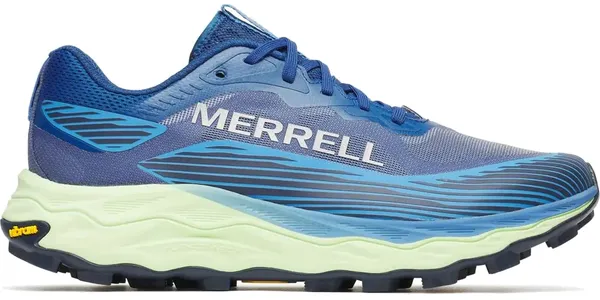
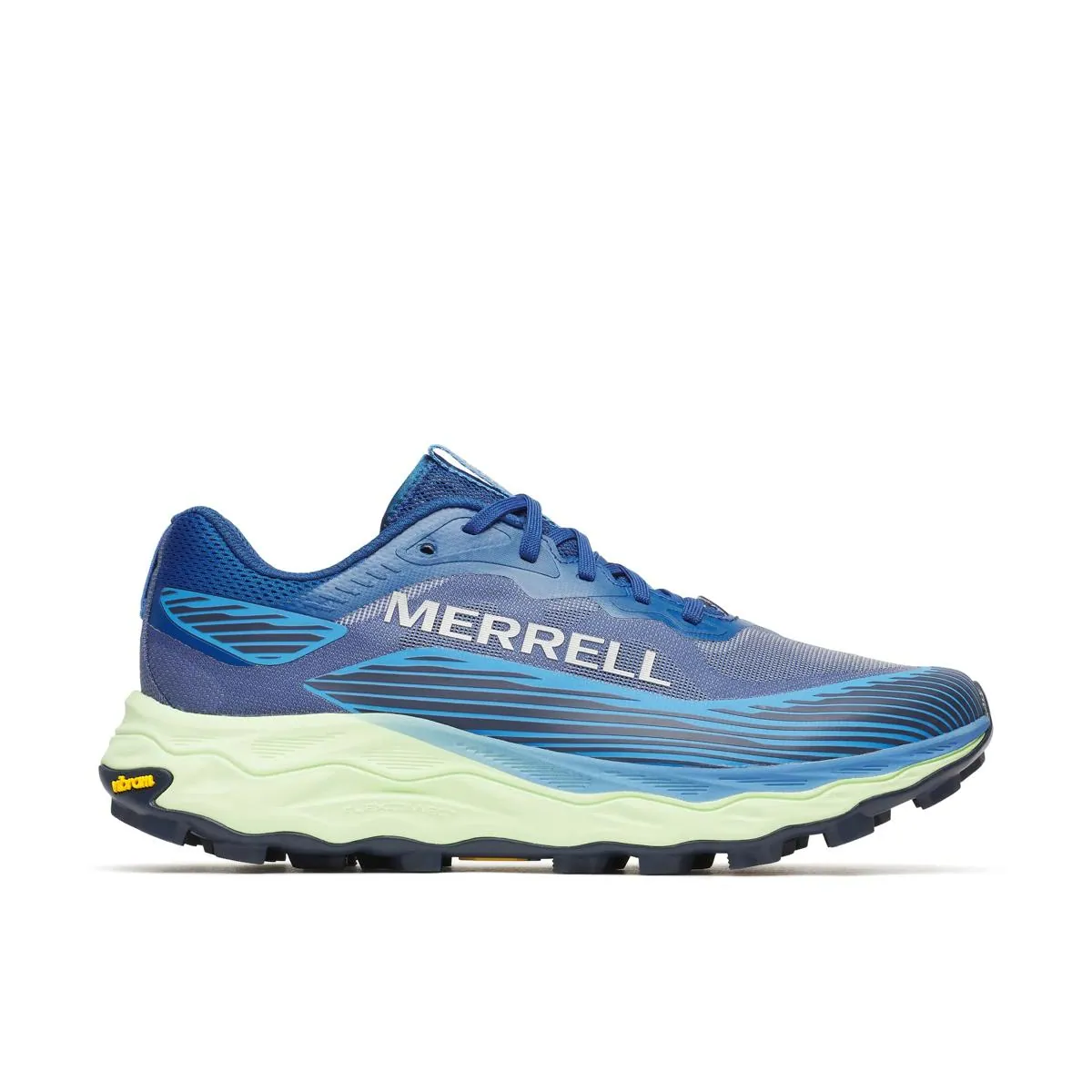
The details that matter
What sits underfoot and how it feels
The midsole is FloatPro foam, which Merrell says gives exceptional energy return and enduring comfort. FLEXconnect grooves let the midsole flex in two directions; the maker says they improve ground connection, and on this version they run the full length of the midsole.
Under the forefoot sits a rock plate, a layer inside the sole that stops sharp rocks and rough ground from pressing through to your foot. Merrell calls it lightweight and impact-resistant, with flexible defense. The outsole is Vibram Megagrip rubber with 5 mm lugs, all of them Traction Lugs, which the maker says add traction and shed debris with each step.
Reviewers see the plate differently from the maker. Believe in the Run calls it a stout plate covering the whole forefoot that gives the shoe stiffness and protection, and Michael found the forefoot exceptionally stiff. RunRepeat measured the foam at 36.7 AC, around average for trail shoes, yet found the ride noticeably firm because of the deep lugs and rock plate.
If rock protection is your priority, that is a plus. If you like a shoe that bends easily with your foot, put weight on the forefoot at the try-on and see how easily it flexes.
The upper: breathability and lockdown
Merrell lists a breathable mesh, synthetic and TPU upper, with 3D-printed and TPU overlays in wear zones for durability. The lining is 100% recycled mesh, the collar is padded and the footbed is removable, and this version has a lighter, more breathable upper. The bellows tongue (a tongue joined to the upper at the sides) keeps out debris, Merrell says.
RunRepeat measured breathability at 62 BR, slightly below average. It stops short of strongly recommending it for hot summer days, but says it manages sweat reasonably well and should keep feet comfortable on all-day hikes and trail runs in moderate temperatures. If you often run in hot sun, it may feel a bit warm.
On lockdown, Jeff found the midfoot slightly more secure than version 5, as the new flat laces seem to snug up more securely than the old round ones. Michael describes an otherwise secure fit, except for some lift at the heel.
How it felt on the trail
Jeff Valliere has mostly run on snow, ice and slush of nearly every frozen or semi-frozen consistency, plus dry trails, minor scrambles and steep, loose off-trail ground, and says he never felt hesitant. He found the FloatPro foam very soft, well cushioned, supportive and resistant to hardening in the cold, comfortable for daily training and long distances. He also felt the cushioning was more ample than the numbers suggest, perhaps partly because of the 5 mm lugs.
Others felt it differently. RunRepeat found the ride noticeably firm and says the shoe can feel harsh on short road sections or smooth dirt roads but truly shines when the terrain gets demanding. Michael at Believe in the Run found the foam lacklustre, yet says the shoe is still a great all-round option for technical terrain.
If your route includes road before the trail, jog on a smooth surface at the try-on too.
Reading the stack, drop and weight figures
Drop is the difference between heel and forefoot sole thickness, and this shoe has several sets of figures. Merrell lists 38 mm under the heel, 30 mm under the forefoot and an 8 mm drop. Road Trail Run gives the same 38 mm heel and 30 mm forefoot in its spec line, but its text mentions 32 mm under the heel and 26 mm under the forefoot. Believe in the Run lists 32 mm heel, 26 mm forefoot and a 6 mm drop.
RunRepeat measured its own men's US9, taking the heel at 12% and the forefoot at 75% of the shoe's internal length: 36.1 mm under the heel, higher than average, 24.6 mm under the forefoot, and an 11.5 mm drop. RunRepeat calls this drop far from the official spec, and says the ride clearly feels high-drop. If you are used to a low drop, run in it before buying.
Compare weight only at the same size. Road Trail Run weighed a men's US10 at 298 g; Believe in the Run lists 270 g for a men's US9 and 225 g for a women's US7. Merrell lists 287 g per shoe for the men's model and 229 g for the women's, without stating the size weighed. In the shop, lift it next to the pair you use now.
Check heel hold
Lace snugly and walk up an incline. If your heel lifts, try the additional eyelet first, then try another size.
Room at the toes
RunRepeat found the forefoot narrows sharply and the toebox height is below average. At the try-on, spread your toes and check for side or top pressure, even if the midfoot already feels right.
Judge drop on a test jog
Merrell lists an 8 mm drop, but RunRepeat measured 11.5 mm and found the ride feels high-drop. If you are used to a low drop, take a short test jog before deciding.
What to check at the try-on, and what to compare if it does not suit
Wear your usual running socks, lace up snugly, then walk, jog and climb an incline if the shop has one. Check whether your heel moves; if it does, try lacing through the additional eyelet, as Jeff did. Then spread your toes to see whether the sides or top of the toe area press on them, and put weight on the forefoot to see how easily it flexes. Michael says the main culprit for his heel lift seems to be the forefoot stiffness from the rock plate.
If the toe area is tight, try the Wide version. If the sole feels too firm or hard to flex, compare a softer trail shoe with a more flexible forefoot. If you run mostly on roads, look at a road shoe instead. Before buying, check the exchange policy too.
Size, width and heel hold
Jeff Valliere tested a men's US10 and found it true to size and very close to version 5, with a slightly more accommodating toe box. He got heel lift on steep or even moderate hills, as with version 5, and quickly solved it with the additional lace eyelet.
Michael at Believe in the Run went down half a size from his usual US 9.5 to US M9 and says either size may have worked. The fit was otherwise secure, but he had some heel lift, and he sees the forefoot's exceptional stiffness from the rock plate as the likely main culprit. Start with your usual size, then try it against half a size smaller.
On width, RunRepeat measured just 70.4 mm across the toe area (70.5 mm in its results table) and says the forefoot narrows sharply, limiting toe splay, so it favours narrower feet over those needing extra room. RunRepeat also measured below-average toebox height, which reinforces the overall snug fit. If the toe area is tight, try the Wide version on before buying.
60949M-J00005008 · 2026-11-24 · Recorded sizes, not current stock