The details that matter
Sole and insole: a soft insole that comes out, with upsides and downsides
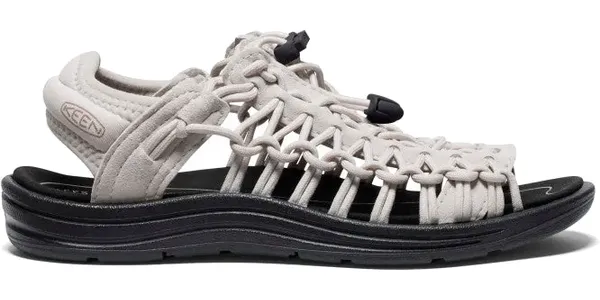
Underfoot there are three layers. At the bottom is a rubber outsole that KEEN describes as higher-traction and non-marking, with razor siping in the tread that KEEN says channels water away for better grip in wet conditions. Above it is a midsole that KEEN says absorbs shock, without naming the foam. On top is the insole, a foam layer that sits on the sole under your foot, which is removable and has arch support. KEEN also describes a metatarsal ridge under the forefoot that enhances grip and helps keep the ball of the foot in place. All of this is the manufacturer's description.
Wearers talk about the insole more than the outsole or midsole. The blogger at potatofave, who wears the men's version, says the suede-like insole is very cushioned, so much that the older UNEEK felt flimsy in comparison, and that it hardly slips whether barefoot or in socks. Runya7575 on Rakuten found the shoe light and felt a little cushioning.
The downside of a removable insole is that it is not glued to the sole. 爪牙00 on Rakuten saw the insole lifting at the toe and thought the pair was defective, before learning it comes out for washing. RUUSUPUU also noticed that the insole and sole do not seem to be glued together. R. on KEEN.com objected that the insole is designed to come out, because they did not want it shifting around in the ocean, and points out that in the original closed-toe UNEEK this part is sewn directly into the sole.
A separate matter from the removable design is a quality report. Stacy finds the shoes comfortable, but the whole footbed is lifting off the sole; KEEN replied with an apology for the quality issue and suggested a warranty claim.
If you like taking the insole out to wash it, this is a plus. If you want every part fixed in place, 爪牙00 advises thinking this over before you buy.
Upper: two cords adjust the fit, but loosening them does not fix tight toes for everyone
The upper is two free-moving cords that KEEN says have infinite points of adjustability and conform to the shape of your foot, cinched with a bungee cord and lace-lock toggle. It is lined with soft microfiber, and KEEN adds an odour control it describes as natural and pesticide-free.
The cord helps at the instep and ankle. Nancy P., who has thin feet, says they adjust to fit perfectly. The potatofave blogger, who wears the men's version, points out that the material at the toe end is fixed. At the toes, results differ: fran r. loosened the ties at the toe and found the shoe very comfortable, but Sara still had little-toe pinch with the cord adjusted for maximum space. RUUSUPUU on Rakuten found that the cord, which looks like rubber, does not stretch as much as expected. potatofave also feels the toe of this model is rounder than the older UNEEK's and seems to suit wider feet better.
The cords running along the sides of the foot can also rub. Judith A. finds the shoe generally comfortable, but says all the lacing on the sides makes rubbing more of a potential problem.
On odour, KEEN says the shoe has odour control, and potatofave says the insole has an antibacterial, anti-odour treatment, but it absorbs sweat easily, so store staff recommended washing it regularly. Odour control does not mean your feet will stay odour-free. If you will wear it barefoot on hot days, take the insole out and wash it regularly. KEEN's care advice for the shoe is to hand wash it in cold water with mild soap, never machine wash it, and air-dry it away from heat.
How it wears: comfortable for a full day of walking once the size and cord tension are right
Most reviewers wear it for everyday walking and travel. Kimberly A. finds it comfortable for extended wear and walking, Margaret V. wears it every day and calls it a favourite summer shoe, and June V. wears the larger size every day. Judith A. bought it to replace old KEEN walking sandals used for comfortable urban walking, and found these the closest match. The takeworld5 blogger says the stretchy cord makes long walks no trouble.
NEPIA's experience on Rakuten shows how much cord tension matters. Trying them on barefoot, the shoes were so loose they nearly came off, so NEPIA cinched the cord very tight. With thick socks on a trip the instep felt uncomfortable, so NEPIA loosened the cord back as close as possible to the tension the shoes arrived with, and the shoes did not come off as feared. After that, NEPIA spent a whole day out in ordinary socks in comfort.
When the size is off, problems may show up after hours of wear, not at the try-on. Toni N. bought the usual size, and after a few hours the shoes cut into the feet at the toe. めぇいたん on Rakuten walked for about three hours and got a blister that took the skin off the little toe, even after going up one size. By contrast, the takeworld5 blogger never had a painful blister, in socks or barefoot, but mentions other people's reviews of rubbing on the outside of the little toe and the instep, and suggests wearing socks until you get used to the shoes.
On socks, Sarah Q. on KEEN.com says they can be worn with or without socks, in three seasons; potatofave says socks work, but they feel hot in summer, so barefoot is preferable; and めぇいたん, whose pair was on the tight side, says socks look impossible. If you plan to wear socks, try the shoes on with the socks you will actually use.
On water, KEEN says the rubber outsole crosses terrain, even water, but R. was told by staff the shoes weren't designed for the ocean, and KEEN's reply under that review says the shoe is not meant to be fully submerged. So do not buy it as a shoe for playing in the water.
Reading the specs: what each number tells you
The product pages for both Silver Birch/Black (style 1028576) and Black/Black (style 1027297) give the same set of figures: 225 g (7.94 oz) per shoe, a drop (the difference between sole thickness under the heel and under the forefoot) of 4 mm, and what KEEN calls a Heel Height of 18 mm and a Shaft Height of 65 mm.
The 4 mm drop means the heel sits only slightly higher than the forefoot, and the 18 mm Heel Height is not sole thickness.
If you want to know how soft the sole is, look at the wearer reports in the sole section rather than the numbers.
What the 4 mm drop tells you, and what it does not
KEEN lists a 4 mm drop on both colour pages. Drop is the difference between sole thickness under the heel and under the forefoot. It only tells you the heel sits slightly higher than the forefoot; it says nothing about how thick or soft the sole is, or which activities it suits. To judge softness, read the wearer reports in the sole section.
Heel Height 18 mm and Shaft Height 65 mm are not sole thickness
KEEN lists a Heel Height of 18 mm and a Shaft Height of 65 mm in the product details, but does not explain what they measure from and to. So 18 mm should not be read as the sole thickness under the heel, and neither number should be used to compare with other shoes.
225 g per shoe: KEEN does not say which size
KEEN lists 7.94 oz, or 225 g, per shoe on both colour pages without saying which size was weighed. Shoe weight changes with size, so this number cannot be compared reliably with other models whose weight is given for a stated size.
Five things to check when you try them on
1. Little toe and the edge of the material at the toe end: stand with your full weight on your feet and check whether the edge presses on or crowds your little toe. めぇいたん sized up, yet got a blister that took the skin off the little toe after walking about three hours.
2. Loosen the cord fully first, then cinch it: if your toes are still tight with the cord fully loose, change size. potatofave, who wears the men's version, says the material at the toe end is fixed, while fran r. went up a size, still had to loosen the cord at the toe, and then found the shoe very comfortable.
3. Heel strap: walk briskly and take some stairs to check whether your heel slides out of the strap. takeworld5, whose heel band slipped quite a bit and sometimes came off the heel, suggests cinching the cord a little tighter.
4. Instep: if you have a high instep, check that once the cord is snug, it does not press painfully on the top of your foot. One Rakuten buyer had to loosen the cord because the instep hurt, and @ツヤコ says their son, who wears the same size but has a high instep, could not wear them because they were too tight.
5. Socks and the exchange policy: try the shoes on with socks or barefoot, the way you will wear them, and if you buy online, check first that the shop lets you exchange sizes. The 30-day return policy KEEN describes is for the KEEN US website, so it may not apply to the shop you buy from in Thailand.
If a loose heel hold is a problem for you, potatofave suggests that people who prioritise heel hold may prefer the original UNEEK.
Sizing: many go up half to one size, but not everyone, and wide feet should try them on first
KEEN sells the women's version in US sizes 5–11 including half sizes, and describes a contoured fit that follows your foot for a “comfortably snug fit”. The size selector on the KEEN US product page offers no wide option.
On KEEN.com, several reviewers advise going up. Nancy P. wore the usual size 8 and found absolutely no room to spare in the toes or heel. June V. had to return the first pair because of the size and advises getting a size bigger than usual. Leslie wears a half size bigger than usual. fran r. went up a size on others' advice and still had to loosen the cord at the toe. Marcia M. believes they run small and wishes they came in wide, but is keeping them, being between 8.5 and 9.
On Rakuten Japan, several buyers went up 0.5–1 cm from their usual size and found it right. Runya7575 usually wears 23 cm and chose 24 cm; NEPIA, who gives her size as 25.5 cm with a high instep and narrow width, chose 26.5 cm; RUUSUPUU, who wears 22.5 cm sandals and 23 cm sneakers, chose 23.5 cm and found it just right on slightly swollen evening feet; and 爪牙00, usually 23.5–24 cm, found 24.5 cm just right.
Not everyone got it right, though. めぇいたん usually wears 23.5 cm, went up to 24.5 cm and still found it on the tight side barefoot, and slightly regrets not going up 1.5 sizes. Meanwhile @ツヤコ and another buyer were fine in their usual size.
For wider feet, experiences differ. Sara, who describes Sara's own feet as wider, still had little-toe pinch after trying a size up and loosening the cord for as much room as possible. Margaret V., on the other hand, found them slightly adjustable for wider feet and wears them every day.
Patricia D. is a separate case. Patricia calls the support and fit great, but could not wear them because the shoe hit right at the bunion on the left foot, making them unbearable, and says this is not the shoe's fault.
Of the two Japanese bloggers, one wore the men's version and the other does not say which version, so their notes help with the shape but should not be used for women's sizing.
The potatofave blogger tried the shoe on at a KEEN-operated store before buying the men's version: with 26.5 cm feet and 27.5 cm sneakers, 28 cm fit well overall. takeworld5 recommends your usual sneaker size or one size up and calls the fit “narrow and long”: considerable room at the toes, but narrow, slightly tight sides and instep, which the stretchy cord can adjust to a degree.
In short: if you are between sizes, take the bigger one, as Nancy P. advises; if you have wide feet, a high instep or a bunion, try them on in a shop before buying, as めぇいたん recommends for high insteps and wide feet; and if you measure your feet in centimetres, compare with your shop's size chart.
511
womens-uneek-ii-open-toe-silver-birch-black · 2026-11-24 · Recorded sizes, not current stock