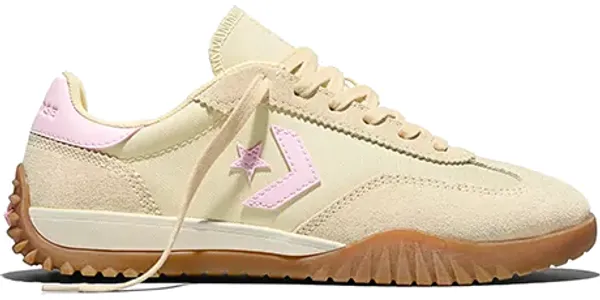
The details that matter
What sits under your foot
This shoe has no foam midsole like a running shoe. The only cushioning is the insole: Converse describes it as a three-layer memory-foam sockliner that forms to your foot. RunRepeat measured it at 6.3 mm, thicker and softer than usual, and it is removable, so you can swap in your own.
Underneath is a 7.8 mm rubber outsole, 31% thicker than average, meant to protect your feet from hard city surfaces. At 85.0 HC the rubber is about average in hardness, which RunRepeat says usually balances durability and grip; Converse also says the outsole helps with grip. In the Dremel abrasion test the tread wore down 1.0 mm, about average durability.
The whole sole bends and twists very easily, which RunRepeat says is one reason it felt comfortable from the first wear, but it gives little support. RunRepeat measured the sole 99.7 mm wide at the forefoot and 70.8 mm at the heel and concluded it is not a stable or supportive shoe.
Upper: real suede, durable, but little airflow
According to Converse, the upper is nylon with suede overlays around the shoe and leather accents in places, with punched eyelets and waxed laces. RunRepeat burned a piece of the suede and confirmed it is real suede.
The upper is very durable: the toe area scored 5/5 in the abrasion test. The heel lining, however, scored only 1/5, so if you take your shoes on and off often, keep an eye on that area.
For airflow, it scored 1/5 in RunRepeat's smoke test; no smoke passed through the upper. If you want a shoe that lets air through on hot days, this one does not fit that need.
The tongue is only 3.8 mm thick. Because it is not attached at the sides, the shoe is easy to slip on even without a heel pull tab. During wear tests, though, the tongue slid a little from side to side, and the waxed laces could not hold it in place. The heel counter (the stiff part wrapping the heel) scored only 2/5 for stiffness and bent under a thumb press, though the rubber outsole extending up the heel adds some structure.
How it feels in use
RunRepeat found it comfortable on walks from the first wear, with no break-in needed. They credit part of that to the sole bending very easily with the foot and to the shoe being lighter than average.
The same review also lists it as not for all-day wear. These two points do not contradict each other: comfortable for a walk around town is not the same as comfortable when worn all day. If your day involves standing or walking for hours, know that there is only an insole and rubber outsole underfoot, with no midsole foam to absorb impact.
Your foot sits close to the ground, with heel and toes at almost the same level. RunRepeat says this makes the ankle and calf muscles work a little harder than the hips and knees.
For running or sports, RunRepeat's lateral stability test led them to conclude that, despite its sporty look, the shoe is not built to stop your ankles from overextending, so it is not a shoe for playing sports.
How to read this shoe's numbers
RunRepeat measured the heel stack at 17.2 mm, 42% lower than average, and the forefoot stack at 13.7 mm. The drop (the difference in sole thickness between heel and forefoot) is therefore 3.5 mm, among the lowest they have measured. These numbers mean your foot sits close to the ground and the heel is barely raised above the toes. If you usually wear thick-soled shoes, walk around the store for a while to see whether you like this feel.
The same review gives two weights: the text says 322 g (18% below average), while the results table says 333 g. Use it to judge that this is a fairly light sneaker, but do not compare it gram for gram with other models; holding it next to other pairs in the store is a clearer check.
The flexibility result (11.2 N to bend it 90 degrees, 51% below average), torsional rigidity (1/5) and breathability (1/5) show this shoe's trend well. To compare with other models, check whether they were tested the same way.
Check width, not just length
RunRepeat measured the interior at its widest point at 85.4 mm, among the narrowest casual sneakers they have recorded, and 64.9 mm at the big toe. When trying it on, wiggle your toes and notice side pressure. If it pinches in the store, this sturdy suede upper does not give much, so compare a half size up or look for a model with a wider forefoot.
Thin sole, low drop
The heel stack is 17.2 mm and the forefoot 13.7 mm, so the drop is 3.5 mm. The heel stack is 42% below the average RunRepeat measures. Your foot sits close to the ground with the heel barely raised, and your ankles and calves work a little harder. Walk around the store for a while to see whether you like this feel.
Weight: a rough guide only
RunRepeat weighed it at about 322–333 g, fairly light for a sneaker. Hold it next to other pairs in the store to compare.
What to check when trying it on, and what to compare
When trying it on, check width before anything else. Wiggle your toes and feel for side pressure, especially around the big toe and the widest part of your foot. Lace up snugly and walk around the store for a while; watch whether the tongue slides sideways and whether your heel lifts out as you walk. If you use your own insoles, bring them along, since the original insole is removable. Before buying online, check the size-exchange policy.
If it feels too tight, compare retro sneakers with a wider forefoot. If you want a shoe for actual running or workouts, look at running shoes with a foam midsole and a more stable base. If you will mostly wear it on hot days, consider models with a mesh upper.
Size and fit: very narrow, slightly small
RunRepeat rates this shoe as running slightly small and a bit too snug. Using a gel mould, they measured the interior at its widest point at 85.4 mm, one of the narrowest casual sneakers they have recorded and too snug for a standard (D) width. Forefoot width at the big toe is 64.9 mm, narrower than average. RunRepeat also says the shoe is 5 mm narrower than the adidas Samba. The upper is sturdy and does not give much, so space inside is limited.
Height above the toes is 27.1 mm, close to average, so there is decent room for the toes to move up and down. The issue with this shoe is width, not height.
Wide-footed buyers can skip this model. If your feet are average, try it on first and compare it with a half size up as well.
YELLOW US 5YELLOW US 6YELLOW US 8
run-star-trainer-suede-a16660cf-s6ylpi · 2026-11-24 · Recorded sizes, not current stock