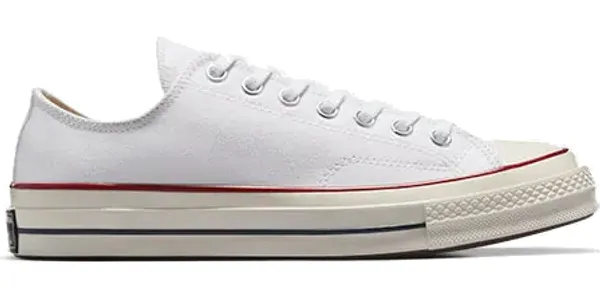
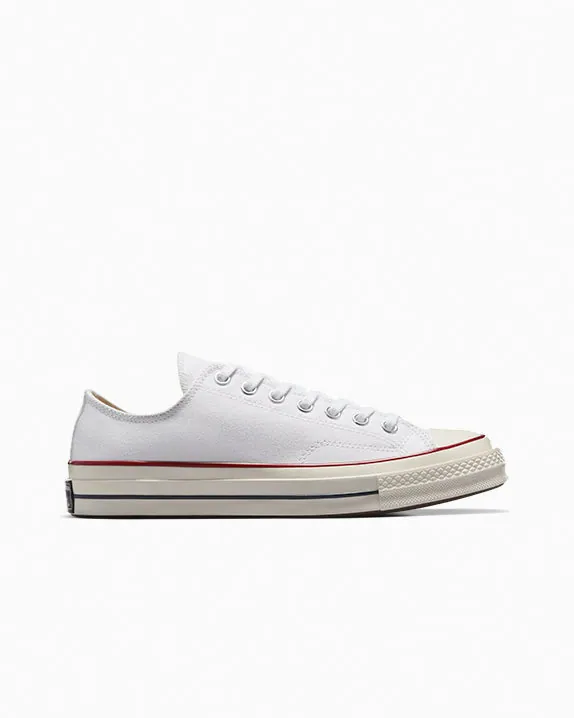
The details that matter
Underfoot: thick rubber and an unusually thick insole, but little shock absorption
Under your foot, the Chuck 70 has an OrthoLite insole on top, a foam layer below it, and then a vulcanized rubber outsole wrapped by a tall rubber sidewall. Converse describes a varnished off-white midsole and toe cap for a vintage look, ornate stitching and a taller rubber sidewall, and says the OrthoLite insole helps you walk comfortably all day.
RunRepeat sums up how it differs from the regular Chuck Taylor All Star: a higher rubber midsole and foxing, a thicker and more comfortable OrthoLite insole, and a one-piece rubber bottom sole instead of a three-piece one.
Most of the softness comes from the insole, which RunRepeat measured at 13.9 mm against a 4.9 mm average. It is removable, but RunRepeat advises against replacing it, because it basically works as the shoe's primary cushioning and follows the shoe's narrow, tapered shape, so some insoles will not fit properly. If you use your own insoles, take them to the store and try them in this shoe.
RunRepeat says about two-thirds of the platform is hard rubber and firm foam. Shock absorption measured only 66 SA (average 87 SA); the higher the number, the more impact the sole absorbs.
Energy return, the share of force the sole gives back as you step, measured 40%, among the lowest. So RunRepeat says it feels pretty flat when walking, with no bounce.
The upside is a durable sole. The outsole rubber is 7.4 mm thick against a 5.1 mm average, and under the Dremel it lost 1.1 mm, which RunRepeat calls the same as average (the chart average is 1.0 mm). RunRepeat also notes that Converse shoes often draw complaints about the rubber overlay peeling from the upper at the little toe, but on the Chuck 70 the seal there looks much more solid than on the cheaper Chuck Taylor All Star.
The sole looks thick and stiff, but it bends more easily than you might expect. RunRepeat's machine needed only 9.3 N to bend it to 30 degrees, against a 13.6 N average, even though the tested pair was not fully broken in. For grip, RunRepeat measured a friction coefficient of 0.48, close to the 0.49 average, and says this means very reliable, consistent grip on dry and wet surfaces.
Upper: thick, durable canvas that breathes poorly and has almost no heel counter
Converse describes a heavyweight, durable canvas upper for a structured Chuck 70 look and feel, with eyelets on the inner side of the shoe (the arch side) for optimal airflow.
RunRepeat's tests point the other way. When it filled the shoe with smoke, only a tiny streak escaped, mostly through the metal eyelets and the gaps between the tongue and the upper. The two vent holes on the inner side did not help much, and a microscope showed no pores in the canvas that could help ventilation. RunRepeat scored it 2 out of 5 (average 2.8) and says it is not a great option above 21°C.
Two Zappos customers who compared it with regular Chucks felt the same. Fasbguy (2016) says it wears hotter, but sees that as a non-issue because it does not make the bottoms of the feet ache the way regular Chucks do. Another (2020), who had worn them for only about a week, finds it warmer and might keep it for cooler weather, wearing an old pair of All Stars on warm days. Thailand is warmer than 21°C almost all year, so if you will wear it daily, weigh this first.
The tongue is only 1.3 mm thick (average 9.7 mm), just a small piece of canvas between the metal eyelets and your foot. At the back, RunRepeat found basically no heel counter (the stiff structure around the heel), just canvas. So there is almost no heel hold or ankle support, though the shoe moves well with your foot.
On durability, the reinforced toe box scored 4 out of 5 for abrasion resistance, but the lining inside the ankle collar tore after only 4 seconds under the Dremel, scoring 2 out of 5, and RunRepeat expects it to be the first part to show wear.
The blue high-top page (A18155C) says the Chuck Taylor ankle patch is leather. A Zappos customer (2019) only found this out after getting the shoes, returned them, and warns vegans. If you avoid animal materials, ask the store whether the ankle patch on the colour you want is leather.
How it wears: softer than a regular Chuck, but firmer and closer to the ground than most sneakers
Can you walk in it all day? It depends on what you compare it with. Some Zappos customers walk in it all day comfortably. Fasbguy (high-top, 2016) wore it for 12 hours in 80°F-plus (about 27°C) weather and says it fit great and was very comfortable. Nick (low-top, 2019) wore it daily on a three-day trip to New Orleans, walking from morning until well into the evening, and found it terrific apart from feet generally sore from hours of standing and walking.
RunRepeat sees it differently: for day-to-day comfort and support, it does not recommend the shoe for prolonged wear. The forefoot felt very close to the ground, and pebbles, bottle caps and other urban debris did not go unnoticed.
On arches, RunRepeat lists no arch support. In Zappos surveys most chose “Moderate arch support” (80% on the high-top page, 71% on the low-top page). Pamela (Zappos low-top, 2020) has on-again/off-again plantar fasciitis and says the support is so “moderate” that it causes problems on long walks, noticed after a few hours. Put simply: if you have walked all day in regular Chucks, this pair will likely feel softer, but if you need a soft sole or clear arch support, it does not fit the brief.
Stiffness comes up often, but for different reasons. Valerie (Zappos low-top, 2020) says it is much heavier and stiffer than the Chuck Core because of the heavy-duty materials and thinks it needs a break-in period before it feels comfortable. Another Zappos customer (high-top, 2014) found it too bulky: more padded and more cushioned, but thicker, heavier and significantly less flexible. Appropriate-Print855 on Reddit found it very stiff and somewhat painful when trying it in a store, then got a bigger size and says it is extremely comfortable; in that post, what helped was the size change, not wearing them in. RunRepeat says the shoe comes across as very stiff, yet its tests found it easier to twist and bend than the average sneaker.
RunRepeat says the sole is the bulkiest part, so it may feel somewhat bottom-heavy at first.
Owner reports on sole durability vary widely. BigMiddleKnuckle on Reddit has worn a wide-fit pair “semi-daily” for six months and says the outsole is turning into racing slicks; the poster already had to epoxy the outsole back on, and the heel has worn down quite a bit too, if not to the same extent. In the same thread, thesnazzle says their pair took almost two years to start wearing down and still doesn't look as bad. A Lemon8 user (5 Nov 2023) says they have worn theirs often for about three, almost four years, and it is still fine, with the sole still good.
On stability, RunRepeat says the firm, nearly flat sole does not compress, so it stands stable, but it would not recommend the shoe for people who overpronate and need side-to-side stability or arch support, because the canvas upper has no structure and the sole is too narrow at the heel. A Zappos customer (high-top, 2015) says it is great for weightlifting because the thicker canvas gives lots of lateral support. RunRepeat also notes that this close ground contact once made the shoe popular for weightlifting, especially deadlifts.
Reading the numbers: a thin, grounded sole and a narrow toe
RunRepeat measured a 26.2 mm heel stack (average 30.4 mm) and a 17.6 mm forefoot stack (average 19.4 mm). Both are thinner than average, which is why it feels grounded. The drop (the height difference between heel and forefoot) is 8.6 mm, a little lower than the 10.9 mm average, and RunRepeat says that is hard to notice unless you have worn dozens of sneakers with different drops.
Foam firmness: RunRepeat pressed a durometer into the foam layer and got 25.1 HA (HA is a hardness unit; lower means softer), softer than the 28.3 HA average but still firmer than the Nike Air Force 1 '07 and New Balance 9060. RunRepeat says most of the firmness comes from the hard vulcanized outsole and the tall rubber overlay, so the softness comes mainly from the 13.9 mm insole.
Weight: the high-top in a men's US 9 weighs 482 g, on the lighter side among the high-tops RunRepeat has tested but heavier than the 388 g average across 107 sneakers. Other sizes will weigh differently. To get a feel for it, lift it against the pair you wear now when you are in the store.
Width: the toe box measures 66.5 mm where the big toe ends (average 75.3 mm), which tells you how sharply the toe tapers. The heel platform is 73.6 mm wide, a whole 10 mm narrower than the average sneaker, and RunRepeat says such a slim sole can make people with flat feet or overpronation feel less than surefooted.
How narrow is a 66.5 mm toe box?
RunRepeat measured the toe-box width at 66.5 mm where the big toe ends, about 10 mm narrower than the 75.3 mm average, while the widest part of the toe box measured 100.1 mm, close to the 99.1 mm average. So the widest part of the forefoot is not narrow, but the toe tapers quickly. When you try it on, check the tips of your big toe and little toe, not just whether the forefoot feels tight.
Standard or wide fit
Converse Thailand's Chuck 70 Wide page (A10353C) says it is 1 cm wider than the standard model, only in the forefoot inside the shoe, with the same exterior. The size guide, writing about wide sizes in general, says they have more volume and a broader platform by about 15 mm at the ball and instep and 6 mm in bottom width. The two pages give different figures. If your forefoot is wide, try the standard and wide versions side by side before buying.
Most of the cushioning comes from the 13.9 mm insole
RunRepeat measured the OrthoLite insole at 13.9 mm, nearly three times the 4.9 mm average. It is removable, but RunRepeat advises against replacing it, because it basically works as the shoe's primary cushioning and follows the shoe's narrow, tapered shape, so some insoles will not fit properly. If you plan to use your own insoles, take them to the store and try them in this shoe before buying.
Five things to check when you try it on
1. Compare with the Chuck size you wear now. If you have a pair, wear it to the store. If not, measure your feet the way Converse's size guide describes: put paper against a wall, stand straight with your heel against the wall, mark the longest point of your foot and measure from heel to that mark. Do both feet, because left and right can differ.
2. Check the toe box. RunRepeat says the tall rubber sidewalls around the toe box make it feel even more cramped, especially at first. Make sure your big toe has room, and wiggle your little toe to see whether it gets squeezed. If your forefoot is wide, try the wide version (Chuck 70 Wide) alongside it.
3. Check how well the shoe holds your heel. RunRepeat found basically no heel counter. JayJitsBJJ on Reddit ordered a pair online that turned out long in the toe box, and the heel slipped up when walking around at home. Lace it snugly and walk around for a while; if your heel still moves up and down with the laces tight, that size may be too long. A Zappos customer (2015) found the factory laces too stretchy to lace up tight and fixed it with 54-inch round athletic laces.
4. If you choose the high-top, walk and flex your ankle to see whether the Achilles area feels hampered. Highjumpsuit on Reddit, who sized down, says the fit is great, but sometimes when walking the Achilles area is hampered because it is a high-top, and asks the thread whether they got the right size.
5. Try it with the socks you will actually wear.
If you order online, Converse's size guide suggests that if you are unsure, you order a half size up and a half size down and return the one that doesn't fit. Check the store's return terms before you order.
If it does not suit you after trying it on, look for a casual shoe with a roomier toe box, better breathability and more shock absorption.
Sizing: people choose differently, and the toe box tapers narrow
Converse's size charts, men's and women's, say the Chuck Taylor All Star and Chuck 70 run a half size large. It is one shared recommendation for both models, not split by high-top and low-top. A 67-vote poll on RunRepeat says the high-top fits slightly large, while Zappos fit surveys show 54% saying it felt true to size for the high-top and 47% for the low-top.
Those who kept their size: Fasbguy (Zappos high-top, 2016) found it very similar to regular Chucks, perhaps a shade longer but not even half a size. RR (Zappos high-top, 2016) wore their usual 8 and found it perfect. Another (Zappos low-top, 2017) put the soles side by side with regular Chucks and found them the same length and width. Both-Station-2244 on Reddit finds the 70s about a quarter size longer than All Stars but wears a 7.5 in both.
Those who sized down: a Zappos customer (low-top, 2018) found their toes about a centimetre farther back than in their regular Chucks, exchanged for a half size smaller, and it then fit like the old pair. JSCOTT (Zappos low-top, 2014) wears a 9.5D in all other shoes but needed an 8.5 here. Sertoff on Reddit went a full size down in the low-top from a men's US 9 Jack Purcell. Direct-Competition34 says all three of their pairs are a half size down and fit perfectly.
Those who sized up: Appropriate-Print855 on Reddit found it stiff and somewhat painful in store, got the bigger size, and now finds them extremely comfy, way better than the Chuck Taylors. GhostbaneTV on Reddit, whose right foot is slightly wide near the little toe, found 9.5–10 right for length but the little toe too squished, and went up to an 11.
JayJitsBJJ on Reddit hit a different problem: a men's 8 fit well in store, but the same size ordered online from Converse Canada was long in the toe box, fit completely differently from the pair tried in store, and slipped at the heel when walking at home. Part of why the advice varies is that people compare against different shoes: some against regular Chucks, others against running shoes or other models.
On width, RunRepeat measured the toe box at 66.5 mm where the big toe ends, about 10 mm narrower than average and very tapered, while the widest part of the toe box measured 100.1 mm, close to the 99.1 mm average. On Zappos most said it felt true to width (91% high-top, 90% low-top). Tiwana (Zappos high-top, 2019) says the 8.5 feels great for length but a bit narrow, like most Converse; RR found the toe box a bit narrow; J.T. (Zappos low-top, 2019) says there is plenty of space for a wider forefoot.
On Pantip, a member with 26.5 cm feet and a fairly wide forefoot finds their Chuck 70 high-top in UK 8 rather squeezing and is weighing UK 8.5 against UK 9. In another thread, one replier (9 Apr 2564 (2021)) says Converse in general runs slightly narrow: in the men's shape they need a 38 instead of their usual 37 or their toes hurt a lot, but in the women's shape they wear their usual size.
Wide fit: the Chuck 70 Wide page (A10353C) says it is 1 cm wider than the standard model, only in the forefoot inside the shoe, with the same exterior. Converse's size guide, writing about wide sizes in general, says they have more volume and a broader platform by about 15 mm at the ball and instep and 6 mm in bottom width. The two pages give different figures. BigMiddleKnuckle on Reddit, who wears the wide fit, says it is comfortable enough. If your forefoot is wide, try the standard and wide versions side by side before buying.
Converse Thailand lists sizes in US units (US 5–11 on the blue high-top page, US 4–12 on the white low-top page). Ask the store whether that is the men's or women's US scale, and compare your foot length in centimetres before ordering.
If you have regular Chucks that fit, start by trying that size and a half size smaller. If your forefoot is wide or your little toe gets squeezed, try your usual size, a larger one or the wide version side by side.
WHITE US 4WHITE US 5WHITE US 6WHITE US 7WHITE US 10WHITE US 11
chuck-70-canvas-162065cu-f0wtxx · 2026-11-24 · Recorded sizes, not current stock