The details that matter
Lightstrike foam, a TPU plate and full Continental rubber underfoot
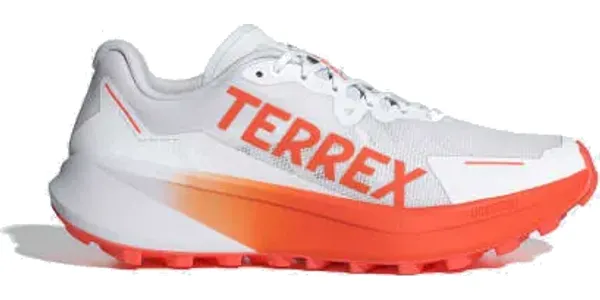
adidas's JI0951 product page lists a Lightstrike midsole with a TPU plate inside the sole, which adidas calls a stability plate. adidas claims the new Lightstrike is softer. The outsole that contacts the trail is Continental rubber, with 4 mm lugs in the middle of the sole and 5 mm lugs around the edges; adidas claims it grips in both dry and wet conditions.
Mike Postaski at Road Trail Run points out that the rubber covers the full sole with no cutouts for weight saving or flexibility. He could not really feel the TPU plate through the foam, but says it stiffens the ride a bit. Sam Winebaum says the plate stabilizes and protects from rocks.
Matt Klein agrees the shoe protects against rocks underfoot, but found the foam hard and the shoe fairly rigid. He describes an initially clunky ride that took several miles to break in, and mild forefoot flexibility that took 20 miles (around 32 km) to break in. This was his experience, not a break-in distance everyone must complete.
A secure upper, but check the heel and the inside on your feet
adidas lists a textile and synthetic upper for JI0951 with abrasion-resistant overlays and a gusseted tongue, meaning the tongue is stitched to the sides. adidas claims the upper is breathable and helps keep feet cool. Mike Postaski found the mesh open and quite breathable on the run, and Sam Winebaum notes a thin, soft mesh lining at the front.
Matt Klein found the upper stiff, slightly snug and lower in volume. He says the tongue locked his foot down well, but the heel collar has only a little padding and the counter is stiff. He would always wear socks with this upper because the inner aspect is "aggressive and tough". Mike sees the collar differently: a tad high, but with plenty of cushioning and a pliable edge, and 47 miles (around 76 km) without any discomfort at the rear.
One Reddit owner says the tongue moves around some, but not in a way that causes discomfort. When you try it on, wear your running socks, lace it securely and check whether the collar, heel counter or inside of the upper presses or rubs anywhere.
Testers ran it on different terrain, with different results
Matt Klein at Doctors of Running sees the shoe as best for easy paces on soft, technical, unstable terrain; the more technical the terrain, the better it feels, because the stiffness gives inherent stability. That same stiffness makes it feel awkward on smooth trail and terrible on road. He also found it felt heavier than its weight and awkward when picking up the pace.
Sam Winebaum at Road Trail Run had a different result. Most of his runs were on smoother terrain, with quite a bit of pavement and gravel, and he says the shoe performed surprisingly well there as a door-to-trail shoe, with a relatively quiet footstrike, plenty of cushion and some rebound. He also chose it for a 17 km trail race in Switzerland on moderate terrain including pavement and gravel roads, and planned to take it hiking in the Alps. Mike Postaski ran it on everything from smooth sandy paths to rocky ground and off-trail bushwhacking, and never lacked grip.
John Calabrese at Believe in the Run says it works best on easy to medium trails, and for more rugged adventures he would choose a different shoe with bigger lugs. In a later reply, though, he said he had no issue with the lugs; his biggest complaint was weight. He felt the shoe was great uphill, downhill and on the flats. Reddit user u/dr_doctor_obvious says traction seems good in Colorado, but he does not run in mud.
If your usual routes include long road sections or are mostly rough terrain, look for the tester who ran the same kind of routes as you, then try running in the shoe on surfaces close to your real routes before buying.
The 8 mm drop matches across sources; stack and weight vary by source and size
Drop is the difference between sole thickness under the heel and under the forefoot. adidas and all three review outlets list 8 mm, though Matt Klein felt it ran closer to 5–6 mm. The number describes sole shape; it does not tell you whether the sole feels soft or firm, or which terrain the shoe suits.
Stack height differs by source. adidas's JI0951 page lists a 31 mm heel and 23 mm forefoot; another adidas Thailand product page (JI0955) lists a 30 mm heel and 22 mm forefoot. Doctors of Running and Road Trail Run list a 34 mm heel and 26 mm forefoot, and Believe in the Run lists a 32.5 mm heel and 24.5 mm forefoot. Treat these as an approximate range.
Always read weight together with size. adidas lists 275 g in UK 8.5. The same page also shows 286.4 g, and the JI0955 page lists 245 g; neither of those gives a size. To compare with other shoes, use figures that state a size. Doctors of Running lists 292 g and Believe in the Run 293 g, both in men's US9. Matt says this is on the lighter end for a trail shoe, but the stiffness makes it feel heavier than its weight.
Check length and upper volume separately
Even when the length fits, try spreading your toes and check pressure over the instep. If you're considering half a size up, walk down a slope and check that your heel stays in place.
An 8 mm drop doesn't tell you how soft it feels
Every source lists an 8 mm drop, yet Matt felt it closer to 5–6 mm, and testers felt the softness very differently. Judge softness by trying the shoe on for a run, not by the drop figure.
Always read weight with its size
adidas lists 275 g in UK 8.5, while review outlets list around 290 g in men's US9. To compare with other shoes, use figures that state a size.
What to check when trying it on, and what to compare if it doesn't suit you
Try both shoes on with your running socks, lace them securely, then walk, jog lightly and walk down a safe slope. Check whether your toes hit the front: John Calabrese jammed a toe once while bombing downhill. Then check pressure around the heel and over the instep, and whether the sole feels too firm for you. If buying online, compare the size chart and read the exchange policy before ordering.
If this shoe doesn't suit you, compare according to what you need. For days when you want to run faster, Matt Klein suggests looking at the Agravic Speed or Speed Ultra, and Mike Postaski describes the Speed Ultra as much bouncier. If you regularly run rugged terrain, John says he would pick a shoe with bigger lugs. If you prefer a softer feel, try running in a trail shoe that prioritises softness and compare.
Most testers found it true to size, but forefoot room reports differ
adidas recommends ordering your usual size, and the shoe comes only in a regular width. Matt Klein wore his usual US10 and found it true to size, but the upper slightly snug and lower in volume, with a fairly straight toe box that tapers quickly at the end and a normal-to-slightly snug forefoot. John Calabrese also found it true to size right out of the box.
Sam Winebaum at Road Trail Run sees the room differently: plenty of toe box room, with a squared-off front that avoids any pointy feel. The fit is true to his usual US8.5, and he says that size suits narrower to medium feet, but for wider feet or long runs in heat one could go up half a size, as Mike Postaski did. Mike sized up to US10 and got plenty of comfort without losing hold, and says those with narrower feet or who don't want as much room up front could go true to size.
The Reddit owner, who describes a somewhat wide forefoot and a regular/narrow heel, found it true to size and comfortable, with no irritation at the side of the big toe. A reviewer named Dh92 on the adidas product page advises going half a size up because the toe box is quite narrow.
Reports differ, so don't go up half a size just because someone else did. Try them on and check one thing at a time: length, forefoot width, toe-spreading room and instep pressure.
5.5 UK6 UK6.5 UK7 UK7.5 UK8 UK8.5 UK9 UK9.5 UK10 UK10.5 UK11 UK11.5 UK12 UK12.5 UK13.5 UK14.5 UK
JI0951 · 2026-11-24 · Recorded sizes, not current stock