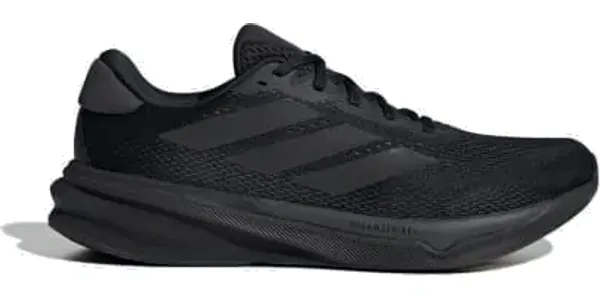
The details that matter
Underfoot: EVA with Dreamstrike+ in the forefoot, and an Adiwear outsole
The midsole uses two foams. adidas describes a Carrier EVA base with Dreamstrike+ foam placed in the forefoot, meant to support push-off and a smooth heel-to-toe transition. Run-Evasion describes full-length Dreamstrike+ on an EVA base, plus an extra Dreamstrike+ insert in the forefoot, giving a balance of soft comfort and structure.
In use, Run-Evasion says Dreamstrike+ adds a touch of liveliness without turning it into a speed shoe, and the push-off effect is modest next to premium PEBA foams. The heel cushioning absorbed impacts very well at moderate paces.
The outsole is adidas's own Adiwear rubber, not Continental. It covers almost the whole contact area, with cutouts under the arch and around the toes to save weight and let the foot flex. The heel and forefoot wear zones are reinforced. On dry asphalt and hard surfaces the grip is reassuring; in the wet, Run-Evasion found it adequate but not exceptional, so take care on road markings and manhole covers.
Upper: breathable mesh and a secure heel
The upper is a breathable sandwich mesh (layered mesh) of textile and synthetic materials, with a textile lining. The collar and tongue are padded, and synthetic overlays sit at the stress zones for durability.
On breathability, Runnea says the upper breathes well, which matters when running in the hottest part of the year. Run-Evasion also found it ventilated well on summer runs while staying warm enough for winter runs, but in very cold weather during winter 2026 the mesh was a little limiting, and that was the main weak point they found.
At the heel, Run-Evasion says a well-sized heel counter (the stiff structure around the heel) and a generously padded collar hold the heel well, with no slipping even on quick changes of direction. The foot feels wrapped softly without feeling closed in.
On the run: comfortable and reassuring, with split views on speed
Run-Evasion ran more than 150 km in it, mostly on asphalt with some track and treadmill sessions, in dry and wet conditions at 5–25 °C: easy runs at 8–10 km/h, sessions up to 14 km/h and long runs up to 20 km. They found it predictable and reassuring, with stability that is fine for a neutral shoe and a slight, easily managed roll in tight turns. Runnea also notes a smooth heel-to-toe transition. A YouTube video that ran a 5K in it sums it up as a shoe for runners who want comfort, stability and good cushioning over medium distances.
On speed, the two publications disagree. Runnea says it combines good cushioning with enough responsiveness to run fast. Run-Evasion found that at paces faster than 4:30/km it lacked the response and energy return to hold the pace. If your pace on days you want to run faster is still slower than that, this pair will do. If you often run faster, keep a second pair for those days.
On distance, Run-Evasion stayed comfortable on 20 km long runs, though the weight began to show in the last kilometres. Runnea recommends it for 21 km at most, since adidas has more cushioned models for longer runs.
Beyond running, Runnea says it works for everything from gym sessions to runs that are not too intense, and Run-Evasion also sees it as a shoe for both sport and everyday wear.
Reading the numbers: drop, stack and weight
Drop (the difference between heel and forefoot thickness) is 10 mm according to adidas and Runnea, while Run-Evasion gives 9 mm. Either way, this is not a low-drop shoe. Run-Evasion says this drop supports a natural heel-to-toe roll, but runners used to minimalist or low-drop shoes may not like it.
For stack, adidas lists 34 mm under the heel and 23 mm under the forefoot. Runnea lists 33 mm under the heel and 23 mm under the forefoot, just 1 mm apart at the heel.
There are three weight figures. adidas Thailand lists 269 g and Runnea lists 225 g, neither with a size. Run-Evasion cites an announced 278 g in size 42 (EU). Figures without a size cannot be compared directly. At size 42, Run-Evasion felt the weight slightly but found it within the normal range for this type of shoe, while Runnea calls it light. When trying it in a shop, pick it up and compare it with the running shoe you wear now.
Drop and stack
34 mm under the heel, 23 mm under the forefoot, a drop of about 10 mm (Run-Evasion says 9 mm). If you usually wear low-drop shoes, walk and jog in the shop to see whether a heel this much thicker than the forefoot feels natural to you.
Weight depends on size
Listed weights range from 225 to 278 g (278 g is EU 42). In the shop, hold it next to the pair you use now.
Size and inside room
Use your usual size for walking; for running, also try a larger size. Standard to slightly wide feet fit comfortably; with very narrow feet, check that your foot doesn't slide around once laced snugly.
What to check when trying it on, and what to look at if it doesn't suit
When trying it on, wear your running socks, lace it snugly and check three things: can your toes move, do the sides press on your foot, and does your heel stay put when you walk or jog? If your feet are very narrow, check whether there is so much room inside that your foot slides around. If you are buying it for running, try a larger size as well for comparison.
If this pair doesn't suit, choose by what you want more of. For fast runs or racing, look at shoes with a bouncier foam, such as models using PEBA. If you prefer a low drop, look at low-drop shoes. For runs longer than 21 km, look at more cushioned models.
Size and fit
Run-Evasion says it is true to adidas sizing. For walking or casual wear your usual size is fine, but for running they recommend going up from your usual size to allow for the foot swelling during effort.
Forefoot width is average, with enough room inside for standard to slightly wide feet. Very narrow feet may find it a little roomy. The heel holds well without slipping.
adidas lists one width only: Regular.
6 UK6.5 UK7 UK7.5 UK8 UK8.5 UK9 UK9.5 UK10 UK10.5 UK11 UK11.5 UK12 UK12.5 UK13 UK13.5 UK14 UK14.5 UK15 UK16 UK17 UK
IH2508 · 2026-11-24 · Recorded sizes, not current stock