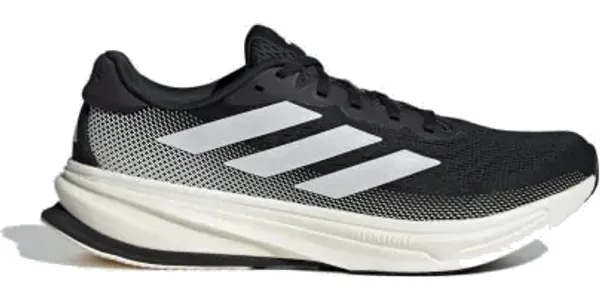
The details that matter
Foam, support rods, rubber and sole shape: what each part does
Adidas lists a Dreamstrike+ midsole with a Support Rods system and says the rods help guide you from heel strike to toe off. RunRepeat describes the rods as a firmer layer of red REPETITOR foam below the Dreamstrike+, and Matt at Doctors of Running says these denser pieces make the midfoot slightly stiff. Larry Lam at Running Shoes Guru, by contrast, never really felt a difference from the rods and thinks that may be because Larry typically doesn’t need stability.
On the outsole, RunRepeat reports Adiwear rubber at the heel and forefoot with a strip of translucent rubber through the midfoot, and explains that this translucent rubber tends to feel slippery on wet roads, which is why adidas limited it to the centre, where traction matters less than at the heel and forefoot. Reddit poster Character_Trip5912 also says the rubber in the middle didn’t feel good on wet terrain.
In RunRepeat’s traction test, the forefoot scored 0.38, below the 0.53 average across the 407 running shoes it compares. RunRepeat calls the grip decent, holding up well on dry pavement and passable in wet conditions, but one of the few areas where the shoe felt slightly underwhelming.
The sources describe the sole’s shape differently. RunRepeat says this is not a rocker shoe (a sole curved like a rocking chair to help the foot roll forward): it has a moderate heel bevel and slight forefoot curvature, and RunRepeat rates the sole as flexible based on a 7.3 N result in its 30-degree bend test. Matt and Andrea at Doctors of Running, however, felt a large toe spring. Matt says moving through toe-off takes a decent amount of toe flexibility and that people with toe mobility issues will not do well in this shoe. Andrea found the shoe’s forefoot quite flexible when bending it by hand, but not flexible at all when running, likely because the highest point of the toe spring sits beyond the big-toe joint, towards the tip of the shoe. When you try it on, rise onto your toes and jog a few steps to check whether the shoe bends where your big-toe joint bends.
Adidas and RunRepeat class it as a neutral shoe (for runners who don’t need help correcting the foot rolling inward), and RunRepeat notes some stability features: small sidewalls that wrap the heel and an angled rear section that adds a gentle push for heel strikers. If you land on your heel and like a traditional, flexible platform, that layout is likely to suit you; if you want a strongly curved rocker, look elsewhere.
A mesh upper that holds well, but check how warm it feels
Adidas lists an engineered sandwich mesh upper with a textile lining. RunRepeat found the revamped, lighter mesh contributed significantly to the shoe’s weight reduction and gave breathability 4 out of 5 in its lab test, while advising season-specific socks. Larry Lam at Running Shoes Guru says the upper is not the lightest or the most breathable, but stayed comfortable with both thick and thin socks. Andrea at Doctors of Running found the mesh on the thicker side, which kept Andrea’s feet warm on runs in sub-freezing temperatures, and on one treadmill run Andrea was pleased that the upper did not feel warm indoors. If you often run outdoors in hot, humid weather, try it on with the socks you actually run in and check whether it feels airy enough.
The tongue is not gusseted and is thickly padded: RunRepeat measured 9.4 mm of tongue padding against a 5.8 mm average. Running Shoes Guru and RunRepeat both mention a loop that holds it to the laces, but Matt at Doctors of Running still felt it slide a little and had to tighten the laces around the heel to hold it. Matt also says the inside of the upper is decently comfortable apart from some stiffness from the toe guard. If a shifting tongue bothers you, lace up snugly during the try-on and jog a few steps to see whether it stays put.
Firm, balanced or a bit soft? Testers don’t agree
RunRepeat says the midsole rides a bit soft, based on its 32.3 AC durometer reading. Matt at Doctors of Running calls it slightly firmer than the first version but more resilient, and a little snappy, while Nick Harris-Fry at Tom’s Guide found it not exactly soft or firm, but fairly dull and not particularly responsive at faster paces. Stacey at RunToTheFinish found it firmer than Stacey likes for easy miles, which made it hard to find a rhythm: on the first run, on a treadmill, foot discomfort began about a mile in and did not go away, and the same issue came back when running outside. Larry Lam at Running Shoes Guru, by contrast, says the shoe seemed to disappear on the foot during a long run, with no rubbing or discomfort, and that the ride was great on a threshold run with strides.
In the runner community, the original poster of an r/RunningShoeGeeks thread really likes the Dreamstrike+ for being not too hard and not too soft, and says 400 m repeats at 5K effort felt smooth. Reddit poster lifeDNP calls the shoe boring but supremely comfortable for everyday miles, says you can pick up the pace if you want, but not to expect it to be your fastest shoe or the shoe you’d pull for workouts. Another Reddit commenter, who says they are 60+ lb heavier than the poster they replied to, likes the shoe fine but says it starts to feel hard on the heels on runs longer than an hour. Matt at Doctors of Running found the heel transition somewhat clunky because of the large rear flare of the sole, until the shoe broke in at around 20-30 miles.
For walking, the Doctors of Running checklist says yes to walking and standing, and RunRepeat calls it a walk-friendly option based on its bend test.
On durability, Doctors of Running and Running Shoes Guru saw no outsole wear after 25-50 test miles. Community reports go both ways. The original poster of the r/RunningShoeGeeks thread, at about 200 miles, calls the outsole definitely durable, as they don’t think there is any noticeable wear, and another commenter, who calls it their current favourite treadmill shoe, says the upper mesh is fine and the pair is holding up okay at about 100 miles (160 km). On the other side, one Reddit commenter says the heel foam broke down quickly, but adds that the pair was also used quite a bit for walking; another had the toe box tear, where the material flexes with each step, after 100 km; and in a second thread, a poster who treats it as a lifestyle shoe and ran in it only twice reports an upper rip after four months of daily wear.
Try it at the pace you run most often, and if you want a soft feel for long easy runs, compare it with a thicker, softer shoe on the same visit.
The numbers: about 9-10 mm of drop, but stack and weight figures vary by source
The spec table on this page uses figures from the adidas Thailand page for JQ7691: a 9 mm drop, 34 mm of sole under the heel, 25 mm under the forefoot and a weight of 230 g. The adidas Thailand page for IH2504 (men’s), saved on 20 June 2026, lists a 10 mm drop, 36 mm under the heel, 26 mm under the forefoot and 275 g for a UK 8.5. So adidas’s own pages for two product codes disagree; if these numbers matter to you, check the product page for the code you plan to buy.
Drop (the difference between the sole thickness under the heel and under the forefoot) does not tell you how soft the shoe feels. Every source puts it at 9-10 mm: RunRepeat measured 9.5 mm, while Doctors of Running, Tom’s Guide and Running Shoes Guru list 10 mm.
Stack figures vary more. Doctors of Running and Tom’s Guide list 36 mm under the heel and 26 mm under the forefoot, matching the IH2504 page. Running Shoes Guru lists 34 mm under the heel and 24 mm under the forefoot. RunRepeat measured 33.5 mm under the heel and 24.0 mm under the forefoot, and lists brand figures of 33 mm under the heel and 23 mm under the forefoot. All the heel figures fall roughly between 33 and 36 mm, so treat them as a range rather than relying on any single number.
For weight, Doctors of Running lists 9.7 oz (274 g) for a men’s US 9 and 228 g for a women’s US 8, and RunRepeat weighed its pair at 9.05 oz (257 g). Tom’s Guide lists 9.5 oz for a men’s US 9.5, between those two figures, and Running Shoes Guru lists 9.1 oz, close to RunRepeat’s figure. The 230 g in the spec table, RunRepeat’s 257 g and Running Shoes Guru’s 9.1 oz don’t say which size they are for. In the shop, lift it against the pair you wear now in the same size.
A drop of about 9-10 mm sits on the high side
Drop is the difference between the sole thickness under the heel and under the forefoot. Adidas pages list 9 mm (JQ7691) and 10 mm (IH2504); RunRepeat measured 9.5 mm against an 8.4 mm average across 486 running shoes. RunRepeat links this drop to heel strikers and says forefoot strikers may find it less appealing. Matt at Doctors of Running says the rear heel flare makes the drop feel slightly higher than the number. Drop describes the sole’s shape, not how soft it feels; when you try it on, notice whether the heel feels higher than in the shoes you usually wear.
Stack height: moderate, not max-cushioned
RunRepeat measured 33.5 mm under the heel against a 35.6 mm average across 486 running shoes, and Tom’s Guide notes that many daily trainers now have more than 40 mm under the heel. Tom’s Guide found this shoe gives more ground feel than max-cushioned shoes, especially under the forefoot. Sources give different stack figures, so compare ranges rather than exact millimetres.
Weight only means something with a size
Adidas gives 275 g for a UK 8.5 on the IH2504 page, and Doctors of Running 274 g for a men’s US 9. When comparing weights, use figures for the same size and gender.
What to check when you try it on
Wear your usual running socks, lace up snugly, then walk, jog and rise onto your toes. Check whether the shoe bends where your big-toe joint bends. Andrea at Doctors of Running found the shoe slightly long, so the toe spring did not line up with that joint, and pushing off took more work, which Andrea puts down to the stiff midfoot, the aggressive toe spring and the slightly long fit together. Andrea adds that runners with short toes compared with their foot length may have similar issues. Matt at Doctors of Running describes a moderately stiff heel counter (the stiff structure that wraps the heel) with a decent amount of padding between it and the heel; Matt says people with high heel sensitivity will not do well in this shoe, although the counter did not bother Matt thanks to that padding. So push your heel to the back of the shoe and walk a few steps to feel for rubbing, and check whether the laces press on your instep. You can’t test wet grip in a shop, so if you often run on wet roads, start with dry-day runs and try wet surfaces carefully before running fast in the rain.
If relacing still leaves a spot pressing on your foot, compare the next size or a differently shaped shoe instead of waiting for it to soften, and read the return or exchange terms before ordering online. If the sole feels too firm for easy days, compare a thicker, softer trainer, and if you land on your forefoot, RunRepeat thinks lighter, more balanced options offer a smoother ride.
Most say true to size; the room inside is where they differ
Matt at Doctors of Running, Tom’s Guide, Running Shoes Guru and RunToTheFinish all found it true to size or a good fit in their usual size. Andrea at Doctors of Running, though, found it slightly long in a usual women’s US 9.5, and Running Shoes Guru says this version feels a little longer than the first.
The room inside is where reports split. Matt at Doctors of Running, in a men’s US 10, calls the fit lower volume through the length of the shoe and slightly snug, with a tapering toe box that stretches slightly thanks to the mesh, and recommends it for normal to narrow feet. Andrea describes average toe-box width and lower overall volume, but no pressure points at the base of the big toe or little toe. RunRepeat’s lab, by contrast, measured it roomier than average: 98.7 mm of width at the widest point (average 95.2 mm), 77.7 mm of width at the big toe (average 73.2 mm) and 28.4 mm of toe-box height. Tom’s Guide found the toe box wider and roomier than some Adizero shoes, Running Shoes Guru says the toe box feels more spacious than the first version’s, and RunToTheFinish describes great room in the toe box, yet RunToTheFinish also says the fit is slightly narrow for wide feet. Width, overall volume and height above the toes are different measurements, so check each one on your own foot.
Heel hold felt secure to Tom’s Guide, RunToTheFinish and Andrea at Doctors of Running, although Andrea had to snug the laces more than in other shoes; Matt got a secure overall fit without having to tie the laces down much, and the original poster of the r/RunningShoeGeeks thread had no heel slip. Running Shoes Guru’s tester scorecard marks the heel as tight, but in the review text Larry Lam says it did not feel tight personally and thinks some people may find it tight. Adidas labels the shoe Regular; RunToTheFinish says there is no wide option, while the brand spec table on RunRepeat’s page lists Normal and Wide. Don’t count on a wide version, and check the sizes offered on the product page before ordering. RunRepeat found the insole removable and had no trouble fitting custom orthotics.
6 UK6.5 UK7 UK7.5 UK8 UK8.5 UK9 UK9.5 UK10 UK10.5 UK11 UK11.5 UK12 UK12.5 UK13.5 UK14.5 UK15 UK16 UK17 UK
IH2504 · 2026-11-24 · Recorded sizes, not current stock