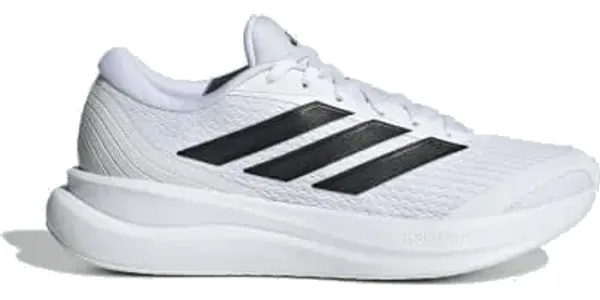
The details that matter
Under the foot: a single Cloudfoam slab, no plate
The midsole is full-length Cloudfoam. RTINGS identifies it as a basic single slab of EVA, with no secondary foam and no plate (a stiff insert embedded in the sole). adidas describes Cloudfoam as ultra-soft from first contact, but RTINGS found it tuned to be firm rather than plush. The forefoot is one of the firmest RTINGS has tested, and its cushioning is even worse than the heel's.
In use, landings and toe-offs feel very secure, but the harsh sole protects poorly from the first stride, so your legs feel beaten up fast. Energy return is very poor (66.0% forefoot, 63.8% heel in the lab), so the ride isn't bouncy and you work harder to hold your pace.
The heel has a curved rocker that RTINGS rates as good, giving heel strikers a smooth landing. The forefoot rocker is mild and buckles easily under load, and with the thin forefoot the sole flattens instead of rolling your foot forward at toe-off.
The outsole is full-length rubber. 42k.tools says it grips reliably on park paths, asphalt and gym floors, while techbloat and itechguides advise caution on wet roads, painted lines, metal covers and polished tile.
Upper: textile and synthetic, secure once laced
The upper is a mix of textile and synthetic materials, which adidas says keeps it light and breathable. 42k.tools and shoestrace describe it as a breathable mesh. Inside, there is a textile sockliner.
The tongue is not stitched to the sides of the shoe (non-gusseted). When trying it on, lace up and check that the tongue sits centred and doesn't press on the top of your foot. The flat laces have moderate stretch, and RTINGS found they kept the midfoot locked down consistently without overtightening.
The toe box is a bit low, and RTINGS warns it may bother people with taller toes. On heat, shoestrace says it suits hot days, while itechguides says it may not stay cool enough in high heat. If you'll run in the sun, try it on with the socks you actually use.
In use: good for walking and the gym, not for long runs
Opinions on softness split clearly. adidas calls it ultra-soft, and techbloat, itechguides and 42k.tools, writing from adidas's specs and descriptions, also describe it as soft and comfortable. shoestrace calls it plush even over extended mileage. RTINGS, which bought a pair and measured it in the lab, found the opposite: a firm, unbouncy sole with poor impact protection that leaves legs beaten up beyond 10K.
Where sources agree is on short use. RTINGS sees it as a walking or workout shoe first, fine for treadmill warm-ups and cool-downs. adidas positions it for road runs of 0–6 miles (about 0–10 km). trainingplan.dev and techbloat see it as suited to easy runs, run-walk sessions and everyday walking.
For speed sessions, tempo runs or racing, RTINGS and trainingplan.dev advise against it. RTINGS also finds it on the heavy side for a daily trainer.
Reading the numbers: about 10 mm drop, moderate heel stack
Drop (the difference between heel and forefoot sole thickness): RTINGS measured 9.8 mm in a men's US 9. adidas lists 10 mm in several places, and the adidas Thailand product page lists 9 mm. All land around 10 mm, so the heel sits clearly higher than the forefoot. 42k.tools sees this drop as suiting beginners who land on their heels.
Stack: RTINGS measured 35.3 mm under the heel and 25.5 mm under the forefoot (men's US 9), close to the 35 mm heel and 25 mm forefoot adidas Thailand lists. The 42k.tools table shows 39 and 29 mm, higher than both RTINGS and adidas. trainingplan.dev says this height doesn't make it a max-stack shoe. RTINGS sees the thin forefoot as one reason the shoe doesn't roll your foot forward.
Weight: adidas Thailand lists 240 g. The catalog cited by trainingplan.dev lists the women's version at 8.5 oz (about 241 g). RTINGS weighed a men's US 9 at 276.9 g and calls it heavy for a daily trainer, while itechguides calls it relatively light. The figures come from different sizes. In the store, hold it next to the shoes you wear now.
What an approximately 10 mm drop means
Drop is the difference between heel and forefoot sole thickness. This shoe sits around 10 mm (RTINGS measured 9.8 mm in a men's US 9), so the heel is clearly raised. 42k.tools sees it as suiting beginners who land on their heels. If you're used to lower-drop shoes, walk and jog in it first to see how it feels.
Check the sole's firmness before buying
adidas calls Cloudfoam ultra-soft, but RTINGS measured one of the firmest forefoots it has tested, with a very firm heel too. Walk on a hard floor and jog a little in the store. If it already feels harsh when you try it on and you want to run beyond 10K, look at models with softer foam.
Check the room around your toes
RTINGS found the length true to size but the toe box a bit low. When trying it on, wiggle your toes to check they don't press against the upper. If it's tight at the sides, trainingplan.dev advises choosing the wide version rather than sizing up.
What to check when trying it on, and what to compare
When trying it on, walk and jog on a hard floor for a while. If the sole already feels too firm in the store, it may not suit your running. Wiggle your toes to check for room and that they don't touch the upper, especially if you have taller toes. Lace up snugly and check that your heel doesn't slip and the tongue doesn't shift. If your foot rolls inward a lot when you land, stand and walk to see whether the midfoot feels stable enough, because RTINGS found the outsole a bit narrow under the arch.
If you want a running shoe with more cushioning and rebound, compare trainers with softer foam. RTINGS points to the adidas Adizero Evo SL, which is livelier, more protective and lighter, though the Runfalcon 6 is much more stable, and the Brooks Trace 4, which is equally stable but has significantly more cushioning and rebound. If you need a shoe that controls inward rolling, look at stability models, because the Runfalcon 6 is a neutral shoe.
Size and fit
adidas says it runs true to size and recommends your usual size. RTINGS tested a men's US 9 and found the length spot on, with forefoot and arch width close to its reference fit. Inside the shoe, RTINGS measured 274 mm in length, 98 mm across the forefoot and 61 mm at the heel. It recommends your usual size even though the toe box is a bit low for taller toes. shoestrace calls the fit true to size and snug. trainingplan.dev suggests starting from your usual adidas running size and then checking the actual shape.
On width, RTINGS reports that adidas offers standard and wide versions for men and women. The adidas Thailand page for this model lists only the regular width. If the regular version feels tight at the sides, trainingplan.dev advises choosing the wide version rather than sizing up.
3.5 UK4 UK4.5 UK5 UK5.5 UK6 UK6.5 UK7 UK7.5 UK8 UK8.5 UK9 UK9.5 UK10 UK10.5 UK
IH9534 · 2026-11-24 · Recorded sizes, not current stock