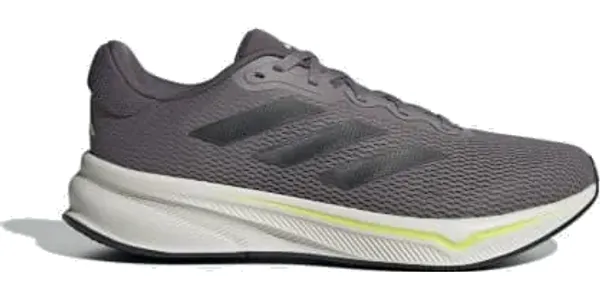
The details that matter
What's under your foot
The midsole is EVA foam running from heel to toe; adidas says it gives cushy comfort. On top sits an OrthoLite sockliner, the layer your foot touches. The outsole is rubber that adidas lists as all-surface and grippy, to keep your pace steady.
One RateItAll wearer says the shoe has good flexibility and the sole a fair elastic rebound; another, who has owned 3–4 pairs, says the sole stays cushy for a while.
RunnerExpert says its test pair had a midsole combining Boost foam with Cloudfoam, while adidas's current product pages list EVA. The tester found the shoe stiff and not responsive enough, and the midsole not the best quality, and noted a lot of material in the heel that heel strikers will feel. If you land on your heel, jog a few steps in the shop to see whether the heel feels soft enough for you.
Upper and in-shoe feel
The upper is mesh with a textile lining. adidas says the shoe contains at least 20% recycled materials.
One RateItAll wearer calls it breathable; another says the shoes are very soft inside and very flexible. RunnerExpert's tester praised the nicely padded heel.
When you try the shoe on, lace it snugly and walk for a while to check for pressure or rubbing from the lining.
How it runs
Many RateItAll wearers use it for regular running and are happy. One calls it good for short to medium runs; another says it is comfortable enough for long-distance or recreational running. One track-and-field athlete who also runs cross country prefers it for its excellent traction and light weight. Others wear it for workouts, walking or lounging. One wearer who has owned 3–4 pairs says it is great for hiking or trail running, though adidas lists it as a road shoe.
RunnerExpert's tester ran six times over about a week in it and found it heavy and therefore quite slow, not great for long runs or sprints. In the tester's view it is not the best option for beginners and suits well-trained runners who run a lot.
One wearer found it nice but less comfortable than expected; another found it less comfortable than most adidas shoes. A wearer with bad knees and big thighs felt it did not give them enough support and padding.
Reading the numbers
adidas Thailand's pages for two product codes list different numbers. IH6094 lists a 29 mm heel stack, 19 mm forefoot stack, 10 mm drop and 327 g. IH6091 lists 27 mm under the heel, 18 mm under the forefoot, a 9 mm drop and 268 g.
Drop is the difference between heel and forefoot thickness. Around 9–10 mm means the heel sits roughly 1 cm higher than the forefoot. If you usually wear shoes with similar heel and forefoot thickness, walk and jog a little in it first.
Weight impressions vary. RunnerExpert's tester (men's version), used to running in shoes under 300 g, found it heavy, while several RateItAll wearers call it light. When you try it on in the shop, hold it against the running shoe you use now; that is the clearest check.
Check the forefoot when trying it on
Response comes in regular width only, with no wide version, and width reports disagree. When trying it on, check that your toes can move, there's no side pressure, and your heel doesn't lift out of the shoe as you walk.
Compare the weight in the shop
adidas's pages for two product codes list different weights (268 g and 327 g). When you try it on in the shop, hold it against the running shoe you use now.
What a 9–10 mm drop means
The heel sits about 1 cm higher than the forefoot. If you usually wear shoes with similar heel and forefoot thickness, walk and jog a little in it to see whether it feels natural.
Trying it on, and what to compare
When trying it on, check three things:
1) Forefoot: can your toes move, and is there side pressure? RunnerExpert's tester found the front very narrow.
2) Arch support: does it suit your arch? One wearer loves it, another didn't like it.
3) Jog a few steps to judge whether the sole feels soft enough or too firm for you.
If it doesn't suit you:
- For long runs or running faster: look at lighter shoes with a bouncier sole.
- For wide feet: look at models sold in a wide version, since Response comes in regular width only.
- For more support: look at support-focused shoes.
Size and fit
adidas sells Response in regular width only, with no wide version, and width reports disagree:
- RunnerExpert's tester (men's version), who has normal-to-wide feet, found it narrow, especially very narrow in the forefoot.
- One RateItAll wearer calls them tight; another says they don't conform well to their feet; another found them a bit bulky with a fit that isn't uniform.
- A wearer who ran in them for a year found them too wide; another praises them as wide and stable.
- A wearer with long, narrow feet and a very high arch was recommended Response by a running store, and it worked out well.
Before buying, compare adidas's size chart, try on both shoes, and check the exchange policy.
6 UK6.5 UK7 UK7.5 UK8 UK8.5 UK9 UK9.5 UK10 UK10.5 UK11 UK11.5 UK12 UK12.5 UK13.5 UK14.5 UK15 UK16 UK17 UK
IH6094 · 2026-11-24 · Recorded sizes, not current stock