The details that matter
Underfoot: deep foam, no plate, full-length outsole
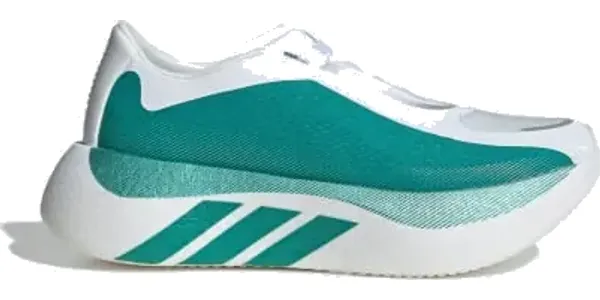
The midsole is a single slab of Hyperboost Pro foam. adidas took Lightstrike Pro (the PEBA-family foam in its racing shoes), turned it into beads and re-moulded it, so it carries the Boost name but not the old Boost material. Doctors of Running says it is much lighter than the original Boost and has a clear bounce when loaded.
On softness, RunRepeat measured 32.5 on the Asker C scale at room temperature, clearly softer than average, yet testers say you do not sink into it. Nils at RoadTrailRun found the foam initially slightly denser than typical super foams, a little like classic Boost.
There is no carbon or plastic plate, but the sole does not bend easily: RunRepeat measured 19.8 N in its 30-degree bend test, thanks to the sheer amount of foam. The forefoot has a rocker (a curved sole that helps the foot roll forward) that engages very late and encourages a more forceful toe-off. Some runners like it; some find it awkward. The heel rocker is milder, so heel strikers get less help.
The outsole is full-length LIGHTTRAXION, a CPU-type material lighter than conventional rubber. It is only 2 mm thick but resists wear well, and it helps steady the tall, fairly narrow platform.
Upper: secure, but stiff and warm
The upper is Primeweave, a thin but very dense woven textile, with large TPU overlays around the foot and a softer, more pliable fabric at the toe. The laces run through hidden internal loops, so there are no visible eyelets. The tongue is gusseted to the sides and thinly padded.
The upside is lockdown: several testers said the heel and midfoot stay put, and a shoe this tall needs that kind of hold. The downside is stiffness. Léa at RoadTrailRun said on first try-on it felt almost as stiff as Stan Smith sneakers, and the overlays cover much of the woven fabric, so airflow is limited. RunRepeat scored breathability 62, below average, and only 47% of its artificial sweat evaporated in 3 hours. Nils had no trouble in spring temperatures but expected it could get hot in summer, while Meg at Believe in the Run never found it overly warm.
The collar is the part to check most carefully. It is high and rigid. The heel counter (the stiff structure around the heel) is split into two side pieces with a flexible centre at the back, leaving room for the Achilles, but the side edges can press on the ankle bone, especially when turning on a track or running cambered roads.
How it runs
Easy and long runs: this is where testers agree most. Nils found it pleasantly soft and very comfortable on recovery runs at around 5:00 min/km or slower. Meg at Believe in the Run reached for it most for recovery runs and easy 10–12 mile runs, and said the bounce never faded from mile 1 to mile 12. Tom's Guide's tester, a light runner with a shuffling stride, found it springy at all times, even at easy pace.
When you want to run faster: opinions differ. Nils comfortably completed threshold runs at about 3:40 min/km and shorter intervals at 10K race pace. Kelly at RoadTrailRun named long road runs and tempo workouts as its best uses. Another RoadTrailRun tester found it bulky at paces faster than 6 min/mile, and Tom's Guide said its size makes it feel a little awkward at faster paces. It makes more sense as a training shoe than a racer.
Heel versus forefoot: the forefoot is praised as smooth and snappy; the heel draws mixed views. Doctors of Running says the rear heel flare and limited bevel make the heel transition clunky, noticeable when running slow. RunRepeat says it suits midfoot strikers best but still works for heel strikers.
Stability: many testers found it more stable than expected for its height and reassuring on smooth roads, but RTINGS and a RoadTrailRun tester found it shifts sideways in fast corners, on cambered roads, or as fatigue sets in.
Surfaces: it is built for roads. Nils found good traction on park paths and forest trails, and Kelly ran a few miles of gravel without trouble, but Doctors of Running found little traction on dirt or mud. Kelly also noted the outsole squeaks loudly on many indoor floors.
Reading the numbers: drop, stack and weight
Drop (the difference between heel and forefoot sole thickness): adidas states 6 mm, RunRepeat measured 6.5 mm and RTINGS measured 7.5 mm in a men's US 9, a spread of under 2 mm. Drop describes the slope of the sole; it does not tell you which footstrike the shoe suits. For that, look at the heel shape discussed under How it runs.
Stack: the adidas Thailand page for code KK0288 lists 45 mm under the heel and 39 mm under the forefoot. RunRepeat measured 44.6 and 38.1 mm; RTINGS measured 43.3 and 35.8 mm in a men's US 9. Another product page (code KI1915) lists 43 and 36 mm. The figures vary by page and method, but all point the same way: this is a very tall sole with almost no ground feel.
Weight: the two adidas Thailand pages disagree (258 g and 221 g), so read them alongside size-qualified weights. RTINGS weighed 245.5 g in men's US 9, RunRepeat 247 g, Nils about 264 g in US 10.5, and Believe in the Run 270 g in men's US 10.5 and 225 g in women's US 7.5. Compare other shoes at the same size. Several testers said it feels lighter on the run than the numbers suggest.
How tall is it, and what does a 6 mm drop mean?
The heel sits on roughly 43–45 mm of sole and the forefoot on 36–39 mm, depending on the source, with almost no ground feel. The drop of about 6–7.5 mm only describes the slope. On try-on, jog a few steps to feel whether the heel landing is smooth or clunky and whether the tall platform feels steady.
Compare weight at the same size
Measured weights run from 245.5 g in men's US 9 to 270 g in men's US 10.5, and 225 g in women's US 7.5. Compare against your current shoe at a similar size, or simply pick both up side by side in the store.
Check toe-box height and instep room
The forefoot is roomy in width, but the toe box is low (24.8 mm per RunRepeat) and midfoot volume is low. On try-on, lift your toes to see if they hit the upper, then lace up snugly and check for pressure on top of the foot.
What to check on try-on, and what to compare if it doesn't suit
When trying it on, sit down and loosen the laces first: the collar is rigid and there is no heel tab, so it is hard to step into while standing. Wear the socks you run in, then walk and squat. Check the three points RoadTrailRun recommends: does the back of the collar touch your Achilles, do the side edges press on your ankle bones, and does the upper press on the top of your foot? Wiggle your toes up and down too, since the toe box is low. If the heel collar starts to rub, socks with extra heel padding can help. If buying online, check the exchange policy first.
If it does not suit your feet, look at tall-stack super trainers with a softer upper. Several reviewers compared it with the ASICS Superblast 3, finding its upper more comfortable and suited to more runners; a RoadTrailRun tester sees it as the more reliable choice for high mileage. The ASICS Megablast is lighter and bouncier but less stable. If you do not need this much foam, RTINGS says the adidas Hyperboost Run is less cushioned but more stable.
Size and fit
Length: most reports say true to size, including RTINGS (men's US 9), Doctors of Running testers (men's US 9.5 and US 10), Nils (US 10.5), Meg (women's US 7.5) and 68 user votes on RunRepeat. A few notes: Chad at Believe in the Run received a men's US 11, smaller than his usual 11.5–12, and still had enough toe room to run, saying adidas tends to run long. Sally, a narrow-footed RoadTrailRun tester, had extra room in length. Kelly went up half a size (women's US 8.5) in the revised blue version; it fits slightly long but holds the foot securely.
Width and volume: RunRepeat measured 97.4 mm of internal forefoot width, wider than average, and several testers found plenty of forefoot room. But the toe box tapers (RunRepeat measured 71.4 mm at the toes) and is low (24.8 mm toe box height), so RunRepeat does not recommend it for runners who need extra toe space. Midfoot volume is also low, so a high instep may feel pinched on top. The heel is slightly narrow. Nils says the new last is less narrow than typical adidas, but very wide feet will not get much give from the TPU overlays. The adidas Thailand page and RTINGS list standard width only.
Revised version: RoadTrailRun reports adidas sent a revised blue version with a thin added layer under the sockliner at the rear. Kelly blistered at the Achilles within three miles in the original red version; in the revised pair, which she wore half a size up, she had no Achilles blisters. Léa, in the same revised-version review, still got chafing and blisters from the stiff upper in her first few runs, which gradually eased in later runs. RTINGS also updated its review to note changes to the heel collar in newer versions.
3.5 UK4 UK4.5 UK5 UK5.5 UK6 UK6.5 UK7 UK7.5 UK8 UK8.5 UK9 UK9.5 UK10 UK10.5 UK
KI1915 · 2026-11-24 · Recorded sizes, not current stock