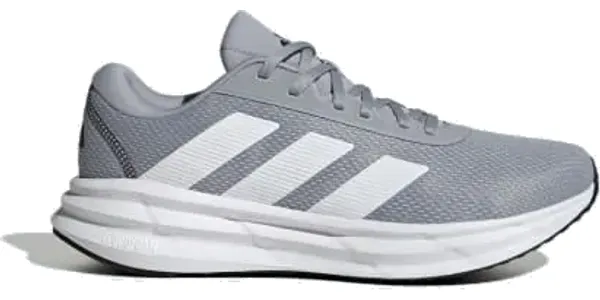
The details that matter
Under the foot: soft, not springy
The midsole (the foam layer between your foot and the outsole) is Cloudfoam (Solefeed identifies it as EVA), the same compound as the previous version, but the Galaxy 8 has a thicker sole. RunRepeat measured foam hardness at 39.2 AC (a foam hardness scale; lower is softer), softer than average. RunRepeat also found shock absorption improved by about 9% at both heel and forefoot, but says this is not a maximalist cushioned trainer, and these results apply to shorter runs.
Do not expect bounce. RunRepeat measured energy return at 51.0% at the heel and 52.6% at the forefoot, typical of budget trainers. adidas says the outsole is flexible, but RunRepeat measured the Galaxy 8 and found the shoe hard to bend: it took 18.0 N (newtons; higher means harder to bend) to flex it, on par with some nylon-plated tempo shoes. If you like a shoe that bends easily with your foot, flex it and walk around when you try it on. There is a noticeable rocker (the sole curves up at the toe to help roll you forward), though it is softer than on the Galaxy 7.
adidas lists a TPU outsole. RunRepeat found rubber running the full length of the outer edge, with a section covering part of the central forefoot. RunRepeat measured the outsole at only 2.2 mm thick, below average, but much tougher: after Dremel grinding it lost just 1.0 mm, 1.6 mm less than the previous version. Runnea says the high-wear areas are reinforced against asphalt abrasion. For grip, RunRepeat measured a 0.52 friction coefficient, slightly above the lab average: reassuring on dry pavement and adequate on occasionally wet roads.
Upper: breathable, less durable
The upper is an engineered synthetic mesh with a thin tongue, and it breathes very well. After a 3-hour test RunRepeat gave it 95 BR (RunRepeat's breathability score; higher breathes better). RunRepeat also tested how fast the shoe dries: 55% of the moisture evaporated within 3 hours, which it calls a very acceptable result for a budget shoe. The inside has a textile lining, as adidas lists. Runnea says the one-piece interior supports the foot's natural movement and adds comfort.
The trade-off is durability. RunRepeat says the upper favours breathability, so it is less durable: the toebox mesh scored 2 out of 5 in its Dremel test and the heel padding only 1 out of 5. If your previous shoes tended to wear through at the toe or inside the heel, this pair may also wear quickly at the same spots.
The laces run through standard punched eyelets, with lacing bridges in the midfoot to even out lace pressure. RunRepeat measured the tongue at only 4.7 mm thick, and it is not gusseted, so lace with care to avoid pressure on the top of your foot. The heel design is simple with no heel tab; the heel counter (the stiff structure around the heel) is medium, scored 3 out of 5 by RunRepeat. There are no reflective elements, so add reflective clothing or gear for night runs.
Opinions on warmth differ. RunRepeat's lab result says the shoe breathes very well, while Solefeed's summary of wearer comments flags a warm upper and says it is not a breathable summer trainer.
How it feels on runs and walks
All three reviews agree Galaxy is for easy running. RunRepeat's testers found the ride comfortable and forgiving, with a natural-feeling drop (the difference between heel and forefoot thickness), but it does not suit runners who want an energetic, responsive ride. Runnea calls it ideal for combining occasional running with walking, for sessions of up to one hour at paces slower than 5:30 min/km. Solefeed says the ride feels balanced and forgiving for walking and short, easy road runs.
Comfort depends on pace. Solefeed says it is comfortable for easy miles but feels heavy at faster paces, and RunRepeat says the shoe feels very heavy for its category.
For stability, RunRepeat measured the forefoot midsole width at 113.0 mm, about 4 mm narrower than before, so the shoe feels more agile but less stable at toe-off. The heel midsole width measured 94.4 mm, above average. Galaxy is a neutral shoe (not built to guide the foot) with minimal guidance. Runnea lists it for heel strikers and normal feet, and RunRepeat does not recommend it for runners who need support.
How to read the numbers
Stack height: adidas Thailand lists 35 mm under the heel and 29 mm under the forefoot. RunRepeat measured the Galaxy 8 at 37.5 mm at the heel and 30.5 mm at the forefoot, close to max-cushion territory without feeling clunky.
Drop: adidas Thailand lists 6 mm. RunRepeat measured the Galaxy 8 at 6.9 mm (adidas's Galaxy 8 spec says 5 mm), and on the run it feels like 6–8 mm. It is a moderate drop that RunRepeat calls natural-feeling.
Weight: adidas Thailand lists 310 g, RunRepeat weighed 318 g, and Runnea lists 294 g for an average men's size. RunRepeat and Solefeed both call the shoe heavy. In the store, pick it up next to the running shoe you use now.
What a 6–7 mm drop feels like
Drop is the difference between heel and forefoot thickness. adidas Thailand lists 6 mm; RunRepeat measured the Galaxy 8 at 6.9 mm, and it feels like 6–8 mm on the run. That is a moderate figure that RunRepeat calls natural-feeling. If you are used to near-flat shoes, walk and jog in it next to your current pair.
Weight: compare it with your current pair
RunRepeat and Solefeed both say this shoe is heavy. In the store, pick it up next to the running shoe you use now. If it feels clearly heavier and you want to run faster, look at a lighter model.
Roomy upper, narrow toebox
RunRepeat measured the upper at 97.5 mm at its widest, but only 70.8 mm across the toes. When you try it on, check more than length: make sure your toes can spread and the sides of your forefoot are not squeezed. The tongue is thin, so lace up snugly and check for pressure on the top of your foot.
What to check, and what to compare
When you try it on, check four things:
• Toes: the toebox is tapered and narrow. Wiggle and spread your toes; if your little toe or the sides of your forefoot feel squeezed, this pair may not suit your feet.
• Top of the foot: the tongue is thin. Lace up snugly and walk for a while; if the laces press on the top of your foot, loosen the upper laces.
• Heel: walk and jog lightly to see whether your heel lifts.
• Sole stiffness: the shoe is hard to bend and has a rocker. Walk a lap to see whether you like that feel.
If Galaxy does not suit you, compare these kinds of shoe: for faster running or lots of hot-weather running, Solefeed recommends a lighter, more breathable budget trainer. If you need support, look at stability shoes. If you have wide feet, look for a roomier toebox. Among other adidas models, Solefeed says the Duramo SL 2 offers a slightly better ride, so it becomes more appealing when the price gap between the two is small; Galaxy makes the most sense when it is clearly cheaper.
Size and fit
Sizing reports differ slightly. RunRepeat's results table says the Galaxy 8 fits slightly small, while Solefeed says it is generally true to size with a standard forefoot. If you are between sizes, try both and compare.
The upper is roomy, but the toebox is narrow. RunRepeat measured the upper at 97.5 mm at its widest, so there is plenty of room inside, but the toebox tapers: it measured 70.8 mm across the toes, about 2 mm narrower than the previous version, so wide-footed runners will feel their toe splay restricted. RunRepeat measured toebox height at 28.8 mm, enough for some toe wiggling.
Sources disagree on a wide version. The Galaxy 8 spec listed by RunRepeat includes a wide width, Solefeed says adidas does not offer a wide width for this model, and the adidas Thailand page lists Regular only. If you have wide feet, try it on before you buy.
3.5 UK4 UK4.5 UK5 UK5.5 UK6 UK6.5 UK7 UK7.5 UK8 UK8.5 UK9 UK9.5 UK10 UK10.5 UK11 UK11.5 UK12 UK12.5 UK13.5 UK
KJ3498 · 2026-11-24 · Recorded sizes, not current stock