The details that matter
What's under your foot and how it behaves
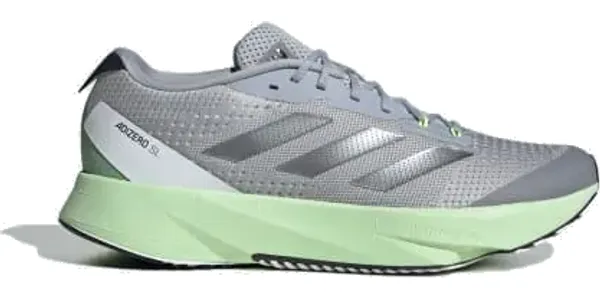
Most of the midsole is Lightstrike (adidas's EVA foam), with a Lightstrike Pro insert under the forefoot. There is no carbon plate and none of the midfoot rods or shanks found in the Adizero Boston and Adios.
The lab numbers and the feel on foot don't match. RunRepeat's hardness reading puts the foam in the middle range (36.5 AC), but it feels firmer than that on foot. The heel absorbed impact less well than average and returned only 48.7% of the energy as bounce, while the forefoot returned 64.8%.
RunRepeat says midfoot and forefoot strikers get a completely different experience thanks to the Lightstrike Pro insert up front. The Doctors of Running reviewer, though, did not really notice it and found the ride typical of Lightstrike.
The sole is stiff: RunRepeat measured 18.3 N to bend it 30 degrees, well above average. That gives a snappier ride at faster paces but makes it less suited to walking or gym use.
The outsole uses Adiwear rubber in the forefoot rather than the Continental rubber of other Adizero models. It is about 3.4–3.5 mm thick. RunRepeat's test with a small rotary tool (Dremel) left only a 0.7 mm dent, better than most shoes it has tested, and RunRepeat's grip test found it reliable on both sunny and rainy days.
The upper: airy and soft, but mind the tongue and laces
The upper is a soft engineered mesh covered in punched holes of different sizes; adidas says it uses at least 50% recycled material. A thin full textile lining sits inside. RunRepeat found the lining so thin it does not block airflow and scored breathability 5/5. Doctors of Running calls the forefoot upper thin and well ventilated, while RunningShoesGuru rates breathability as moderate.
The tongue and ankle collar are well padded; RunRepeat found the 4.1 mm tongue padding keeps the instep comfortable, with no pain there. But the tongue is not attached at the sides. Doctors of Running had it slide during workouts with turns, and RunningShoesGuru found the extra-wide tongue bunching while tying; pulling it taut before lacing helps.
The laces are flat and narrow. RoadTrailRun's Dominique found lacing tedious because each lace has to be pulled through the eyelets individually; the first two rows are cord loops instead of eyelets. The WeeViews wearer says the laces come untied, so a double knot before a run is worth it.
The heel counter (the firm shell around the heel) is not very stiff but well padded. RunRepeat scored its stiffness 3/5 and found it prevents heel slip well; Doctors of Running says anyone wanting a really stiff counter will be disappointed. A fold-up tab at the back works as a pull tab. There are no reflective details, so add reflective gear if you run in the dark.
On the run: reviewers split on the firmness
Firmness is where reviewers disagree most. RoadTrailRun's Michael says the firmness is distinct, but is a fan. Dominique finds it firmer than the daily trainers Dominique usually wears, yet says the firmness helps deliver a faster ride and the Lightstrike Pro insert creates a propelling motion.
Peter sees it differently: firm and kind of stiff. After about 45 miles it was still as stiff and had not broken in, and Peter felt beaten up after runs in the forefoot, knees and hips.
Slow running feels stiff, and the ride gets more fun as the pace rises, though reviewers place the sweet spot differently. Zack found the midsole felt best at moderate paces: somewhat stiff and unforgiving when slow, yet too soft and not responsive enough at fast workout paces.
RunningShoesGuru says the ride feels best when picking up the pace with a midfoot strike; at an easy pace with more of a heel strike, the transition to toe-off is a bit blocky rather than smooth. Doctors of Running found the stiff forefoot slightly awkward at slow speeds until the shoe breaks in, and the ride softening with more miles.
On distance, opinions differ. RunRepeat sees it as better for shorter runs than long ones, and the WeeViews wearer probably wouldn't recommend it for over 8 miles unless you really like firmer midsoles. Yet the Doctors of Running reviewer did several runs over 10 miles and a 6-mile tempo with zero issues, Zack used it for a 15-mile progression run (gradually picking up the pace), and the RunningShoesGuru reviewer calls it one of their favourite everyday shoes for mid to long runs.
Most praise the grip, but Doctors of Running rates it only average. Peter and Zack had no traction issues in the wet, and Zack found it fine on packed snow. Michael ran mostly on the treadmill and found the grip very good. Doctors of Running found it fine on wet and dry roads and very grippy on the track, making curves easy, but calls the grip average overall because it is not Continental rubber, and harder going on snowy roads. RunningShoesGuru ran in snow and slush and says the grip helps, though snow packs into the gaps between the rubber lines.
Light trails are fine. RunRepeat says you can run on light trails without worrying about outsole durability. Doctors of Running used it on well-groomed trails, but the tall, floating-feeling heel made dirt or grass a little tricky at times.
The outsole is tough, but the foam starts to show compression lines after a while. Doctors of Running saw barely any outsole wear at 46 miles and Zack very little at 60. RunningShoesGuru saw compression lines in the foam at around 80 miles but no dip under the forefoot at 100, and advises runners who wear down midsoles quickly to avoid it. The WeeViews wearer, at 198 miles, wore through the outer rear outsole of the left shoe fairly quickly, though they call themselves a 'reaper of soles'.
How to read the numbers
Drop (the difference between heel and forefoot sole thickness) for the men's shoe is listed by adidas at 10 mm, from a 35 mm heel and 25 mm forefoot. RunRepeat measured an 8.6 mm drop from a 34.9 mm heel and 26.3 mm forefoot. The adidas Thailand product page lists a 36 mm heel, 27 mm forefoot and 9 mm drop. If you are used to low-drop shoes, run in it and see whether you like the taller heel.
RunRepeat says the forefoot stack is slightly above average and the heel is 4.7 mm taller than the Nike Pegasus 40's. A thick sole is not the same as a soft one: this shoe has a fair amount of foam but rides firm.
Weight only means something alongside size. adidas lists 241 g for a men's US 9; RunningShoesGuru lists 8.6 oz (about 244 g) for the same size; the adidas Thailand page lists 244 g; RunRepeat weighed 249 g; and RoadTrailRun weighed a men's US 11 at 277.8 g. In larger sizes, expect more than the listed weight.
Drop: the figure depends on the source
adidas lists a 10 mm drop for the men's shoe, RunRepeat measured 8.6 mm, and the adidas Thailand page lists 9 mm. If you're used to low-drop shoes, run in it to see whether you like the taller heel, especially if you'll run on dirt or grass.
A thick sole isn't a soft sole
The heel stack is around 35 mm, but RunRepeat found the foam firmer than its hardness reading and heel shock absorption below average. Jog in it slowly and a bit faster to see whether you like this firmness.
Read weight together with size
adidas's 241 g figure is for a men's US 9; RoadTrailRun weighed a US 11 at 277.8 g. In larger sizes, expect more than the listed weight.
What to check when trying it on, and what to compare if it doesn't suit
Jog in it both slowly and a little faster, since the firmness feels different at different speeds. Lace to the top eyelet and check that your heel stays put. The Doctors of Running reviewer in a men's US 9.5 found heel lockdown okay, though they do use the last eyelet. The same review mentions very mild heel slip, not bothersome for daily miles but noticeable when pushing the pace. Check that there is enough room in front of your toes, because some found it slightly short, and straighten the tongue before you tie the laces.
If it feels too firm, compare a softer, more flexible daily trainer. RoadTrailRun's Peter found the Hoka Mach 5 lighter and more forgiving, the On Cloudmonster heavier but lighter-feeling and less stiff, and the Rebel v3 a bit more fun and flexible. For harder efforts, Michael would reach for one of adidas's plated shoes instead. For rough trails, Doctors of Running suggests the adidas Terrex range.
Size and fit
Most wore their usual size. One Doctors of Running reviewer found it true to size in a men's US 9.5; another, in a men's US 10, true to size if slightly short. RoadTrailRun's Peter (men's US 11) found it a tiny bit short with not much toe room, but did not need to size up. RunningShoesGuru says it fits true to size, while RunRepeat's summary says it runs slightly small.
On width, RunRepeat measured the toebox at 102.4 mm, among the widest of daily trainers, and says even wide-footed runners can stay in the standard size. Doctors of Running (US 10) found it slightly wider, especially in the forefoot, but with a low upper over the toes, which runners who like height up front will not enjoy. Dominique found it roomy rather than snug, with only average forefoot hold, yet would not recommend sizing down half a size. RunningShoesGuru calls the toe box medium-width: narrow forefeet may find it too roomy, and wide feet may feel cramped.
Zack had no lockdown issues at all, while Peter felt the overall firmness of the shoe push the heel up a little, though not a dealbreaker. The 3.7 mm insole is not glued; RunRepeat found it easy to swap for other insoles.
The adidas Thailand page lists a regular width, and the brand specs RunRepeat lists include a wide option. If the regular version feels tight across the forefoot, ask the store whether a wide version is available and try it on before buying.
3.5 UK4 UK4.5 UK5 UK5.5 UK6 UK6.5 UK7 UK7.5 UK8 UK8.5 UK9 UK9.5 UK10 UK10.5 UK11 UK11.5 UK12 UK12.5 UK13 UK13.5 UK14 UK14.5 UK15 UK16 UK17 UK18 UK
IG3337 · 2026-11-24 · Recorded sizes, not current stock