The details that matter
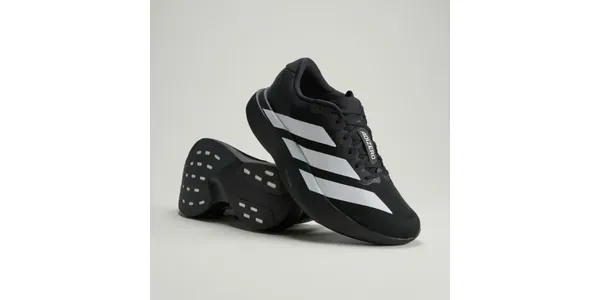
What's underfoot: all-foam midsole, a plastic shank and thin rubber
The midsole is Lightstrike Pro throughout, with no second foam or stiffening rods. RunRepeat cut the foam and examined it under a microscope, finding it the same as in the Adios Pro 3; adidas's project lead told RoadTrailRun the same. Doctors of Running felt it differs from the foam in the Evo Pro and Adios Pro 4: more solid and more comfortable at training paces.
There is no carbon plate, but a small plastic shank sits in the midfoot to keep the soft foam from twisting too much. Doctors of Running felt its stiffness reaching into the forefoot and heel, adding snap when the pace picks up. RunRepeat, by contrast, says runners who want the feel of a plated shoe won't get it here.
The forefoot curves up into a rocker that helps the foot roll forward. RunRepeat says the front rocker has moved from where it sits on the Adios Pro 3 to the same position as on the Adios Pro Evo 1. Michael and Nils at RoadTrailRun say it supports efficient forefoot running and a comfortable ride at higher speeds, while RTINGS notes the gentle rocker angle limits how forcefully the shoe pushes you forward.
The forefoot rubber is Continental, specified as Conti Winter; the heel has two pieces of adidas Clear Rubber. RunRepeat measured the rubber at 1.6 mm, about half the thickness of most outsoles, yet it wore just 0.6 mm in testing. More foam is exposed at the heel, so RTINGS warns heel strikers will see faster wear there. A Doctors of Running tester who scuffs their feet found the rear-outer heel rubber piece started tearing off at about 45 miles (about 72 km).
Upper: thin breathable mesh, but the tongue and laces need attention
The upper is a single-layer synthetic mesh with a textile lining. RunRepeat gave it a 76 BR breathability score in a 3-hour test with a footform heated to 38°C. OutdoorGearLab calls it very breathable, though not the most breathable. The thin mesh costs durability: RunRepeat scored toe-box durability just 1 out of 5.
The tongue is thin and not stitched to the upper. Testers at RoadTrailRun, WeeViews and OutdoorGearLab had it shift during runs; OutdoorGearLab warns it may rub on top of the foot and tends to roll as you put the shoe on. The Doctors of Running tester, on the other hand, had no tongue slipping.
The laces are flat, thin, low-stretch and a bit short; for heel-lock lacing there's just enough length. OutdoorGearLab had a knot cinch impossibly tight on a wet run.
The heel counter (the stiff structure around the heel) rises about two-thirds of the way up and flexes slightly. It didn't bother the Doctors of Running tester, who still advises caution for people sensitive to heel counters. Michael at RoadTrailRun had no heel slip and no irritation. OutdoorGearLab found the heel cup roomy while keeping good heel retention, with no Achilles abrasion. RunRepeat gave the heel padding a perfect 5 out of 5 for durability.
On the run: fun when you speed up, mixed views on slow days
Several outlets agree the shoe rolls smoothly and becomes clearly more responsive as you speed up. RunRepeat thinks it shines most between marathon pace and high zone 2 aerobic runs. Michael at RoadTrailRun found it especially good around marathon pace, and Nils says it was really comfortable at 4:15–3:40 min/km. Doctors of Running found the midsole slightly soft and less responsive than hoped at first, then gaining more and more bounce after about 20 miles (about 32 km) of running in it.
Slow days are where views differ. Doctors of Running says it rolls along nicely at easier efforts, and OutdoorGearLab found it gave a controlled feeling at easy paces. RTINGS, however, found a firm forefoot that most runners will find a bit harsh for recovery runs. On genuinely easy days Michael felt the shoe nudging him to speed up. Sam says that at anything but lively paces he had a hard time transitioning from the soft heel past the midfoot shank; for him it is not a shoe for running slower than 10 min/mile (about 6:13 min/km) or when back on the heels.
On stability, RunRepeat found a remarkably steady, confidence-boosting ride for runners who don't need support, but notes a narrow heel for this stack height. RTINGS found the soft heel foam not very stable and says runners who land farther back or whose ankles roll inward may find it too unsteady for relaxed running. Sam finds the platform with its shank quite stable, but the upper not supportive enough for runners who need pronation support.
On grip, OutdoorGearLab had no issues from icy asphalt to hot, wet concrete, but RTINGS found wet-concrete grip disappointing, Michael nearly fell on a wet crosswalk, and two WeeViews testers found it somewhat lacking on slippery surfaces. On gravel, OutdoorGearLab found the lack of lugs a significant drawback, and Nils at RoadTrailRun says it isn't ideal for gravel, light trails or cobblestones.
Reading the numbers: drop, stack and weight
The drop (the height difference between heel and forefoot) is roughly 6.7–8 mm as measured by the labs: RTINGS got 6.7 mm and RunRepeat 8.0 mm. Listed figures range from 6 to 9 mm: adidas Thailand's product pages say 6 mm on one page and 7 mm on another, RoadTrailRun, Doctors of Running and WeeViews use 6.5 mm, and OutdoorGearLab gives 9 mm.
The number doesn't tell the whole story. Doctors of Running feels the drop is just right, not too high or low, while RTINGS says it feels like a higher drop on the run, likely due to the rocker shape.
The stack is generous without being extra tall. RTINGS recommends it for runners who want a deeply cushioned shoe without a tall stack. RTINGS measured 36.9 mm at the heel and 30.2 mm at the forefoot in a men's US 9. adidas lists 38.5 mm at the heel and 32 mm at the forefoot for a US 9; RunRepeat measured slightly lower, at 36.1 mm at the heel and 28.1 mm at the forefoot. One adidas Thailand product page lists 39 mm at the heel and 32 mm at the forefoot, another 36 mm at the heel and 30 mm at the forefoot.
OutdoorGearLab weighed a men's US 10.5 at 247 g (8.73 oz). Smaller sizes will be lighter and larger sizes heavier, so compare other shoes' weight at the same size.
The 2.4 mm insole is removable, but RunRepeat says there isn't much room inside for aftermarket orthotics.
Drop: judge the feel, not just the number
Labs measured the drop at 6.7–8.0 mm, and listed figures run from 6 to 9 mm. RTINGS felt it rides like a higher drop, likely due to the rocker shape. If you're used to low-drop shoes, take a short test run and notice how your calves and landing feel.
Stack: well cushioned without being tall
RunRepeat and RTINGS measured 36.1–36.9 mm at the heel and 28.1–30.2 mm at the forefoot (RTINGS in a men's US 9), and RunRepeat notes a narrow heel for that height. When trying it on, balance on one foot and run through a turn to see if the heel feels wobbly.
Length and forefoot: check your toes and midfoot lacing
Mostly true to size, though some find it slightly short. Press for space in front of your toes, then lace the midfoot snugly; if your foot still slides forward, the size or shape may not suit you.
What to check when trying it on, and what to compare if it doesn't suit
When trying it on, lace the midfoot snugly first; OutdoorGearLab found that under-tightening lets the foot slide forward. Then check you have enough room in front of your toes, since some testers found it slightly short. Centre the tongue, walk or jog a few steps, and see whether it shifts or presses on top of your foot. Try both slow and faster running, because the midsole feels different at different speeds.
If it doesn't suit, compare by what's missing. If your feet roll inward or you need support, look at shoes designed to support the foot. If you want a race-day shoe for a personal best, RTINGS rates the Adios Pro 4 as better for racing. If you mostly run slowly, Michael at RoadTrailRun picks the Nike Pegasus Plus for easy days, and Nils sees the ASICS Novablast 4 as more of an everyday trainer. If you want a more secure upper, RoadTrailRun found the Adizero SL2 fits better and holds the foot more securely.
Size and fit
For length, most say it runs true to size. RunRepeat found it true to size, and RTINGS (men's US 9) found it true to size in both length and volume. Michael wore his usual US 8.5 without issues. Doctors of Running, in a US 10, found it mostly true to size but slightly short at first because of the tapered toe box. Eric at WeeViews also found it runs a little short. Nils wore US 10.5, his regular running-shoe size (half a size above his regular size), and the length fit perfectly. One commenter under the RTINGS review says they had to size up by 1, while Sam wore true to size and would go half a size down next time.
Forefoot views differ. RunRepeat measured the toe box tapering sharply to a width of 71.6 mm, and RTINGS calls it a snug performance fit, yet OutdoorGearLab says the forefoot is generous by adidas standards, even bordering on too roomy for narrow forefeet. Sam also found the forefoot somewhat baggy and support lacking at the lace-up and midfoot. RunRepeat measured 28.1 mm of toe-box height and calls it enough for most runners. Doctors of Running says it fits normal-width feet best, with a little extra forefoot room while still giving a snug performance fit.
If your forefoot is wide, try it on before buying and check for pressure along the little-toe side.
6 UK6.5 UK7 UK7.5 UK8 UK8.5 UK9 UK9.5 UK10 UK10.5 UK11 UK11.5 UK12 UK12.5 UK13 UK13.5 UK14 UK14.5 UK15 UK16 UK17 UK
JP7149 · 2026-11-24 · Recorded sizes, not current stock