The details that matter
What sits under your foot
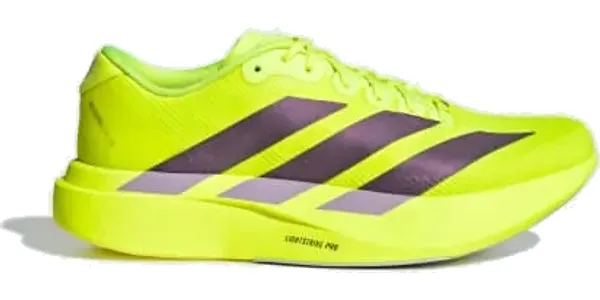
The midsole is full-length Lightstrike Pro. RoadTrailRun notes this is the foam adidas uses in its Adizero racing models. It has strong rebound but a firm base tuning, so it feels responsive without being spongy or wobbly.
Under the midfoot there is a small nylon shank, not a carbon plate. A RoadTrailRun tester describes the shoe as moderately stiff but not rigid, without the carbon-plated snap of an Adios Pro or Takumi Sen.
The outsole uses Continental rubber at the forefoot and in high-wear areas, with clear rubber at the heel and some areas left without rubber to save weight. The flat tread is made for roads and firm ground. Nils from RoadTrailRun ran about 500 km in the original EVO SL, which uses the same outsole, without noticeable wear or loss of performance, so he expects the Woven to last about as long.
The woven upper: better hold, less airflow
The upper is a new woven mesh, similar to the Adios Pro 4's, and more structured and stable than the original's. There are reinforced areas at the midfoot and forefoot. A silvery mesh cage on the inner and outer sides adds structure and support, while soft fabric at the toe reduces friction. The lining and sockliner are textile.
The tongue is gusseted, stitched to the shoe on both sides. Testers noticed this most: the tongue stays in place, the foot does not slide and lockdown improves. Pull the tongue straight before lacing, because one tester found it can bunch.
The trade-off is airflow. Several testers say it breathes less than the original. One says the mesh is perhaps not the most breathable, but it worked well in early-spring weather in Massachusetts, while a reader commented that the toe box has no ventilation at all. If you often run in hot weather, keep this in mind.
The laces are the same as on the original, and testers do not like them: they are hard to handle and soak up water very quickly. On Nils's test pair they were also too short for a clean heel-lock (marathon) lacing.
How it runs
On the road, testers agree the ride is predictable, with no surprises and a quick, controlled roll from heel to forefoot. RoadTrailRun says it suits heel, midfoot and forefoot strikers. It does its best work on sustained faster runs, tempo and intervals at 10K to half-marathon pace.
It feels firmer than you might expect at first. The Run Testers say it takes a few runs before the foam softens and gets bouncier. RoadTrailRun also found that after a few sessions the midsole flexes slightly more while staying just as responsive.
Testers disagree about comfort on longer runs. The Run Testers find it forgiving and not too harsh, so it copes with longer runs, but Ryan from RoadTrailRun feels its comfort ceiling around 10–12 miles (16–19 km) and would avoid it on easy recovery days. If you like a soft shoe for long, slow runs, weigh this carefully.
Stability at slow paces also differs. The Run Testers say the midsole does not feel wobbly when you ease off, but another RoadTrailRun tester felt the heel was slightly unstable during warm-ups, likely from the narrow heel and soft foam. OutdoorGearLab, which tested the original EVO SL with the same midsole, also says it can feel unstable at slow paces for inexperienced runners.
For grip, the rubber is excellent on dry roads and controllable on wet asphalt, though one tester felt toe-off was less confident on damp pavement. On gravel, sand, damp leaves or mud, grip is poor.
How to read this shoe's numbers
The table uses adidas Thailand's product page for code KJ2002: 36 mm under the heel, 30 mm under the forefoot, a 6 mm drop and 199 g. Another product page (JR2024) lists different figures: 39 mm heel, 32 mm forefoot, a 7 mm drop and 236 g. Neither page says which size was weighed.
The drop (the difference between heel and forefoot thickness) is about 6–7 mm. RoadTrailRun lists 6.5 mm and calls it a moderate drop. It lists the stack as 38.5 mm under the heel and 32 mm under the forefoot. That is a tall stack, but it compresses fairly firmly, so it does not feel as soft as the numbers might suggest.
Read weight together with size. The Run Testers weighed 223 g in men's UK 8 / US 8.5. RoadTrailRun weighed 261 g in men's US 10.5, heavier than the original EVO SL at 236 g in the same size. RoadTrailRun says the original feels noticeably lighter, especially in faster sessions.
What a 6–7 mm drop means
Drop is the difference between heel and forefoot thickness. RoadTrailRun lists 6.5 mm, calls it moderate and says it suits heel, midfoot and forefoot strikers. If your current shoes have a very different drop, jog in these to see whether your calves and footstrike feel different.
Compare weight at the same size
adidas lists 199 g and 236 g on two product codes. Review sites weighed 223 g in men's UK 8 and 261 g in men's US 10.5. To compare with other shoes, compare at a similar size, or hold them side by side in the store.
Tall stack, but not mushy
The heel stack is about 36–39 mm, but RoadTrailRun says it compresses fairly firmly for a shoe of this height. Don't judge softness by the number: jog in it, and remember testers say the foam softens after a few runs.
What to check, and what to compare if it doesn't suit
When you try the shoe on, start with the toe box. Wiggle your toes to check they can spread and nothing presses on top of them, because the toe box is flatter and slightly narrower than the original's. Then pull the tongue straight, lace up snugly, and walk or jog to check whether your heel lifts. If it feels firm in the store, testers say the foam softens after a few runs.
If it doesn't suit you, compare by what you need:
- A roomier toe box and more airflow: the original EVO SL is lighter and breathes better, but its upper is much baggier.
- Trails or more stability: the EVO SL ATR is heavier, firmer, slightly more stable and better on trails.
- More grip: The Run Testers say the Puma Velocity Nitro 4 has a much grippier outsole.
- Race day: RoadTrailRun points to the Adios Pro 4, which is more propulsive.
- Recovery days: a softer shoe.
Size and fit
Length: testers who mention size found it true to size. Mike from The Run Testers wore his usual running size with no cramping in the toe box and good lockdown. Nils from RoadTrailRun wore his usual US 10.5 and it fit well right away.
Width: the midfoot and toe box are narrow, with a race-like feel. Nils says the midfoot is held without being constricting, but the toe box is flatter and slightly more restrictive than the original's, so runners with a high-volume forefoot or wide toe spread may hit its limits sooner. Another tester says that over extended wear there is not much room for the toes to splay. adidas offers only the regular width.
Heel: Nils found the heel stable and unobtrusive, while another tester felt a slight float, not a serious issue but not as dialed in as the rest of the shoe.
6 UK6.5 UK7 UK7.5 UK8 UK8.5 UK9 UK9.5 UK10 UK10.5 UK11 UK11.5 UK12 UK12.5 UK13 UK13.5 UK14 UK14.5 UK15 UK
JR2024 · 2026-11-24 · Recorded sizes, not current stock