The details that matter
Under the foot: two foams and EnergyRods
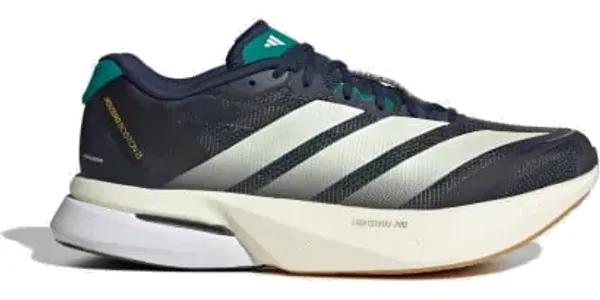
There are two foams underfoot. The top layer, next to your foot, is Lightstrike Pro, the light, bouncy foam adidas also uses in its racing shoes. The bottom layer is the firmer Lightstrike 2.0, which adds stability and durability. RunRepeat measured the bottom foam at 40.5 AC at room temperature and says it is the same firm compound as the previous version.
adidas says this version has 13.8% more Lightstrike Pro, and several reviewers say most of it sits in the forefoot. You can feel it: the forefoot is clearly bouncier than the heel. RTINGS measured 80.8% energy return in the forefoot and 75.1% in the heel.
Between the foams sit EnergyRods 2.0 instead of a full plate. adidas Thailand's product page describes them as glass fibre; some reviews call them carbon rods, and RTINGS corrected its own review from carbon to fiberglass. The rods make the shoe stiffer, snappier at toe-off and more stable.
How stiff it feels varies by tester. RunRepeat says runners who dislike a stiff, plate-like feel should avoid it, yet its 30-degree bend test measured 15.4 N, close to average, while the shoe barely moved when twisted by hand. WearTesters felt the rods were less stiff than in the last two Bostons, and Road Trail Run says they are stiff enough for fast paces but still allow some flex.
The outsole uses Continental rubber in the forefoot at toe-off and lighter Lighttraxion rubber elsewhere. RunRepeat measured the rubber at 2.3 mm thick. Several testers found grip good on wet and dry roads; Road Trail Run found it only so-so on crushed granite paths and wet grass, and the shallow grooves suit roads best.
Outsole durability reports differ a lot. RunRepeat measured only 0.5 mm of wear in its test and Road Trail Run expects it to last very well, but the WearTesters tester found the toe-off area of the right shoe completely bald after about 40 miles (about 64 km). If you buy it, turn it over and check the rubber under the front of the foot after a few weeks.
The upper: more comfortable, but mind the laces
The upper is a single-layer mesh. Under the microscope, RunRepeat found synthetic threads mixed with translucent TPU fibres, thin but tough, letting air through without large holes. RunRepeat scored it 4 out of 5 in its airflow test and says it works in all seasons. A Marathon Sports staff tester said their feet felt relatively cool during 800 m repeats on an abnormally warm morning.
The mesh is not soft and does not stretch much, so if it presses somewhere, it will not give a lot. The fabric over the toes is thin; RunRepeat scored toe-box durability only 2 out of 5.
The clear change from the Boston 12 is extra padding around the collar, heel and tongue. The tongue is now attached to the sides of the shoe with a gusset, which fixes the Boston 12's folding tongue. RunRepeat and RTINGS describe it as semi-gusseted; WearTesters and Road Trail Run call it fully gusseted. Several testers had no hot spots, and Marathon Sports testers all liked the added padding. The tongue is not thick: RunRepeat measured 2.9 mm, the same as before.
The heel counter (the stiff shell around the heel) is much stiffer: RunRepeat scored it 4 out of 5, up from 1 out of 5, and Road Trail Run calls the hold excellent. The inside is textile-lined.
The laces need attention. Believe in the Run says lockdown takes trial and error. Road Trail Run found the laces slip through the eyelets and loosen easily. Tom's Guide says the thin laces can bite into the top of the foot and suggests swapping them. A Marathon Sports staff tester could not keep a single knot tied and needed a double knot, which still looked looser after runs. RunRepeat sees it differently: the eyelets are reinforced, simple and reliable, and allow some fine-tuning.
There are no reflective elements and no heel pull tab. If you run in the dark, add your own reflective gear.
How it runs
The Boston 13 gets more fun as the pace rises. One Road Trail Run tester ran it from about 11 min/mile (about 6:50 min/km) down to below 9 min/mile and says it clearly came alive in the 8s (about 5:00–5:35 min/km). Another found 6- and 7-mile (about 10–11 km) easy runs felt good but nothing special; the shoe only responded clearly better at 10K pace at the end of a long run. Road Trail Run also found it less exciting at 7:30–8:30 min/mile (about 4:40–5:17 min/km) and says it really shines faster. WearTesters says it works well at recovery paces but shines most from marathon pace and faster.
Tom's Guide ran 40 miles (about 64 km) in it and found it fast and responsive enough for intervals, tempo and progression runs, and comfortable enough for easy runs, but also says the ride can seem a little dull, not as springy as some fast trainers and not as smooth as the Endorphin Speed 5.
Marathon Sports says it is a touch firmer than the average running shoe. Believe in the Run felt it was a shade firmer than the Boston 12. RTINGS found the heel very firm, with insufficient underfoot protection there, and the foam does not compress deeply, so heel landings do not feel springy. RunRepeat measured 127 SA heel shock absorption against a category average of 132 SA.
On long runs, views differ. A commenter on Believe in the Run's review calls it very nice for long runs, and Road Trail Run uses it for faster long runs, but RTINGS says the firm forefoot may feel harsh on longer efforts.
Heel strikers get different verdicts too. WearTesters calls it highly stable for heel strikers, while RunRepeat points to a narrow heel (it measured the heel midsole width at 83.8 mm) and says heel strikers wanting extra rearfoot stability may not enjoy it. RTINGS says the shallow heel rocker makes the move from heel to midstance more abrupt. Road Trail Run says the shoe is not aimed at slow-paced heel striking.
The same goes for larger runners. WearTesters recommends it to larger runners who need a more supportive shoe, while RunRepeat says heavier runners may find shock absorption a bit lacking on long runs. These are different things: a stable shoe is not necessarily a well-cushioned one.
Most testers praise its stability. RTINGS praises its lateral stability, Road Trail Run felt very stable despite the cutout under the arch, and one commenter who overpronates and uses an orthotic said it gave the stability they needed on a 10K.
On weight, Believe in the Run sees it as on the heavy side for racing but light for a daily trainer. One Road Trail Run tester found it slightly heavy for uptempo running; another said its responsiveness meant they did not feel the weight.
Reading the numbers
The spec table figures (36 mm under the heel, 28 mm under the forefoot, 8 mm drop, 219 g) match the women's specs listed by Marathon Sports; WearTesters lists the same 219 g women's weight. For the men's version, another adidas Thailand product page lists 36 mm under the heel, 30 mm under the forefoot, a 6 mm drop and 260 g, matching what several reviewers use.
Drop is the difference between heel and forefoot thickness. RunRepeat measured 6 mm, matching the brand's men's figure; RTINGS measured 6.8 mm on a men's US 9. Believe in the Run says it is down from 7 mm on the previous version but the difference is hard to notice on the run. Drop only tells you how much higher the heel sits than the forefoot; it does not tell you what kind of running the shoe suits.
Measured stack is slightly below spec. RunRepeat measured 34.3 mm under the heel and 28.3 mm under the forefoot; RTINGS measured 35.9 mm and 29.1 mm on a men's US 9. Tom's Guide and RunRepeat frame it differently: Tom's Guide compares the overall stack with modern running shoes and calls it relatively low, while RunRepeat looks at the forefoot alone and says it has more foam than most running shoes.
Compare weight only at the same size. RTINGS weighed a men's US 9 at 252.2 g; Road Trail Run weighed a men's US 7.5 at 232 g and a US 8.5 at 248 g; Believe in the Run lists a women's US 7.5 at 215 g. RTINGS says it is noticeably lighter than the Boston 12 but still heavier than other super trainers.
The insole is removable; RunRepeat measured it at 3.3 mm, slightly thinner than average. If you use your own insoles, you can swap them in.
Match stack and drop to the men's or women's version
Women's specs are 36 mm under the heel, 28 mm under the forefoot and an 8 mm drop; men's are 36 mm under the heel, 30 mm under the forefoot and a 6 mm drop. When trying it, walk and jog to feel whether the heel is too firm for you. The drop number alone does not tell you what running the shoe suits.
Compare weight at the same size
The 219 g in the table is the women's figure; RTINGS weighed a men's US 9 at 252.2 g. Compare with other shoes only at the same size and gender, or pick them up side by side in the store.
Check toe room and midfoot pressure
The toe box tapers and the mesh does not stretch much. Lace it snugly, then check that your toes can move, the sides of your midfoot are not squeezed, and your heel does not lift on a short jog. For long runs in hot weather, Road Trail Run suggests staying at your usual size.
Trying it on, and what else to consider
When trying it on, wear the running socks you actually use and lace it snugly before deciding. A Road Trail Run tester laced it too loosely on a first easy run and got some arch blistering.
Then check three things: whether your toes have room or touch the front, since this toe box tapers; whether the mesh presses on the sides of your midfoot; and whether your heel lifts on a short jog. Believe in the Run noticed some heel lift, and when they tried a runner's loop, the laces were too short. If you use that lacing, check the lace length too.
If the ride feels too firm on a test jog, look at a softer trainer for easy or recovery days. Believe in the Run and Marathon Sports mention the Adizero Evo SL as softer; Tom's Guide says it is lighter and springier but less stable; RTINGS sees the Evo SL as the better everyday shoe and the Boston 13 as better for structured speed sessions.
If you want a shoe for your fastest race times, look at a dedicated racer such as the Adios Pro 4. If you have wide feet and this shoe squeezes your forefoot, look for a shoe with a wider toe box and a stretchier upper.
Size and fit
On length, most reports say your usual size works. Believe in the Run (a tester in a women's US 7.5), RunRepeat and Tom's Guide found it true to size. RTINGS says length is true to size on a men's US 9 but runs slightly longer than the Boston 12.
Other reports differ. WearTesters calls it typical adidas sizing, with many going half a size down. One Road Trail Run tester wore a US 7.5 instead of their usual 8.5 and suspects it may run half a size large. Comments under the WearTesters and Road Trail Run reviews, after one 10K run, say it came up about half a size small; the Road Trail Run commenter also had toes touching the end.
Road Trail Run suggests narrow feet try half a size down, but stay at your usual size for long runs in summer heat or with thick socks, advice that fits a hot climate.
On width, RunRepeat measured 97.3 mm of internal width and says it still leans wide-friendly, but the toe-box width near the toes narrowed from 73.2 mm to 70.6 mm, leaving less room for toe splay. RTINGS says the arch runs slightly narrow and the forefoot has slightly less volume, so it is not ideal for wide feet. WearTesters says the toe box has room to wiggle, but the upper isn't very stretchy; many wide-footers will find it a good option, though some may lack room through the midfoot. Road Trail Run found the rear of the forefoot broad yet secure, favouring broader but not high-volume feet, while a women's tester in a men's US 7.5 found the midfoot a little roomy. Some Marathon Sports testers said it fit like a glove; others found it a bit too snug.
On the heel, Road Trail Run calls the hold excellent, while Believe in the Run noticed some heel lift.
adidas Thailand's product pages list a regular width only. RTINGS says no wide version exists, while RunRepeat lists a wide width. If you want a wide version, ask the store you plan to buy from.
3.5 UK4 UK4.5 UK5 UK5.5 UK6 UK6.5 UK7 UK7.5 UK8 UK8.5 UK9 UK9.5 UK10 UK10.5 UK11 UK11.5 UK12 UK12.5 UK13 UK13.5 UK14 UK14.5 UK
KH8859 · 2026-11-24 · Recorded sizes, not current stock