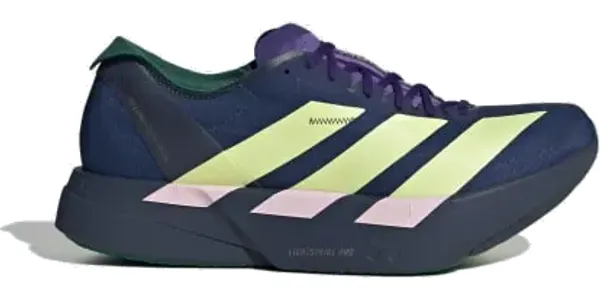
The details that matter
Under the foot: soft foam, carbon rods and a thin outsole
The midsole is a double layer of Lightstrike Pro foam (per adidas), a new TPEE formulation with no secondary foam. RunRepeat measured the foam's hardness at 29.3 (Asker C scale; lower = softer) versus 37.6 on the Adios Pro 3. RTINGS found it does not compress deeply enough to feel like a trampoline, but it rebounds very well.
Inside the midsole are five carbon-infused EnergyRods 2.0, designed to mimic the foot's metatarsal bones, used instead of a full carbon plate. Their job is to help drive the toe-off. RunningShoesGuru found them more natural than a plate. RunRepeat measured 22.7 N to bend the sole, which puts it among the least rigid super shoes (thick-soled racing shoes with carbon), while RTINGS found the forefoot stiff enough to give leverage at push-off and spring back powerfully.
The forefoot curves up in a rocker. OutdoorGearLab measured the rocker starting 62.5% forward from the back of the shoe, with significantly less cushioning past that point, which forefoot strikers should know. RTINGS also found that runners who load the forefoot hard get less protection there.
The outsole is almost entirely Lighttraxion (a soft polyurethane), with a small Continental rubber patch under the big toe where you push off. RunRepeat measured it at just 1.0 mm thick, yet it dented only 0.8 mm in their abrasion test. RTINGS found the forefoot resists wear well but the heel wears faster for heel strikers. On grip, RunningShoesGuru calls it very good, Doctors of Running says the small lugs grip pavement extremely well, and one RoadTrailRun tester noticed no meaningful difference on dry asphalt.
On foam lifespan, RunRepeat estimates this kind of foam is at its best for about the first 100 miles (around 160 km) before declining quickly. RTINGS simulated a marathon distance and found shock absorption drops somewhat but stays reasonably protective to the end.
OutdoorGearLab loves it for hard sessions because the shoe is surprisingly durable.
Upper: snug with good heel hold, but can run warm on hard efforts in the heat
The upper is Lightlock 2.0, a one-way stretch textile (per adidas), with a textile lining. The insole is very thin: RunRepeat measured 1.9 mm, removable and perforated.
The tongue has a 5.6 mm foam pad (RunRepeat) and is stitched to the upper on both sides, so it does not slide and it eases lace pressure on the top of the foot. The laces are flat and thin with little stretch, but they stay tied, and RTINGS found the shoe holds the foot well once laced.
Doctors of Running and RunningShoesGuru say there is no heel counter (the stiff shell around the heel), while RunRepeat says the heel counter is improved but still very soft, scoring its stiffness only 1/5. An external Slinglaunch overlay wraps the heel and keeps the upper locked onto it. Several testers report no heel slip, including a RoadTrailRun tester who had slip in the Pro 3. The Achilles bumpers are soft and suede-like. Doctors of Running says that because there is no heel counter, the shoe will work great for runners with Haglund's deformity (a bony bump at the back of the heel) or sensitive heels.
On breathability, reviews disagree. OutdoorGearLab and one wearer found it breathes well, but RunRepeat scored it 2/5 in its smoke test, RTINGS calls it mediocre at releasing heat, and the RunningShoesGuru reviewer, running in humid Malaysia, found heat and moisture built up during hard efforts, leaving the upper drenched in sweat after racing. The RoadTrailRun tester who found it breathable raced at 37°F (about 3°C). If you race in hot, humid weather like Thailand's, your feet may get warm during hard efforts.
Two more things to know: RunRepeat gave toe-box durability its lowest score, 1/5, and RunningShoesGuru says some colourways have logo stripes that peel, such as the yellow “Wolverine”, though the reviewer's own pair was unaffected.
On the run: the faster you go, the better it feels
This shoe needs speed to be fun. OutdoorGearLab found the faster they ran, the softer and more energetic the foam felt, and a Doctors of Running tester said the harder you land on the foam, the better it responds. At slow paces, though, the forefoot rocker moves you forward almost before you are ready, which feels slightly awkward. A RoadTrailRun tester found slow jogging not particularly enjoyable, and OutdoorGearLab felt the foam was unstable when not running hard. RTINGS does not recommend it for everyday training and calls it a very bad choice for walking.
The best race distance depends on how each tester runs. The first Doctors of Running tester sees it as a 5K-to-half-marathon shoe, best at 10K pace. It did not feel stable enough to them for longer distances.
The second Doctors of Running tester found the shoe shines most on an 11-mile (about 18 km) tempo and longer efforts.
RunningShoesGuru found it performs better at marathon pace than at 5K and 10K pace.
OutdoorGearLab felt great up to about 5K pace. Faster than that, the geometry started to feel a little odd for the tester's mechanics. They recommend it for half and full marathons.
Michael, a RoadTrailRun tester with a 2:20:41 marathon PR, calls the ride fun, bouncy and comfortable, versatile enough for short races and the marathon.
Compared with the Pro 3, opinions also split. Doctors of Running calls it far more responsive, lighter and faster, but RunningShoesGuru found the toe-off less aggressive and less quick than the Pro 3 and felt it was slower overall, and another RoadTrailRun tester found the turnover slightly slower. Both put this down to the bouncier, softer foam. RunningShoesGuru says runners who like squishy, bouncy racers, or found the Pro 3 too firm and too rockered, will enjoy it.
On stability, a RoadTrailRun tester who heel-strikes more than a teammate found the soft heel kept the foot on the heel a bit too long. RTINGS found the cutout on the inner midfoot makes footing harder as you tire. RunRepeat found it noticeably less stable than the Pro 3, RunningShoesGuru also found it less stable, and RTINGS found the Pro 3 slightly more stable. Michael, though, did not find it more wobbly than earlier versions.
RTINGS also measured oxygen use for six runners at marathon pace against its comparison shoe, the HOKA Clifton 11: five improved, and one used slightly more oxygen, so the gain varies from runner to runner.
Reading the numbers: drop, stack height and weight
Drop (the difference between heel and forefoot sole thickness) varies by source. adidas lists 6 mm, while another adidas product page (style KI1471) lists 5 mm. The labs measured more: RunRepeat got 8.1 mm at the official World Athletics points, RTINGS 7.0 mm on a men's US 9, and OutdoorGearLab 9 mm. On the run, Doctors of Running felt it as a 6 mm drop, and RunRepeat says the geometry makes it feel like a 4–6 mm shoe.
Stack height: adidas lists 39 mm under the heel and 33 mm under the forefoot (the KI1471 page lists 37 and 32 mm). RTINGS measured 39.5 mm heel and 32.5 mm forefoot on a US 9, while RunRepeat measured 36.6 mm heel and 28.5 mm forefoot. All are within World Athletics' 40 mm limit. These numbers tell you there is a lot of foam underfoot, not how soft or stable it feels.
Base width is worth checking too. RunRepeat measured the heel at 80.4 mm wide, 3.6 mm narrower than the Pro 3, and says such a slim heel offers heel strikers minimal stability. RTINGS measured the outsole at 82 mm at the heel and 54 mm at the arch, and says the soft heel, narrow base and narrow arch area make its stability not very good.
On weight, RTINGS and Doctors of Running found it lighter than the Adios Pro 3, while RoadTrailRun weighed a US 8.5 and found the Adios Pro EVO 1 about 70 g lighter than this shoe. It weighs about 220 g (7.75 oz) in a men's US 10.5. When comparing with other shoes, compare at the same size.
Drop: the numbers differ, so judge it on a test run
adidas lists a 6 mm drop, but labs measured 7–9 mm. RunRepeat says the geometry makes it feel like a 4–6 mm drop, and Doctors of Running felt it as 6 mm. If you are choosing between shoes, do not decide on drop alone; do a short fast run and see whether landing and toe-off feel smooth.
Stack height and base width
The heel stack is about 36.6–39.5 mm depending on the source, within World Athletics' 40 mm limit, but the heel base is only about 80–82 mm wide. RTINGS says the soft heel, narrow base and narrow arch area make its stability not very good. If you heel-strike, try a single-leg stand and a short run to see whether the heel wobbles.
Size: try on your usual size and half a size up
Several sources say it runs about half a size small with a tapered forefoot, while some narrow-footed runners fit their usual size. When trying it on, press the toe of the shoe to check for space in front of the big toe, then check for pressure along its side and squeeze at the arch. For a marathon, pick the size where your toes never touch the front.
What to check when trying it on, and what to look at instead
Wear your race socks and try on both your usual size and half a size up. Check three things: first, whether your big toe hits the front or feels pressure along its side, since the forefoot tapers and the toe guard is thin; second, whether the arch feels too tight; third, whether the heel sits snugly once you lace firmly. If the store lets you run, do a short fast stretch, because this shoe feels very different at slow and fast paces. Check the exchange policy before buying.
If you heel-strike or feel wobbly when trying it, look at racers with a wider heel base and a firmer platform. RTINGS notes that the Adios Pro 5 is lighter and more stable, while the Pro 4 has stronger heel energy return and a firmer, snappier forefoot. There is no wide version, so if you have wide feet or wide arches and it feels tight when you try it on, look for a racer with a roomier forefoot. If you want a shoe for slow runs or everyday training, look at a cushioned daily trainer and keep this one for race day.
Size and fit: try on your usual size and half a size up
On length, several sources say it runs small. RunningShoesGuru says half a size small and RunRepeat slightly small. A Doctors of Running tester in their usual men's US 10 found it slightly short and advises going up half a size for the marathon; a second tester, normally a US 9.5, wore a 10, says it runs about half a size small and advises sizing up half a size. OutdoorGearLab says the toe box runs just a little small, worth noting for 26.2 miles (42 km). A wearer commenting on RunningShoesGuru with several 20+ mile (32+ km) runs went half a size up and says the fit is perfect.
Others fit their usual size. RTINGS (men's US 9) found the length true to size, a RoadTrailRun tester with narrow-to-medium feet is true to size, and one wearer with a narrow, low-volume foot says true to size is perfect. With narrow feet your usual size may be right; with average feet or for long races, try on both your usual size and half a size up.
On width, there is no wide version. RunRepeat measured the toe box at 69.5 mm at the big toe, narrower than the Pro 3's 77.8 mm, and advises wide-footed runners to stick with the Pro 3, though height above the toes is generous at 28.3 mm. RTINGS found the arch snug, constricting for wide arches, and that the tapered forefoot can cause pressure points or numbness near the big toe. Doctors of Running, on runs up to 13 miles (about 21 km), felt the thin toe guard press noticeably on the big toe, with mild discomfort only during warm-ups. A RoadTrailRun tester heard other runners complain of a too-short length causing toenail issues and a narrow midfoot causing hotspots, but had no such problems.
The heel holds well for most testers. RunningShoesGuru calls it one of the most comfortable uppers if you size up. Doctors of Running rates it “mostly yes” for sockless running.
5.5 UK6 UK6.5 UK7 UK7.5 UK8 UK8.5 UK9 UK9.5 UK10 UK10.5 UK11 UK11.5 UK12 UK12.5 UK13 UK14 UK
KI1465 · 2026-11-24 · Recorded sizes, not current stock