The details that matter
What's under your foot
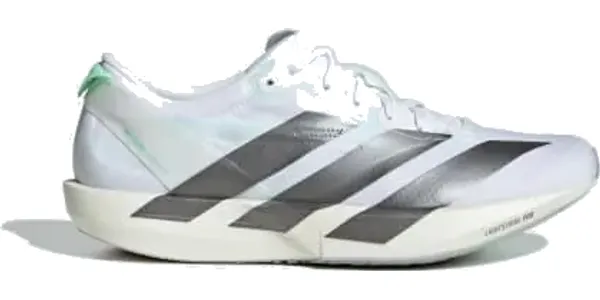
The midsole is a single full-length piece of Lightstrike Pro foam with no second compound, unlike the two foams on the Adios 8. RunRepeat measured 76% energy return at the heel and 77.3% at the forefoot; RTINGS measured 80.1% and 81.7%. RTINGS explains that the foam returns energy quickly, but there is little of it, so the rebound feels fast and direct rather than deep and bouncy.
There is no carbon plate. A thin plastic shank (some reviews call it a nylon structure) sits under the midfoot, just below the insole. It keeps the sole from twisting and smooths the transition forward, but it does not feel like a carbon plate. Meta Endurance could barely notice it; RoadTrailRun warns that runners with a sensitive arch may feel it. The forefoot bends very easily, which RTINGS says limits propulsion at toe-off.
The outsole is full-length Lighttraxion (a light cast polyurethane) with a small Continental rubber patch under the big toe. RunRepeat and RTINGS found excellent grip on dry and wet surfaces and little wear, but RTINGS found poor grip on gravel and mud. It belongs on roads and tracks, not dirt paths or trails.
Upper: thin and secure, but think about heat
The upper is a single-layer stretch mesh with the same Lightlock system as the Adios Pro 4. The fabric stretches in one direction only, which helps keep the foot steady. Inside, a Lightlock band runs from the eyelet row around both sides of the heel. RunnersLab says the upper lacks structure, but this band makes up for it.
The tongue is thin (RunRepeat measured 2.6 mm) with a touch of padding and is semi-gusseted. RunnersLab reports no tester had the tongue slip. The flat laces barely stretch and hold a steady lockdown; RunRepeat says you can lace as tight as you like without the tearing seen on the Adios Pro 3. RoadTrailRun likes that the pull tab is now sewn on the outside, since on earlier models it sat in the lining and gave him blisters again and again.
On breathability, sources disagree. RunRepeat's smoke test showed most air trapped inside, earning 2/5, and RTINGS says air struggles to pass, letting heat build in hard workouts or warm weather. RoadTrailRun ran in it and says the very thin fabric breathes excellently, and RunnersLab finds ventilation satisfactory because the material is so thin. If you often run in hot weather, expect your feet may run warm.
The thin fabric costs durability. RunRepeat's abrasion test practically wore through the toe area, scoring 1/5, and RunnersLab advises avoiding obstacles. There are no reflective elements, so add your own reflective gear for running in the dark.
How it runs
Running fast is where the Adios 9 shines. RunningShoesGuru found striding effortless and says the shoe made him want to go faster. Meta Endurance says the foam feels explosive at faster paces. RunnersLab's tester, a 2:38 marathoner, picks it for 200–400 m repeats, but warns the speed is old-school: quick transitions, not carbon-shoe propulsion. RTINGS had six runners run at marathon pace: all used less energy than in the control shoe, but the average gain was modest, results varied widely, and RTINGS rates the running economy sub-par overall.
On softness, sources disagree. RunRepeat measured the foam as middling (37.6 AC) and RoadTrailRun calls it soft and lively, while RTINGS measured an extremely firm forefoot and a firm heel. What every source agrees on is that the sole is thin: RunRepeat measured only 68 SA of forefoot shock absorption, among the lowest it has tested, so you feel the road clearly. RunnersLab sums it up as on the firm side, but far from the old racing flats that pound the ground, with a very natural roll.
Distance is the question to settle before buying. adidas says it is ideal for races up to a half marathon. RTINGS says it lacks protection for much beyond 10K, and heel strikers will find it harsh on long efforts. RunnersLab's tester says a half marathon takes strong feet and is his own limit in this shoe. On the other side, one RTINGS staff member regularly runs 25 km or more in it without issue, though he already prefers a stripped-down feel. RunRepeat says the thin foam will definitely bottom out under heavier runners, and RunningShoesGuru's bigger-framed tester felt comfortable to about 10K.
Stability depends on how you land. RunRepeat measured the heel at just 72.5 mm wide and calls it wildly unstable for anyone loading the rearfoot. RTINGS agrees the narrow heel can make heel landings dicey, but says the firm forefoot and low profile keep it steady when cornering or picking up speed. RunnersLab also finds it stable because the foot sits close to the ground, while RoadTrailRun says stability is completely lacking because of the narrow platform, soft foam and no heel counter. Meta Endurance says this matters little for short reps.
Reading the numbers
The spec table comes from adidas Thailand's product pages, but its two listings disagree. One gives 145 g, a 27 mm heel and a 20 mm forefoot; the other gives 176 g, 28 mm and 21 mm. Both list a 7 mm drop (the difference between heel and forefoot thickness).
Read weight alongside size. RoadTrailRun lists 176 g as the official weight for men's US 9, RunRepeat weighed 176 g too, and RTINGS weighed a men's US 9 at 173.1 g. The 145 g figure is close to the 144 g RunRepeat lists for the women's version. RoadTrailRun's men's US 10 sample weighed 193 g. Every source agrees it is very light.
Measured stack is close to or a little below the listed figures. RunRepeat measured 25.0 mm at the heel and 18.8 mm at the forefoot, a 6.2 mm drop; RTINGS measured a men's US 9 at 27.1 mm and 19.5 mm, a 7.6 mm drop. RunnersLab's tester says the 7 mm drop feels more like a 4–6 mm shoe and takes some time to adjust to.
Read weight against size
Weights you will see range from 144 to 193 g because they cover different sizes and versions: 176 g is men's US 9, and RunRepeat lists 144 g for the women's version. Compare other shoes at the same size, or hold it next to your current training shoe when you try it on in store.
Low stack and a 7 mm drop
Listed stack is 27–28 mm at the heel and 20–21 mm at the forefoot; labs measured similar or slightly less, with drop between 6.2 and 7.6 mm. RunnersLab's tester felt it more like a 4–6 mm drop. If you usually run in thick-soled shoes, start with short sessions so your legs can adjust.
Check the shape before choosing a size
The toe box is tapered and the midfoot snug. RunRepeat measured plenty of room above the toes (27.5 mm), while RTINGS found limited vertical room in the forefoot. Lace up snugly and check whether your toes can move and whether the midfoot squeezes too much. Several sources suggest going up half a size, while some testers fit their usual size; try on both sizes if you can, and check the exchange policy before buying online.
What to check on try-on, and what to look at if it doesn't suit
On try-on, lace up snugly first, then check three things: whether your toes can move, whether the midfoot squeezes too much, and whether your heel lifts when you jog, because the toe box is tapered, the midfoot is tight and the heel has no rigid counter. If you land mainly on your heel, jog slowly and notice whether the narrow heel feels unstable. If your arch is sensitive to pressure, pay attention to the plastic shank under the midfoot.
If it doesn't suit you, look for a thicker-soled shoe for long distances, or a wider forefoot if your feet are wide. Some reviews also compare it with other models: one wearer finds the Adizero Evo SL far more versatile; RoadTrailRun suggests the Adios 9 for training and the Adios Pro 4 for racing, and can picture running a half marathon in the Takumi Sen 10 more than in the Adios 9. RoadTrailRun's narrow-footed tester says the Topo Cyclone 2's fit is roughly the opposite of the extremely narrow Adios, and rates the Adios at least as good for €50 less.
Size and fit
The Adios 9 comes in regular width only, and nearly every source calls it narrow. RunRepeat measured the toe box at 70.6 mm, tapered enough to limit toe splay, and the widest part at 94.3 mm, slightly below average, though 27.5 mm of toe box height leaves plenty of room above the toes. RTINGS found forefoot width true to size but limited vertical room in the forefoot and a snug arch, and its testers felt pressure points in the tapered toe box. RunningShoesGuru's tester, who doesn't have wide feet, found absolutely no wiggle room, a tight midfoot and a normal heel. RoadTrailRun's narrow-footed tester calls it typically adidas narrow but with enough forefoot width. RunnersLab finds the forefoot narrow, but the stretchy material didn't bother him.
Sizing advice differs. RTINGS tested a men's US 9 and recommends going up half a size. RunRepeat's 137 user votes say it runs slightly small. RunningShoesGuru says it runs small and to buy half a size up, though its tester didn't need to. RoadTrailRun calls it true to size, with the tester in his usual US 10.5 for other brands after replacing the US 10 he first received. RunnersLab finds sizing fairly standard, with a caveat for wide feet. One wearer who takes US 10.5 in the Adios 8 had to go down to US 10 in the Adios 9 and got a nice race fit.
At the heel, RunRepeat rates the counter 1/5 since it has no reinforcement. Meta Endurance says the collar hugged his Achilles. RunningShoesGuru feared the tight collar would cause blisters, but it turned out to be a non-issue. Some RunnersLab testers would have liked more heel support.
3.5 UK4 UK4.5 UK5 UK5.5 UK6 UK6.5 UK7 UK7.5 UK8 UK8.5 UK9 UK9.5 UK10 UK10.5 UK
KH8897 · 2026-11-24 · Recorded sizes, not current stock